The rollout of Competency-Based Education and Training (CBET) in technical and vocational institutions has expanded the pool of skills for the youth, helping them to secure sustainable livelihoods in Kilifi County.
Institution heads in the region say the shift to CBET has significantly enhanced the quality of training by equipping learners with practical, market-ready competencies that align with industry needs.
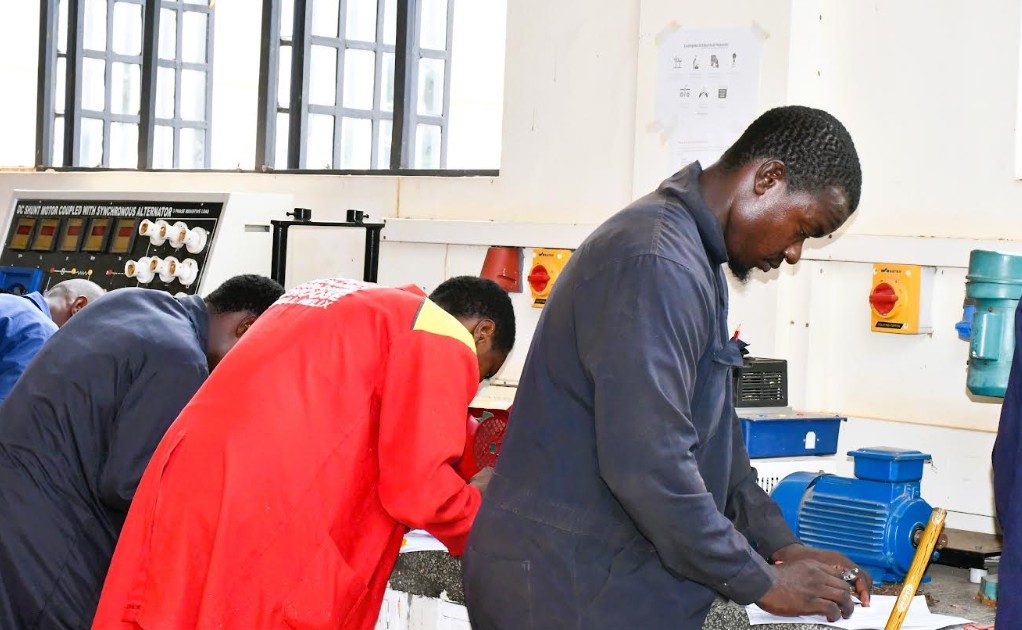
With upgraded workshops and revised training programmes in fields such as welding, garment making, electrical installation, and automotive engineering, more young people are enrolling and completing their courses within shorter periods.
Godoma Technical Training Institute Chief Principal Lidigu Sebastian described CBET as the most transformative development in technical education training, adding that the approach enables trainees to acquire demonstrable skills within a short period.
“CBET is the best thing that ever happened to this country because no student can leave the institution without a skill and with a skill, they can do something out there to earn a living,” he said.
Speaking during a briefing with Technical and Vocational Education and Training officers at the college, Lidigu explained that the model has greatly improved the prospects of young people seeking meaningful work, whether through formal employment or self-employment.
“We are happy about CBET because the students who join, fresh students who join, by the end of three months they have a skill and they can show it. That is what we pride ourselves on,” he explained.
“The modularised curriculum is the way to go because it allows one person to train, go and work. It’s very flexible,” he added.
Local industries have steadily built stronger partnerships with the colleges, offering industrial attachments and helping shape the curriculum to match market expectations.
This collaboration is narrowing the long-standing gap between training and the world of actual work.
Weru Technical and Vocational College Principal Julius Kasuva shared similar observations, noting that the CBET framework has been a turning point for many youths who previously lacked practical exposure.
Trainees now spend half of their study period in class and the other half in industry, gaining experience that prepares them for the job market even before graduation.
“The trainees are spending half of the period in the college and the other half of the period of their training in the industry. When they finish their industry block, these trainees have gained a lot of experience,” he said.
He added that the modular nature of CBET enables trainees to earn certification within short training cycles, allowing them to enter the job market earlier while continuing to advance their skills.
“Within a very short period they acquire skills, obtain certificates, and go out there to start working,” he said.
Although youth unemployment remains a major challenge in Kilifi, institutions say that adopting the CBET model is helping align courses more closely with market needs.
However, they note that inadequate infrastructure and lack of school fees due to high poverty levels in Kilifi County remain critical obstacles to unlocking the full potential of the programme.
The institution heads urged parents and youth to embrace technical training, saying CBET is building a skilled generation capable of driving economic growth, innovation, and self-reliance.
The government has been scaling up CBET implementation across TVET institutions nationwide as part of a broader strategy to equip young Kenyans with industry-relevant skills and reduce the high rate of unemployment in Kenya.
By Jackson Msanzu