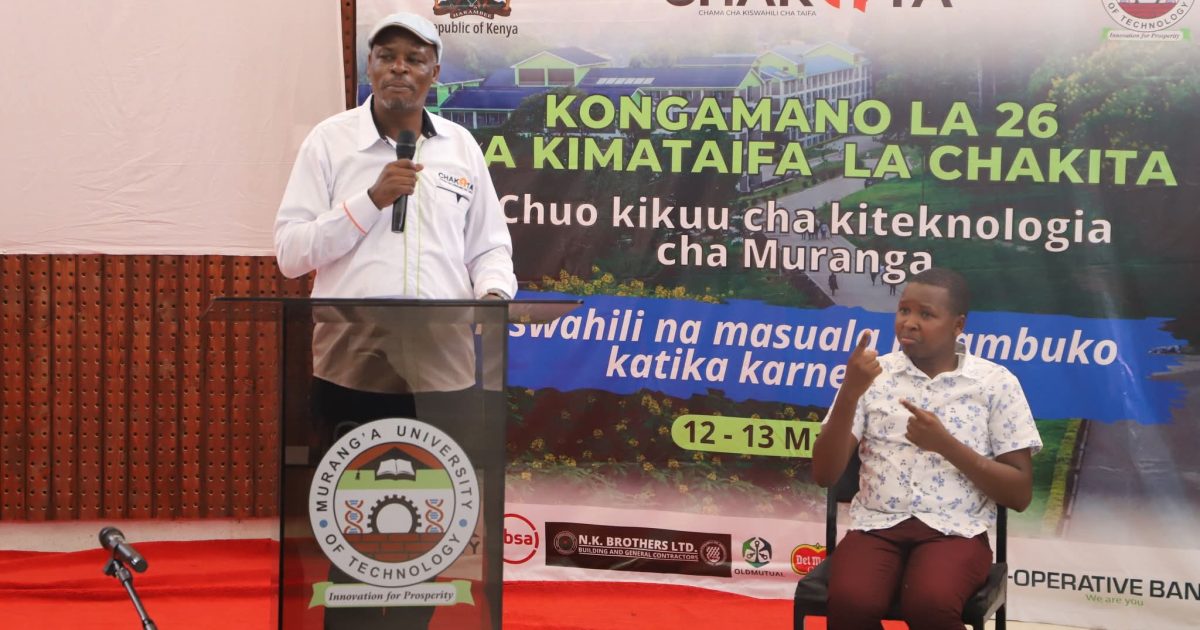
Chama cha Kiswahili cha Kitaifa (CHAKITA) has called for sustained efforts to strengthen and promote the use of Kiswahili in Kenya, across East Africa and globally, noting that the language continues to gain prominence due to supportive policy frameworks and increased adoption in education and other sectors.
Speaking during a conference on Swahili and Cross-Cutting Issues in the 21st Century held at Murang’a University of Technology, stakeholders in the Kiswahili language sector observed that the language has steadily expanded beyond traditional communication roles to become a key tool for education, research and regional integration.
The conference brought together scholars, lecturers and students from various institutions who discussed the evolving role of Kiswahili in addressing contemporary issues such as climate change, gender equality, peace building and digital transformation.
Participants welcomed the continued recognition of Kiswahili as an official language in several East African countries, noting that the move will further enhance its adoption and use in government, education, trade and cultural exchanges across the region.
CHAKITA Chairperson Dr Fred Simiyu said Kenya has made deliberate progress in promoting the language through various policy frameworks that encourage its use in schools, universities and public institutions.
Dr Simiyu said the organization continues to collaborate with stakeholders in the education sector to strengthen Kiswahili teaching and learning at different academic levels.
According to him, the subject has continued to perform well in national examinations, which reflects improvements in both teaching methods and students’ understanding of the language.
“Even in our private and public universities, Kiswahili continues to gain prominence as it has been selected by students in large numbers,” said Dr Simiyu.
“Notably, even in this institution we have been informed that more than 1,200 first-year students are currently pursuing Kiswahili studies,” he added.
Dr Simiyu further noted that CHAKITA will continue championing initiatives aimed at promoting the language through the development and distribution of essential learning materials.
He added that the organization remains committed to ensuring Kiswahili is celebrated as an important cultural and academic resource that can contribute significantly to knowledge production and dissemination.
On her part, Dr Roselida Awour, Director of Research and Technology in the State Department for Education, said the government is committed to supporting research and innovation initiatives that advance the development of the Kiswahili language.
Dr Awour noted that the language has significant potential to contribute to scientific communication, technological advancement and academic collaboration across Africa.
“In this century of rapid technological change, Kiswahili has the opportunity to advance science, research and innovation in Africa and across the world,” she said.
She added that addressing global challenges such as climate change, gender equality, peace building and digitalization requires collaboration among professionals from different academic disciplines, and language plays a crucial role in facilitating such engagement.
Executive Secretary of the East African Kiswahili Commission, Dr Caroline Asiimwe, also underscored the importance of the growing recognition of Kiswahili within the East African Community (EAC).
Dr Asiimwe said the decision to adopt Kiswahili as one of the official languages of the regional bloc represents a major milestone that will further strengthen the language’s position in regional cooperation and integration.
“This shows that we are heading in the right direction in promoting and elevating the status of the Kiswahili language across the region,” she said.
Meanwhile, Murang’a University of Technology Vice Chancellor Prof Dickson Nyariki said the institution remains committed to promoting the teaching and use of Kiswahili among students and scholars.
Prof Nyariki noted that universities have a responsibility to expand knowledge using languages that resonate with ordinary citizens and promote inclusive learning.
“It is our responsibility as scholars and institutions of higher learning to grow and advance knowledge using a language that reaches and resonates with the ordinary citizen,” he said.
He added that the university fully supports CHAKITA’s mission of ensuring Kiswahili is widely embraced in higher education and continues to grow as a language of scholarship and research.
By Florence Kinyua