When one clocks 70 years, they are often too feeble to take care of themselves. Mostly, these men and women are considered too weak to break any of the ten commandments; they are too weak and cannot muster the strength to steal, kill, neither can they commit adultery.
And most of their parents are long dead to be honored or not.
As for coveting other people’s possessions, they are often so house bound, they do not get to see what the neighbour has to envy their belongings.
The spiritual needs of these folk are more often than not overlooked by Christian ministries international; the mainstream churches once in a while visit the homes of men and women who are baptized and confirmed in the faith to give them holy communion because this is one tenet of the faith that ensures that when they die, they will be accorded a Christian burial.
Woe unto the person who is neither baptized nor confirmed, and in some instances those who have not wedded in church; these ones are left to their own spiritual devices.
Mainstream churches have initiated social protection programmes for the elderly, but the evangelical wing of the church has barely any program for octogenarians.
In the circumstances, one Church has decided to do something about this; Christian Ministries International Church (CMI) Kamune in Mathioya Sub County, Murang’a County has taken an active initiative to look after the spiritual welfare of their flock.
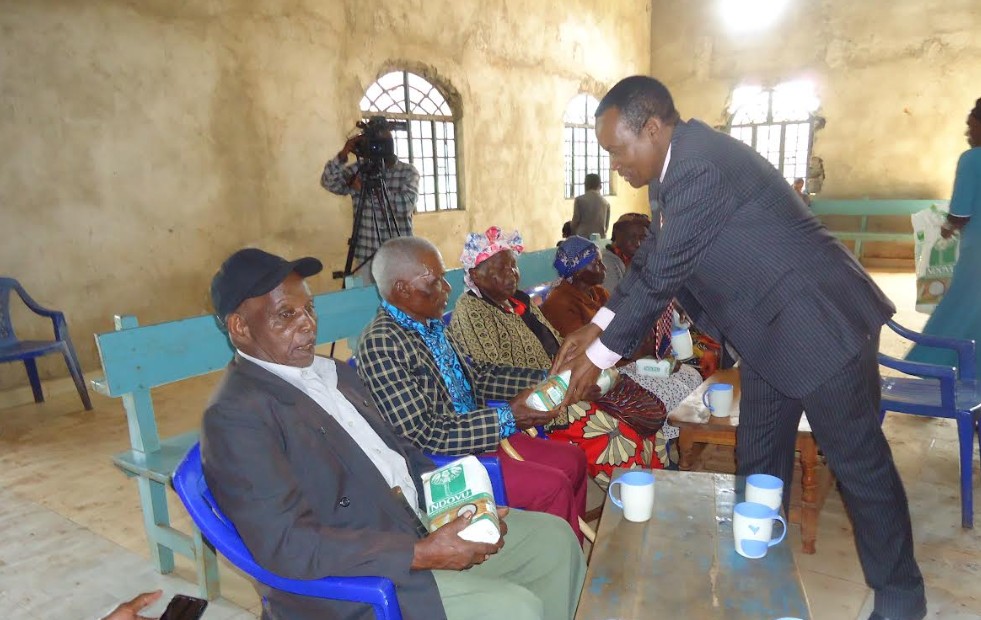
Using the available funds in their treasury, the church has contracted a local taxi operator to go round the homes of about 16 elderly men and women, who in their hey days were active members of the church, to bring them for church service every third Sunday of the month and ferry them back to their respective homes after providing them with a sumptuous meal and presenting them with a gift hamper.
Nestled in the leafy, hilly terrain that is Kamune village, CMI’s congregation consists of retired and elderly men and women, a few employed people, small-scale farmers and a large number of students and jobless youth.
If what he wanted in life was wealth and fame, CMI Bishop John Kiiru Kariuki chose the wrong ‘career’, the wrong location and even the wrong dispensation (age) because many times, the members of Kariuki’s church who dearly love their Shepherd do not have liquid cash and so they generously give whatever farm produce they possess.
One of the faithful, Mrs. Lydia Wacera Gatimu (nee Gathitu or Wamam) ensures that her Pastor gets a healthy breakfast before standing on the pulpit. Every Sunday morning, year in year out without fail, she sends freshly boiled Nduma (arrowroots) and fermented milk sourced from her humble shamba.
It is not all church members who are farmers. There are others who bring along liquid cash as tithes and offerings. One would expect the bishop to utilize the money given to construct a palatial home in the village for his elderly mother and his own family when they are ‘up country’.
However, Kariuki has concentrated his resources into building a sanctuary for people to come and meet their God in a comfortable environment.
“I reckoned, like King David of the Bible, that it would be wrong for the ‘Ark of the Covenant’ to live in shabby dwellings, while I lived in an imperial palace,” Kariuki said.
He was alluding to the fact that his homestead at Kamune village, Mathioya Sub County does not have an imposing gate – access for all and sundry is a walk-in and walk-out affair unhindered.
But this is not something entirely strange for Kariuki. His Mother, Mrs. Helina Wakarima Kariuki, or Wa Mucheru as she is affectionately called, in her prime when Kariuki was growing up, had an open-door policy for all the boys in the village.
“The boys from the village knew where I kept the keys to my house and would find their way to where I kept the food. They knew they were always welcome at my home to eat to their fill,” Wakarima said.
This fact was well known in the village, and some women often disparaged her for it.
“Me, I tell those boys that I’m not Wa Mucheru who plays host to every Tom, Dick and Harry. I tell them to go eat at Wa Mucheru’s home because I’m not willing to give them my food,” Wakarima relates a tit bit gossip one of her neighbors was overheard saying.
“I later on confronted her over this gossip and she was really embarrassed,” she added.
“The apple does not fall too far from the tree” so says the old adage. Following in his mother’s footsteps, Bishop Kariuki uses the hard cash he receives to carry out corporate social responsibility (CSR) activities in the community. One of them involves the elderly people within the neighbourhood of his Christian Ministries International Church at Ngamba, Kamune Village.
Many of these elderly people, due to illness or just plain general body aches of old age, are not able to attend Sunday service as they used to do previously.
Now going on to thirty years since he was ordained as Pastor at Kamacharia Christian Church (now Christian Church International, Kamacharia), Kariuki hires a taxi to ferry the elderly men and women from their homes and back every third Sunday of the week, one of them comes from Karindi, in Nyeri County.
Although these men and women have their own sons and daughters who could ensure they went to church regularly, Kariuki is the urbanite with an eye on the village life, and so he is able to note a need where others with city ministries may not see.
Maybe informed by how he relates with his now bedridden 95-year-old mother, Kariuki and his able-bodied parishioners have taken it as one of their ministry outreaches to add a smile to the otherwise dreary existence of these elderly folk.
“When they come, I ensure that my sermon is brief and to the point so that I do not tire these brethren as some of them find it hard to sit for a long time,” said Kariuki.
After the brief sermon, the elderly folk are served with a hearty meal, and before they leave, he ensures that each of them carries a 2-kg packet of maize floor or sugar, whatever else the church can afford at the time.
“The first time I paid for the taxi, the food and the gift hamper from my pocket, but since then well-wishers have come onboard. One from the United States of America (USA) offered to be purchasing meat for their meal, another usually pays for the transport while my wife offered to be buying maize flour for their take home hamper,” said Kariuki.
Although what he is doing is hardly ever preached about, it is based on scripture. The Apostle Paul in his writings laid the responsibility of the elderly (who have no children of their own to take care of them) squarely on the shoulders of the church corporate.
“How can you tell a needy person to ‘go home and be warm and well fed’ while you don’t give them a coat to be warm or unga to cook a meal with?”, posed Bishop Kariuki rhetorically.
This question is actually a direct quote from the little-read letter of the Apostle James. This James (not son of Zebedee) says evidence that one has faith in God will be evident from the works he/she does.
James 2:14 “what good is it, my brothers and sisters, if someone claims to have faith but has no deeds. Can such faith save them? Suppose a brother or a sister is without clothes and daily food. If one of you says to them, ‘Go in peace, keep warm and well fed,’ but does nothing about their physical needs, what good is it? In the same way, faith by itself, if not accompanied by action, is dead.”
The Apostle James had summed up what being a true believer in Jesus Christ entailed: “Religion that God our Father accepts as pure and faultless is this: to look after orphans and widows (or widowers, in Kariuki’s case) in their distress and to keep oneself from being polluted by the world.”
The elderly people in Kamune village are full of gratitude to CMI for this act of compassion.
Said one Nahashon Mwangi Mbuthia (a former teacher), “I am happy because of how the Church (CMI) has remembered us old people.”
Another beneficiary, a widow, Mrs. Beatrice Wairimu Muhara aka Mama Kenda, now over 80 years broke her back during the Mau Mau struggle for independence in the 1950s after falling down from a tree when she was 17 years old. Her backbone was massaged back into shape, but she did not receive any conventional medical attention.
She had been well and is one of Kariuki’s oldest members; she had been originally a faithful and regular member of Mananga Christian Church, a distance of almost 10 kilometers from her home.
When Mananga Christian church launched Kamacharia Christian Church next to Mathioya Polytechnic, she relocated there as it was nearer her home, though still quite a distance away.
She was one of those who enthusiastically started Christian Church International, Kamune, before it was renamed Christian Ministries International.
Now in her old age, she is not able to attend services at the sanctuary as she used to but is grateful for the way the church has continued to fend for them.
“I am glad because of the church (CMI) thinking of us. Some of us are not able to read the Bible for ourselves and we depend on the word of God that we hear when we come to Church on such a day to keep us going on in the faith,” said Muhara.
She added: “Let us be humble and loving, so that we may be letters of commendation to the world.”
Bishop Kariuki says that some of the elderly parents need someone to take them outside the house to warm in the sun and also to provide them with the basic necessities of life.
“However, some parents are being neglected or even beaten by their children. I want to ensure that our elderly people have no hindrance to reaching heaven due to bitterness,” he said.
Another elderly man Ithe wa Gikuru said: “I’m glad that I am alive today. At home, I cannot sit on a chair for a long time, but when I come here, I am able to persevere and sit still. It is my prayer that God gives us many more opportunities to come here because coming to this church has been like medicinal balm to me.”
Kariuki observes that many of these elderly people are widows and widowers and, in most cases, live alone, noting that more often than not, their only social contact is the one day they are brought to the sanctuary.
He appealed to people of goodwill to help him bring them to the sanctuary more regularly and also provide for a number of creature comforts such as comfortable toilets to ease their lives.
By Esther Mbuthia