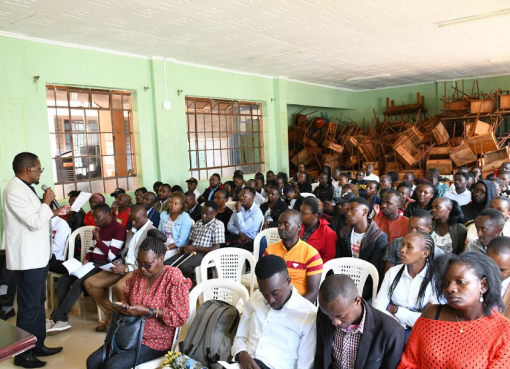
A non-governmental organization has asked for a hybrid revenue-sharing formula that prioritizes equity and regional fairness following the ongoing deliberations in parliament on the Fourth Basis for Revenue Sharing among County Governments.
Speaking in Mombasa, the Coast Peoples Forum (CPF) Secretary General, Stephen Mwakesi, said that the organization proposes adopting a hybrid formula and urged Senators and Members of Parliament to reject any formula that entrenches inequality and instead rally behind a hybrid model that delivers both stability and justice.
He noted that their organization recognizes the Commission on Revenue Allocation’s (CRA) constitutional duty and commends its efforts in promoting transparency, data use, and public engagement in crafting the Fourth Basis.
“The commitment to stabilizing county revenues and incorporating economic disparities through measures such as the income distance parameter is a step in the right direction,” said Mwakesi.
He noted that the organization expresses strong reservations about the current structure of the Fourth Basis as proposed.
“Our analysis, supported by both the CRA and the Parliamentary Budget Office (PBO) reports, reveals that while all counties gain nominally under the proposed formula, the gains are uneven, raising serious concerns about fairness over time. We believe the formula could ultimately widen existing inequalities, particularly for historically marginalized counties like those in the Coast region,” he added.
Mwakesi highlighted that some of the major concerns are the overreliance on population, which he said benefits populous counties and undermines the principle of equitable development.
He added that the removal of targeted indices for health, agriculture, roads, and urban services erases mechanisms that previously supported underdeveloped counties.
According to Mwakesi the omission of Coastal priorities, such as the proposals to incorporate the Blue Economy and coastal-specific indicators, were acknowledged during stakeholder consultations but are absent from the final formula.
“The income distance metric, meant to direct more resources to poorer counties based on how far their economic output per person (GCP per capita) falls below the richest county, lacks transparency in its calculation and has shown limited power to correct disparities in real allocations,” said Mwakesi.
He noted that CRA has not published a detailed county-by-county breakdown showing how income distance values were derived, what data year was used, or how those numbers were determined and how much money each county would receive.
He said the absence of methodological clarity limits countries’ ability to validate or challenge the outcome and weakens the redistributive potential of this metric.
The SG added that while stabilization prevents counties from receiving less than their current allocation, it also locks in historical underinvestment without offering pathways for catch-up growth.
The Vice Chairperson of CPF Dimka Matano congratulated the Kenya Ports Authority (KPA) management for the good job in ensuring there are plans to modernize container terminal one and expansion of the Kipevu city two road.
He noted that the management needs to be reminded that the competition of seaborne trade is at sea and not at the ship-to-shore.
He added that KPA, as a feeder port mainly relies on loading and discharging, lashing and unlashing, cargo trimming, wage keeping, among other services, as opposed to the fifth generation ports that normally advertise with five days as opposed to KPA’s 14 days of advertising.
“There is a need for the KPA leadership to sit with Coast professionals and restructure our maritime logistics and transport hub,” he said.
He added that the feeder ports serve as a link between regional or local economies and the global shipping network often focusing on specific regional or domestic markets.
The Coast Peoples Forum (CPF) is a non-partisan, membership-based platform that brings together professionals, civil society actors, researchers, community leaders, youth, and grassroots organizations from the six counties of Kenya’s Coast region.
Founded in the year 2006 on the values of equity, inclusion, devolution and regional solidarity, CPF seeks to advance the social-economic and political interests of the Coast region through public policy engagement, civic participation, and collaborative action.
By Chari Suche