At the crack of dawn in Naningoi village, Kajiado Central Constituency, Lenah Lipan puts down her cup of tea and puts on her faded rubber shoes. She then takes her backpack and after confirming that all the components needed for the day are in, she sets-off on the rocky footpath that weaves between homesteads.
It is a routine she has repeated for 13 years, not because she must, but because lives in her community depend on it. Lipan is one of the Kajiado’s unwavering Community Health Promoters (CHPs), the often-unseen backbone and pillars of rural healthcare.
With a vast land area of over 21,000 square kilometers and only 136 public health facilities, accessing healthcare services in the rural parts of Kajiado County remains a major challenge.
Bridging this gap, however, are the diligent, stanch, dedicated Community Health Promoters (CHPs), the unsung heroes who have become a crucial lifeline in healthcare access, literally delivering services at the doorsteps of households in some of the most remote areas.
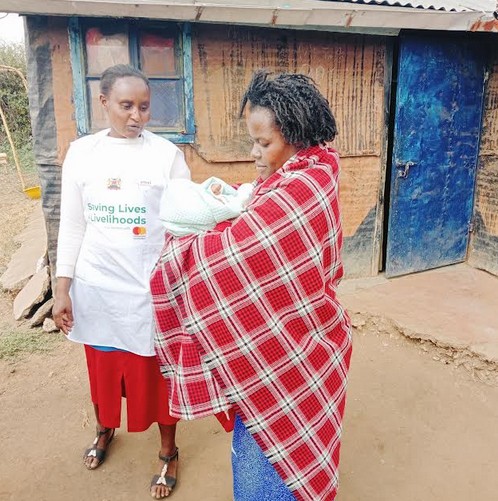
By mid-morning, Lipan arrives at the home of an expectant mother, who recently suffered two miscarriages and was hopeful for a positive ending with the current pregnancy.
“We keep reminding them why antenatal clinics matter. Sometimes you find a mother who doesn’t know she has high blood pressure, putting both her life and their children in danger. A simple check can save two lives,” said Lipan, while she gently checks on the mother’s blood pressure and blood sugar.
Esukuta Unit, which Lipan operates in, has 16 CHPs, each assigned specific households to visit.
Armed with only blood pressure monitors, blood sugar meters, a first aid kit, and basic pain-relief medication, the CHPs play a vital role in early disease detection, maternal health, and preventive care.
“We mostly go house to house during our household visits. We check for blood pressure and diabetes, and we urge expectant women to attend antenatal clinics. We also mobilize residents during medical outreaches whenever they are organized, and also link them with health facilities” says Lipan.
For Veronica Lankoi, a CHP in Intinyika village, her 12-year service has been fueled by the visible positive impact of their work.
“Since we started actively following-up on expectant mothers and encouraging them to attend antenatal clinics, cases of maternal deaths have greatly reduced. This gives me the motivation to keep going, knowing that lives are being saved,” says Lankoi.
Lankoi, narrated that this has been brought by their continuous message on adoption of skilled births unlike before when the community solely relied on traditional mid-wives, even on complicated cases.
She noted that they also assess common childhood ailments, including malnutrition, diarrhea, malaria and pneumonia. They prescribe Oral Rehydration Salts (ORS) to children and adults with dehydration in addition to supplying water purification tablets to households.
“Most children are also getting immunized now as we follow-up on them once they are born to ensure that they are fully immunized and getting the proper care they deserve, including proper nutrition,” said Lankoi.
The adoption of the Electronic Community Health Information System (ECHIS), has further enhanced their work. The centralized digital platform, enables CHPs to record and track household health data, improving efficiency and decision-making in public health interventions.
Data from ECHIS also assists the Ministry of Health in policy formulation and in better planning in terms of budgetary allocations for communicable and non-communicable diseases.
Despite their progress, CHPs still face several challenges that hinder their work.
Stigmatization of diseases such as HIV, is still high in the rural parts of Kajiado. Many people fear disclosing their status due to the stigma, which makes it hard for the CHPs to offer proper guidance and follow-up.
“I had a case in my area where a woman was silently suffering from what was later diagnosed as rectal cancer. Due to fear of stigmatization, she suffered for long before she could disclose her problem to me. When she gained the courage to open-up, the disease was on its advance stages, but luckily, I was able to connect her with a doctor from the Kajiado Referral Hospital, who helped her seek treatment at the Kenyatta National Hospital,” Lipan narrated.
She emphasizes that more sensitization efforts are needed to help communities overcome misconceptions and discrimination surrounding HIV and other health conditions.
Lipan, who is also a grandmother of two, laments that the pay is also very minimal and they are forced to take-up casual jobs for them to sustain their families.
“The National government gives us Sh. 2,000 per month as a stipend which is not sustainable as we have to provide basic needs for our families too. Buying data bundles in order to upload data to ECHIS and paying a Boda boda to take you from one home to another is expensive and one ends-up using all the money on the work with nothing left for self-use. Even though we are volunteers, we would like the government to increase the stipend to cover our other needs,” said Lipan.
Additionally, given the vastness of Kajiado County and the scattered nature of homesteads, mobility remains a major challenge. Many CHPs have to walk long distances under harsh weather conditions to reach households.
Lankoi revealed that some of the households do not welcome them and perceive them as idlers who are out to gossip about their medical reports.
“Some community members demean you and ask when you became a doctor. We usually take a lot of time to build rapport with community members, so that they can divulge their health status to us. For expectant women for example, we usually have to look at their antenatal clinic book to know their progress. This needs a lot of convincing from our side, which usually takes-up time and energy that could have been used in visiting another household,” said Lankoi.
Still, their commitment remains unwavering. For them, every household visit, every screening, and every counseling session, brings the County a step closer to achieving Universal Health Coverage.
Kajiado County Executive Committee Member for Health, Alex Kilowua, said that due to the vastness of the County, implementing health programs in the County is a challenge, especially in the rural areas
“We have a distance of 14 kilometers from one health facility to another in rural areas. In such a situation, it is difficult to monitor health indicators such as immunization, skilled delivery, nutrition and the rest. Poor health seeking behavior among our people is also a major challenge but thanks to devolution, through health systems including services of Community Health Promoters (CHPs), we are now able to do household visits, even in the rural areas. The CHPs are able to do referrals and link the community to health centres, depending on their ailments,” said Kilowua.
He revealed that the CHPs also arrange for community dialogue days and medical health outreaches, which have contributed greatly to improved health outcomes in the County.
The government through the Ministry of Health, has deployed preventive healthcare, anchored on community health services and primary healthcare, as a cornerstone for accelerating Universal Health Coverage.
There are currently over 100,000 CHPs in the country, distributed across the 47 counties based on the population and geographical characteristics.
by Diana Meneto