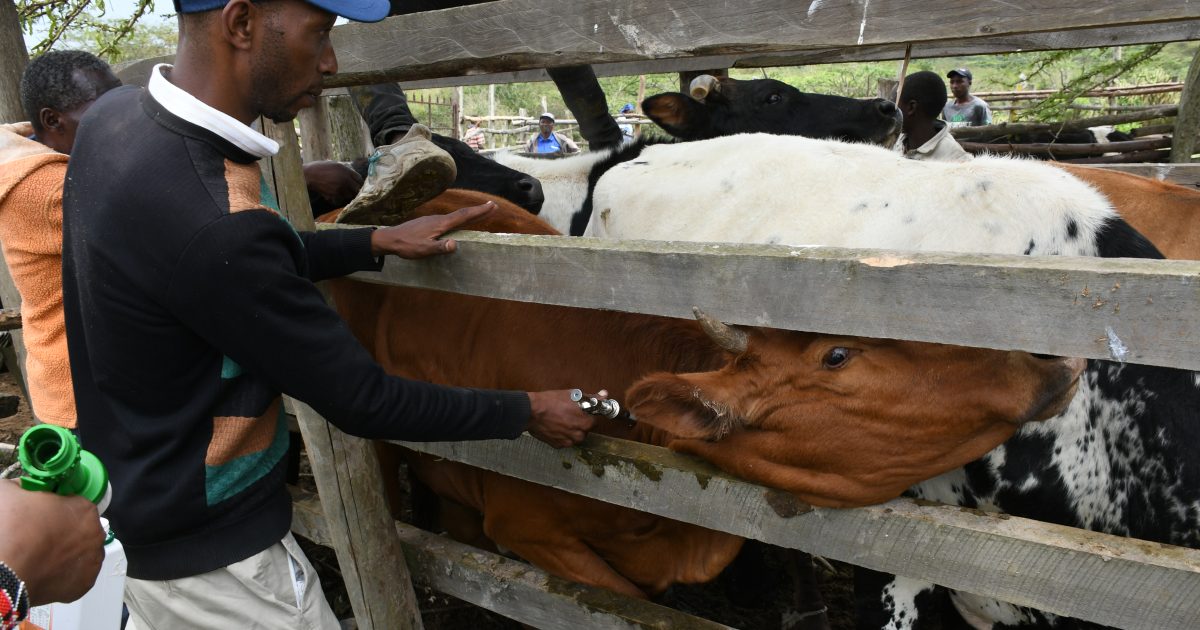
Nyeri County Government is looking for 240 vets ahead of a planned major vaccination drive against Foot and Mouth Disease (FMD).
In a re-advertised notice dated November 12, the government with collaboration with the National Agricultural Value Chain Development Project (NAVDCP) had invited qualified and licensed veterinary and para-professionals to submit their application via an online portal by November 16.
For one to qualify, one must have been registered under the Kenya Veterinary Board and be familiar with digital tools leveraging mobile technology.
However, by the time of the expiry of the deadline, less than 30 people had applied for the posts.
Now acting County Director of Veterinary Services Dr Anthony Muguro says they may be forced to request the 50 county veterinary officers to apply for the jobs in order to try and plug the existing gap.
This is as per the guidelines by the World Bank (which is the financing entity), which requires that anybody participating in the exercise can only do so by applying through the official link.
“We had anticipated getting enough applicants for these slots but the response so far has been low. We were looking for 210 animal health assistants (AHA) and 30 surgeons to work in the 30 wards but by the close of the deadline on Sunday, only 28 had shown interest.
This means we have to go back to the drawing board and extend the deadline and also ask our own veterinary officers to apply for these positions before we can roll out this exercise,” he told KNA.
Those who will take part in the inoculation exercise will receive Sh24 for every head of cattle vaccinated, with the county government targeting a total of 104,000 heads of cattle in the 30 wards.
In addition, the government is paying Sh110 for each head of cattle vaccinated, while farmers are expected to top this amount with Sh50.
“Our initial plan was to get enough veterinary officers to do the job and take them through a two-day training before they can embark on this work. However, going by the poor feedback we have so far received in terms of applications, we will have to work with what we have. And since this is a county-based programme, we cannot ask officers from outside Nyeri to come in .We need people who know this county and who are conversant with the local community and can interact well with people to ensure there is optimum success in this exercise ,”he stated.
The County government has been racing to boost livestock production by coming up with innovative digital platforms to enhance animal husbandry.
In September this year, the county launched a programme to help farmers access subsidised animal health and breed improvement services through an electronic voucher (E-voucher) system.
The system dubbed the Animal Health and Breed Improvement Delivery Model is similar to the E-subsidy fertiliser programme that currently allows farmers to access fertiliser and other farm inputs at a discounted cost from the government.
This Model was developed by the Ministry of Agriculture and Livestock Development in collaboration with value chain players in the sector and it seeks to enhance productivity in dairy and beef production.
Commenting on the programme, Dr Anthony said that the county government was banking on the model to strengthen the delivery of extension services in all the 30 wards.
He reported that the technical committee had already developed guidelines, training modules, and an integrated e-voucher system to support the implementation of the programme.
To benefit from the subsidised rates, which will include animal vaccination, artificial insemination, animal feeds, herd health, and identification services, a farmer must first be registered under the E-voucher platform.
“The programme encourages all the farmers to be linked to a co-operative. One of the expected outputs is that we will identify one ward co-operative from each of the 30 wards, which we will use to provide vaccines, semen and other inputs to the livestock farmers,” he said.
The animal registration criterion is anchored on the Muzzle technology, which uses the biometric pattern of the livestock’s snout to create a unique identifier.
After successful registration an e-voucher will be issued to the farmer, who will subsequently use it to redeem the services from an approved Animal Health Technician.
“For the vaccination process, we will use Mifugo360 SuperApp, a livestock registration, health and traceability platform. The application has in-built modules for biometric ID, geolocation, and information on vaccinations available and also provides information on the financial services available for the participating farmer,” stated Muguro.
By Samuel Maina