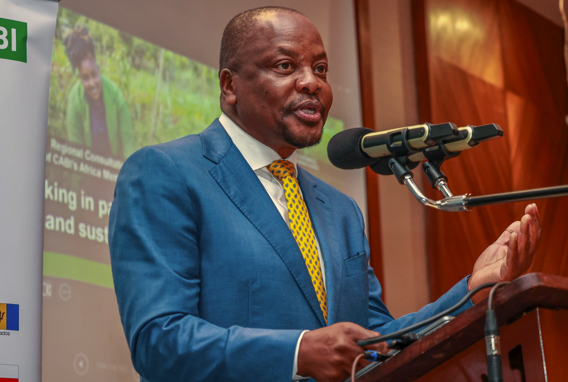
Agriculture and Livestock Development Cabinet Secretary, Mutahi Kagwe, has warned that powerful pesticide cartels are actively sabotaging government efforts to eliminate harmful agrochemicals and enforce food safety standards.
“We are aware that banned pesticide cartels are fighting back—through bribery of legislative and regulatory bodies, infiltration of government institutions, and the sponsorship of media articles to undermine public health reforms,” Kagwe revealed.
Speaking during the opening of the 2025 Centre for Agriculture and Biosciences International (CABI) Africa Regional Consultation, the CS highlighted that the high-stakes battle is underway as Kenya and its African partners attempt to phase out hazardous pesticides and modernise agricultural practices.
Kagwe’s warning came amid renewed calls for regional co-operation in tackling pesticide risks, environmental degradation, and pest-related crop losses.
Hosted in Nairobi, the CABI Africa Regional Consultation brings together policymakers, scientists, and development partners to chart a continent-wide path toward safer, climate-smart agriculture.
He said the country, is unwavering in its commitment to strengthening pesticide regulation, promoting sustainable inputs, and empowering farmers through knowledge and innovation. However, he emphasized that entrenched commercial interests are obstructing progress.
“This is not just a policy issue—it is a fight for the health of our people, the integrity of our food systems, and the future of our environment,” he said.
Citing Kenya’s Agricultural Sector Transformation and Growth Strategy (ASTGS), Kagwe reaffirmed the country’s focus on climate-smart, inclusive farming, improved market access through sanitary and phytosanitary (SPS) compliance, and tighter enforcement of food safety laws.
He praised the CABI, which celebrates 30 years of regional operations in Nairobi this year, for its pivotal role in combatting invasive pests, reducing pesticide dependence, and driving scientific collaboration across Africa.
“From battling fall armyworm and locusts to pioneering nature-based solutions like the National Prosopis Strategy, CABI has helped anchor agricultural resilience across the continent,” Kagwe noted.
As delegates prepare to shape CABI’s next strategic direction, the consultation takes on a deeper urgency—both in countering rising threats posed by climate-driven pest dynamics and confronting vested interests profiting from unsafe agrochemical trade.
Kagwe’s remarks echoed Kenya’s broader leadership in continental integration efforts, including the Comprehensive Africa Agriculture Development Programme (CAADP) and the African Continental Free Trade Area (AfCFTA). He urged African nations to unite behind harmonised pesticide governance, farmer education, and shared regulatory frameworks.
“Let us not leave this room with just another communiqué. Let this be a turning point—a moment where political courage meets scientific truth,” Kagwe challenged.
As Kenya pushes ahead with reforms and global partnerships—including triangular cooperation with the Global South—Kagwe made it clear: the era of toxic loopholes, corrupt protectionism, and silent poisoning of Africa’s food is over.
The meeting continues through 13 June, with stakeholders expected to draft a regional roadmap for safe pesticide use, sustainable agriculture, and a resilient African food future.
By Joseph Ng’ang’a