Pastoralists and livestock traders in Wajir County are facing severe livelihood challenges following a prolonged drought that has led to widespread livestock deaths, reduced market activity and a sharp decline in animal prices.
The drought, which has affected large parts of the county, has resulted in acute pasture and water shortages, forcing herders to trek long distances in search of grazing areas while recording significant losses along the way.
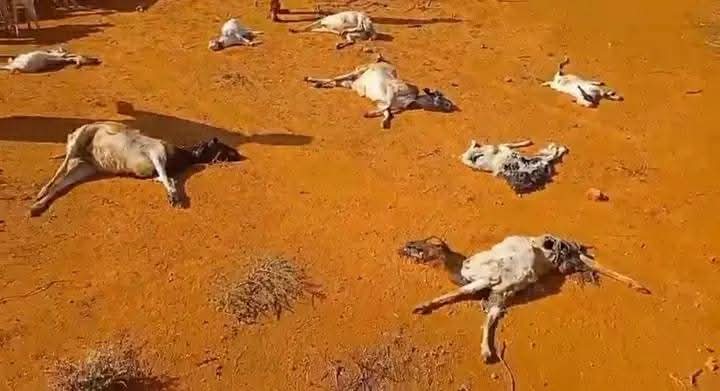
In Dambas area of Tarbaj Sub-County, the impact of the dry spell is evident across the landscape.
Carcasses of cows, goats and sheep are scattered across open grazing fields and rangelands, highlighting the extent of livestock deaths caused by prolonged pasture and water shortages.
Local pastoralists say the situation has worsened over the past few months as rains failed and traditional water sources dried up.
“We have lost many animals due to lack of pasture and water,” said Abdi Hassan, a pastoralist from Dambas.
“We move for long distances but still fail to find grazing areas. Some animals collapse before reaching water points,” he added.
The drought has also disrupted livestock markets, which are a key source of income for households in the arid and semi-arid region.
At the Orahey livestock market, traders report a drastic reduction in the number of animals brought for sale, as well as a sharp fall in prices due to poor body condition.
According to traders, goats that previously sold for between Sh9,000 and Sh12,000 are now fetching as little as Sh600, significantly reducing household income.
“The market is very slow,” said Fatuma Ali, a livestock trader. “Animals are weak and buyers are few. We sell at very low prices because we have no other option. Families depend on these sales for food and school fees.”
Traders further noted that the cost of transporting animals to markets has increased, as herders are forced to move animals over long distances in search of water and pasture before attempting to sell them.
The declining livestock trade has had a ripple effect on the local economy, affecting traders, transporters and small businesses that depend on market activities.
Humanitarian agencies have raised concern over the deteriorating situation.
The Kenya Red Cross has classified Wajir County as being in the alarm phase of drought, indicating a high risk to livelihoods and food security.
“The county is experiencing increased livestock deaths and reduced access to water,” said a Kenya Red Cross official in Wajir.
“Urgent and coordinated interventions are required to prevent further loss of livelihoods and to support affected households.”
Women and children are among the most affected groups, with families reporting reduced food consumption and increased time spent searching for water.
Some households have been forced to migrate in search of pasture, disrupting access to education and health services.
At a temporary settlement near Dambas, residents say they now rely on relief assistance to meet basic needs after losing most of their livestock.
“We used to depend on milk and livestock sales,” said Asha Mohamed, a mother of five. “Now we depend on relief food because most of our animals have died.”
The county government, in collaboration with national government agencies and humanitarian partners, says it has put in place measures to mitigate the effects of the drought.
These include water trucking to the most affected areas, rehabilitation of boreholes and support to vulnerable households.
County officials say early response and coordination with partners is critical to prevent the situation from worsening.
“We are working with partners to ensure water is supplied to affected communities and livestock,” said a county official. “We are also assessing the situation to guide further interventions.”
Pastoralists, however, are calling for additional support, particularly livestock feed, water infrastructure and animal off-take programmes to reduce losses and stabilise household incomes.
Experts warn that recurring droughts continue to threaten livelihoods in arid and semi-arid lands, underscoring the need for long-term solutions such as improved water management, drought preparedness and diversification of livelihoods.
As the dry conditions persist, residents say timely intervention remains critical to safeguarding livelihoods and preventing further economic and humanitarian impacts in Wajir County.
By Hamdi Buthul