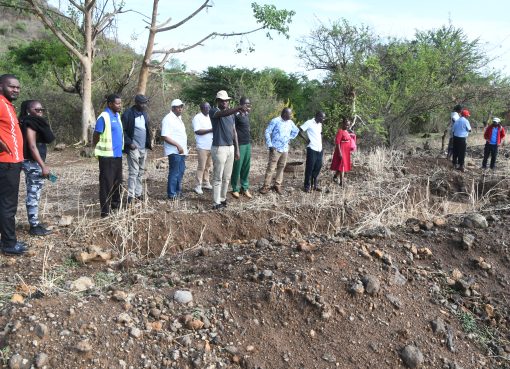
Kenya needs to be a producer of technology and not just a consumer, Principal Secretary of the State Department for Science, Research and Innovation (SRI), Prof. Shaukat Abdulrazak, has stated.
The country has been consuming products from elsewhere for such a very long time and relying on imports for so long, and this should be unacceptable 60 years plus after independence, he said.
Speaking during a media roundtable with science journalists during the National Research Fund (NRF) festival at Egerton University, the PS noted that embracing SRI is a solution for the country not only to produce what it wants but also to be able to safeguard and protect its people.
Prof. Shaukat gave an example of electron beam technology that offers promising applications in agriculture, primarily through food irradiation and pest control.
The non-thermal processing method utilizes high-energy electron beams to eliminate microorganisms, extend shelf life, and control pests.
“For the people who are still wondering whether this application is safe, countries like China literally irradiate all spices and there is nothing wrong with it, it is a misconception of science,” he explained.
He further said that for a Country like Kenya which wants to grow and become middle-income country, it is unacceptable to have children under 5 years being faced with stunting, 1.8 million people facing food insecurity, half a million children going through undernutrition, and almost 40,000-plus Kenyans being faced with challenges like scourge of cancer and yet we can produce feeds that will be more nutritious and prevent importation of food.
“We need to safeguard, be so jealous of our intellectuals, be able to contain the brain drain, and stop working in silos,” he said, adding that among over the 79 universities in the country, there are cutting-edge research and innovations that can be tapped.
He challenged parliament to play a vital role in allocating more funding for research. “It is unacceptable that since 2013, we have been talking about 2 percent of the GDP going to research development but at the moment we are at 0.8 percent.”
The country, he noted, needs at least 1% of the budget allocated to research if it wants to leapfrog. “If we want to compare ourselves with the Asian tigers, it is unacceptable that 60 years down the line countries like Singapore, Malaysia, and South Korea, who we were at par with, are now flying high in research and technology, and we are still walking, and yet we have cutting-edge institutions such as Egerton University.
He said that as government, he is putting a team in place to prepare bankable documents that can solicit resources adding that they will also be having a discussion with the Kenya Revenue Authority (KRA) on tax relief and rebates to make their contribution to the space of science, research, and technology.
Prof. Shaukat termed the government’s Bottom-up Economic Transformative Agenda (BETA), one of whose pillars is agriculture, food security, food safety, and food sovereignty, including nutrition, as key factor in embracing science, technology, and innovation
He added that the government is taking full advantage of County governments to devolve science research and innovation and urged every Governor to leverage the blue and circular economies that are in place in various counties.
Advocating for the public-private partnership is also key, the PS said, adding that the government will continue to create an enabling environment for the private sector and venture capitalists to come in, invest, and take our products to the next level.
He asked that scientists be trusted in coming up with cutting-edge research instead of comparing their work with other countries. “We should not be followers; we can also take the lead, and that is the only way we can transform this country into a middle-income and high-level country.”
Kenya has the Kenya National Innovation Agency that looks at the entire pipeline from the ideas and prototypes towards commercialization at all levels, and also has the youth who are in the research space, and thus we have to change the approach and must have a different mindset towards science and technology.
He acknowledged the National Research Fund (NRF), which, in a small, modest way, is able to fund research and able to produce some products that are able to go out into the shelves but said they needed upscaling to address matters food insecurity.
Baringo Member of Parliament and a member of the Education, Research, and Innovation Committee in the National Assembly, Joseph Makilap, said it is time that the country researches products that should be able to move out of channels, books, and minds to become practical in the field, where they can change the economic matrix of the country.
“If we don’t utilize research, we shall become a consumer country where everything is done elsewhere and dumped in our country. We need to protect science and research and put resources,” he added
Makilap noted parliament is ready to allocate the necessary resources to ensure that research continuously goes on, saying that they will assist in legislation to anchor everything that is done under research and innovation and embed it into law.
The MP further called upon Kenyans to embrace science, research, and technology. “Let us stop reading from the book of lamentation. Let us move to the books of justice, of hope, of encouragement in that we can do research that will give value and also money”,
Makilap asserted that there is a need to create a fund that goes to research in all the universities so that we can grow our research thinking and the innovation going on in the universities and polytechnics, challenging the PS to ensure that when it comes to the budget, they propose five (5) percent of VAT to go to research.
“The government should deliberately, and intentionally decide that this country must become industrialized and therefore put all systems go for research, innovation and technology,” he added.
Makilap proposed establishing master class research centers in the country, one solely on agriculture and its products and another one for technology, but also asked that young scientists be rewarded for their created innovations.
Prof. Joshua Ouma, Associate Professor of Organic Chemistry at Egerton University, said the government is hosting an International Center for Genetic Engineering and Biotechnology at Egerton, a world body that is within the UN system where African countries, both Anglophone and Francophone member states, can access scientists and which specializes in training postgraduate students and post doctorates on product development that is involved in technology transfer.
Prof. Ouma said the construction is ongoing and that in the next two years it will be operational, and this will be able to take research to a higher level.
Dr. Tonny Omwansa, CEO of the Kenya National Innovation Agency, said their role is in developing and nurturing the Kenyan innovation ecosystem that catalyzes the creation of jobs and wealth, leveraging ideas that emerge from research and also from capacity development.
“The journey of commercialization based on ideas that have been identified is one of the core functions that we do as an innovation agency,” he said, noting that they are creating research-based startups, and also looking for people who develop technologies and who know how to do technology transfer and work together within the ecosystem of Egerton University to actually produce ventures that are agriculture-based.
The government has been actively promoting science, technology, and innovation (STI) to drive economic growth and improve livelihoods through established key institutions and policies to foster an STI ecosystem, including the Science, Technology, and Innovation Act, 2013, that has led to the creation of NACOSTI, NRF, and KeNIA.
By Wangari Ndirangu