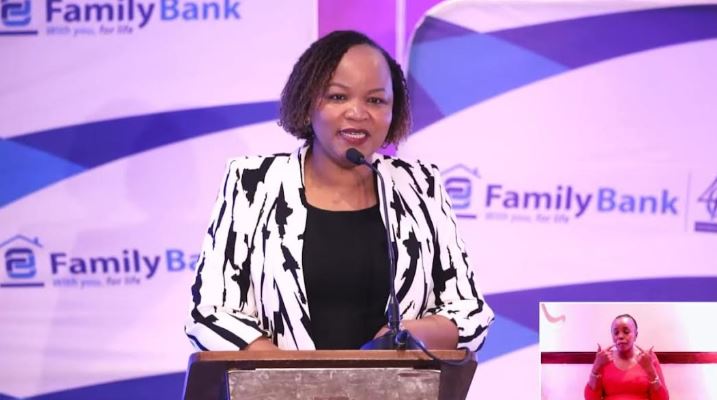
Family Bank has reported a year of strong financial performance marked by double-digit growth across key metrics.
Annual report an expanded national coverage, and increased digital adoption, as the bank unveiled her long-term strategy and commitment to supporting Kenya’s socio-economic development.
Speaking during a stakeholder’s engagement forum, Chief Executive Officer (CEO) Ms. Nancy Njau said the bank’s performance reflects deliberate investment in digital transformation, customer-centric solutions, and sustained support for critical segments of the economy, including MSMEs, agriculture, and women-led enterprises.
She said the bank’s mandate remains anchored on its vision “to positively transform lives in Africa” and its purpose of empowering individuals and businesses to build and preserve wealth through accessible financial services.
The bank currently operates through three subsidiaries: Family Bank assurance, PesaPap Digital, and the Family Group Foundation. According to the CEO, these subsidiaries enable the institution to offer integrated financial and social-impact solutions while strengthening operational resilience.
Family Bank now commands a footprint of 96 branches across 32 counties, supported by more than 92,000 merchants and over 5,000 agents nationally.
Ms. Njau highlighted that the bank has consistently invested in digital channels, leading to more than 92 per cent of transactions now being conducted through digital platforms. The institution is targeting 98 per cent digital migration in the near term.
This growth has been reinforced by multiple recognitions in customer experience, sustainability with women in business, SME banking, and agency banking reporting commendable growth.
Family Bank has also won the Battle of the Banks Africa challenge for three consecutive years, a recognition she attributed to a strong internal talent pipeline and a high-performance workforce.
The CEO noted that the macroeconomic environment has stabilized significantly, creating favourable conditions for lending and business expansion. Kenya’s Gross Domestic Product (GDP) is projected to grow by 5.5 per cent in 2024 and 5.8 per cent in 2026, supported by resilient sectors such as ICT, finance, agriculture, and tourism. Inflation has dropped to 3.65 per cent, while the Central Bank Rate has decreased to 9.25 per cent.
Treasury bill rates have declined and the shilling has stabilized around 129 to the US dollar. She added that diaspora remittances remain strong, with Kenya recording Sh488 billion year-to-date, predominantly from North America.
In outlining the bank’s 2025–2029 strategic plan, Ms. Njau said it will revolve around four core pillars: accelerated digitization and data-driven operations; compelling customer value propositions; improved productivity and efficiency across the institution; and strengthened enterprise risk management.
She affirmed that these pillars are designed to position Family Bank for sustained competitiveness in an evolving financial landscape.
The CEO also underscored the bank’s ongoing engagement forums across the country, which target micro, small and medium enterprises, women entrepreneurs, coffee farmers, youth groups, and the wider agricultural value chain. Through the Family Group Foundation, the bank continues to support education, health, and economic empowerment initiatives.
Chief Finance Officer Paul Ngaragari reported that the bank’s balance sheet has expanded to Sh202.5 billion, representing a doubling of asset size since 2021. Customer deposits grew by Sh19 billion over the past 12 months, while shareholder funds rose from Sh19 billion to Sh28.2 billion, with 87 per cent of the increase realized in 2025 alone.
He attributed the performance to prudent financial management, improved profitability, and strong customer confidence.
Ngaragari noted a 130 per cent increase in other liabilities, driven primarily by higher transaction volumes on digital platforms. Development finance institution (DFI) funding rose to Sh10.6 billion, earmarked for priority segments such as agriculture, youth, and women. He urged businesses within these sectors to take advantage of the available financing.
The bank’s loan book grew from Sh92 billion to Sh108 billion in 2025.
Ngaragari said the institution is currently disbursing approximately Sh1.8 billion per week into the economy, with MSMEs accounting for more than 60 per cent of the credit portfolio.
He emphasised that while the bank invests in government securities to strengthen liquidity, lending to the real economy remains the primary focus.
He added that 86 percent of the bank’s assets are interest-earning, indicating disciplined and efficient capital deployment. Family Bank contributed 27 per cent of the total private-sector credit growth recorded nationally, compared to the country’s overall growth rate of 3.3 per cent.
On profitability, the CFO reported that the group’s profit after tax grew by 56 per cent while the bank’s standalone profit after tax grew by 77 per cent. Interest income increased by 21 per cent, while interest expenses declined by 3 per cent, a trend he attributed to easing interest rates and optimal cost of funds management. Despite paying out Sh1.1 billion in dividends earlier in the year, the bank expanded its retained earnings and is already compliant with the 2029 capital requirements set for Kenyan banks.
Both executives reiterated the bank’s commitment to supporting national development goals, fostering financial inclusion, and delivering sustainable value to customers, shareholders, and the wider economy.
By Mary Ndanu and Lucy Mwende