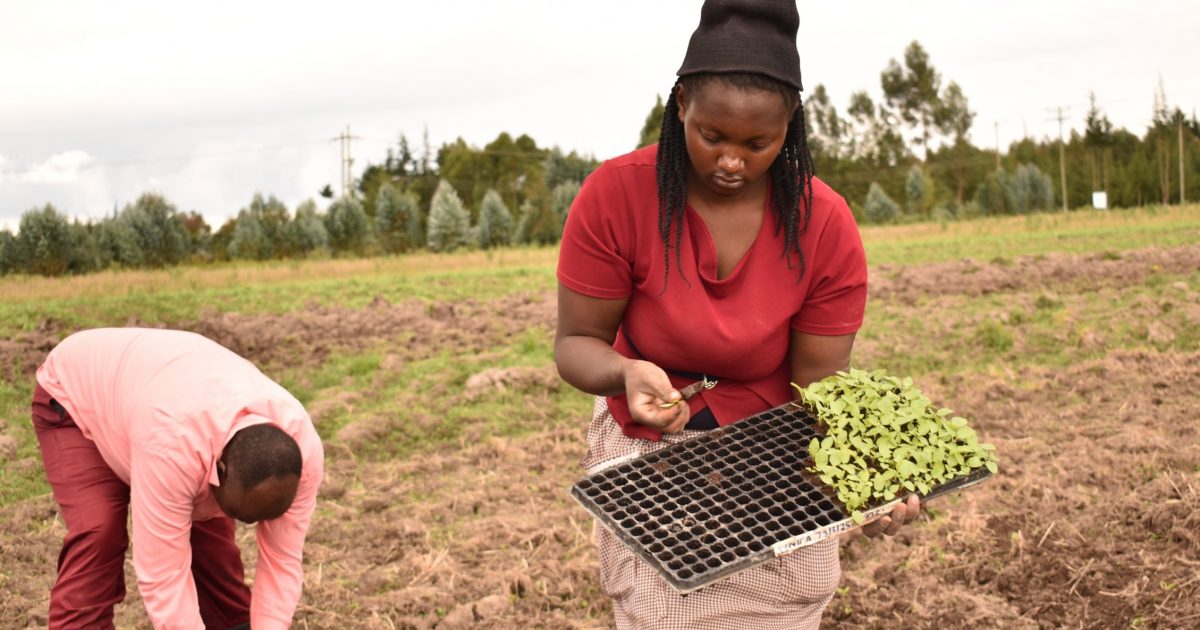
The Association for Strengthening Agricultural Research in Eastern and Central Africa (ASARECA), a sub-intergovernmental organization of the National Agricultural Research and Extension Systems (NARES) of 15 member states, has teamed up to help potato farmers with quality seeds and modern farming techniques.
ASARECA, in collaboration with the National Potato Council of Kenya (NPCK), Kenya Agricultural Livestock Research Organization (KALRO), Egerton University, and FiPs-Africa, is establishing demonstration plots using Rooted Apical Cutting (RAC) technology to multiply the market-demanded potato varieties for members of potato cooperatives or innovation platforms in Nyandarua and Nakuru counties.
KALRO has on-farm demonstration plots that will focus on promoting the use of rooted apical cuttings (RAC) for seed of preferred potato varieties in the country
Elias Kamau, a KALRO scientist based in Muguga, said a farmer-managed on-farm demonstration plot would enhance the knowledge and capacity of farmers on profitable, innovative, and rapid multiplication technologies to produce certified seed potatoes.
“The demo plots will also be used as farmer training centers on good agronomic practices. The practice will enhance the capacity of smallholder farmers to adopt innovations and technologies for potato production,” he added.
Kamau noted that the overall objective of the Innovation Ecosystem for Inclusive Rural Transformation and Livelihoods in Eastern Africa (AIRTEA) project is to achieve sustainable agrarian livelihoods and rural transformation by fostering an inclusive innovation environment.
“The specific objectives are to strengthen the capacities of youth and women in East Africa’s multi-stakeholder innovation platforms and link to solutions within national, regional and global food systems,” said the KALRO scientist.
He acknowledged the need to facilitate technology transfer and uptake through learning routes and multi-stakeholders.
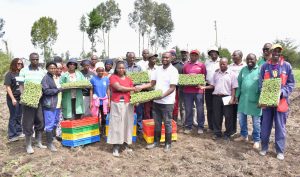
Some of the beneficiaries of the seed programme in Nyandarua spoke of improved income and transformed lifestyles within their social circles.
Farmer groups dubbed “Blessed Unity” within Nyandarua County are literally harvesting the fruits of unity akin to their acronym and smiling all the way to the bank.
Fatigued by the perennial low potato yields occasioned by the overuse of the soil and non-quality seeds, the farmers from Murungaru ward have now embraced modern farming techniques and are reaping big.
Under the watchful eye of seed experts, determined to impart the requisite skills that will not only ensure farmers enhance their income but also improve their livelihood, the farmers’ groups’ communal work is being done in a synchronized motion, with the members having undergone intensive training, including the plating method and the correct spacing.
Nyandarua County, an autograph-devolved unit in potato growing, is slowly ceding ground to other counties largely because of poor seed quality and other myriad shortcomings.
The communal work is not only benefiting individual farmers but also changing the farming landscape in the vast and highly productive agricultural-rich county.
“I had given up on potato farming due to dwindling yield and zero return on investment despite investing in huge tracts of land,” said Rev. Daniel Njuguna Ngugi.
He added that since he teamed up with the Blessed Unity members for communal work before retreating to his own parcel of land to undertake the same farming procedures he learned, he is back and doing better with his farming.
Rebecca Njau, another farmer echoed similar sentiments to Ngugi’s, having been involved in potato farming for close to two decades; “Before we knew about certified seed, farming was no longer a lucrative affair, and many of us were losing hope with failed yields and shrinking markets,” she said.
According to the project implementers, the activities being undertaken will support scaling the production of quality seed and eventual uptake of adoption of the new technology.
By Wangari Ndirangu