Kenya’s scientists have renewed calls for urgent investment in bamboo planting to help close the country’s tree cover gap and restore degraded drylands.
They noted that the fast-growing woody grass, which can be rapidly multiplied through modern tissue culture, offers unmatched ecological and industrial benefits that could accelerate national restoration targets while unlocking new economic opportunities.
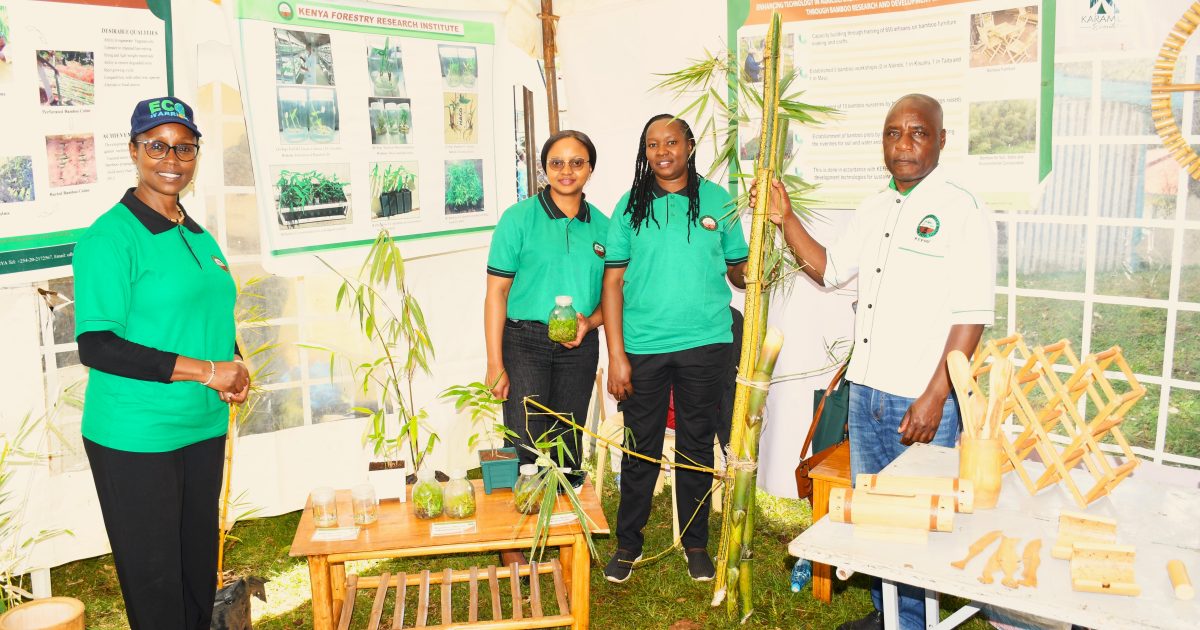
According to the Kenya Forestry Research Institute (KEFRI) Director, Dr. Jane Njuguna, the facility is spearheading efforts to expand bamboo planting through research, propagation and community partnerships.
She said currently Kenya has about 140,000 hectares of bamboo, with 130,000 hectares occurring naturally in forests, while another 10,000 hectares have been established on farms.
Speaking during the World Bamboo Day at the University of Kabianga, Dr Njuguna emphasised that KEFRI has already developed six propagation standards, validated 12 high-performing exotic species, and is working with nine cooperatives across the country to raise quality seedlings and strengthen markets.
The Director added that scaling up bamboo planting will not only make a significant contribution to the country’s 15 Billion Tree Growing Programme but also boost national tree cover beyond the constitutional threshold.
Dr Njuguna explained that bamboo’s rapid growth and ability to regenerate after harvesting make it one of the most efficient renewable resources, capable of supplying raw materials for households and industries, ranging from construction and furniture to energy and packaging, while at the same time locking in more carbon than many tree species.
At the same time, Nellie Odor, Principal Research Scientist at KEFRI, explained that bamboo must become a priority species if Kenya is to meet its long-term restoration targets, saying the country’s indigenous highland bamboo, Oldeania alpina, is largely confined to protected water towers, but its distribution can be broadened, while exotic lowland species introduced from Asia and Africa are already thriving in trials across several counties.
The Principal Scientist noted that since the 1980s, KEFRI had introduced more than 22 exotic bamboo species into Kenya, 12 of which have performed strongly under local conditions, while several others, particularly ornamental varieties, are being grown in pots and used for fencing and landscaping.
“The Institute has tested bamboo in diverse areas, including Kilifi, Muguga, Kaptagat, and Siaya, showing that it can adapt to both highland and lowland zones; therefore, scaling up bamboo in semi-arid and degraded lands could restore vegetation cover, stabilise soils and improve water security,” she said.
Oduor, who is also the Program Director at the National Forest Products Research Programme of KEFRI, underscored that one of bamboo’s strongest advantages is its speed, and unlike indigenous hardwoods that take decades to mature, it establishes quickly, regenerates after harvesting, and produces usable culms within a few years, making it particularly suitable for arid and semi-arid lands, where fast results are needed to combat desertification and erosion.
However, she pointed out that propagation remains a major challenge since many bamboo species’ flowers bloom only once in 45 to 100 years, making seed production rare, while indigenous seeds germinate poorly in nurseries, forcing KEFRI to prioritise vegetative propagation and tissue culture through which it has developed six successful protocols, capable of producing thousands of seedlings without reliance on imported seed.
“Imported seed remains an option but is very costly, ranging between 300 and 500 US dollars per kilogram and yielding only 15,000 to 20,000 seedlings depending on the species, which is why we are working to reduce these expenses by expanding local propagation techniques and linking cooperatives and private nurseries to tissue culture laboratories and with these efforts, we project that KEFRI can produce more than 200,000 bamboo seedlings within six months,” said Oduor.
The scientist added that bamboo’s benefits are not theoretical but already visible, as it helps prevent soil erosion, rehabilitate degraded riverbanks, and protect catchments while also supporting construction, furniture, crafts, energy, fodder, medicine, and even food and beverages, with farmers now packaging bamboo tea andcommunities rediscovering bamboo shoots as a nutritious food.
In the livestock sector, bamboo is proving valuable as fodder since its young shoots and trimmed leaves are rich in protein, making them suitable supplements for dairy animals and creating a new pathway to integrate bamboo into mixed farming systems while adding resilience to rural livelihoods.
“KEFRI is also supporting the development of bamboo cooperatives to strengthen local economies, with nine now operational across the country, some specialising in nurseries and others in crafts and handicrafts.
We are providing training, technical support, and sometimes equipment to improve product quality, with some groups already supplying tea baskets and woven products to the Kenya Tea Development Agency,” explained Oduor.
She stressed that despite the national tree planting drives, data collection on bamboo remains weak since many seedlings are planted during official campaigns without records specifying how many are bamboo, making improved monitoring essential if the government is to track progress towards the target of 225 million bamboo seedlings under the 15 billion Tree Growing Programme.
The Principal Scientist also highlighted cost as a major challenge, noting that beyond seeds, vegetative propagation requires labour and inputs such as polybags, while tissue culture, though highly effective, demands expensive laboratory infrastructure, and KEFRI is, therefore, working to decentralise production by linking farmers and private investors to propagation centres in order to lower the cost of seedlings.
Looking ahead, Oduor said bamboo’s full potential will only be realised if policy, education and markets evolve together, urging universities and technical colleges to integrate bamboo into forestry and industrial training.
She noted that a dedicated bamboo curriculum is already being developed, while also calling for stronger policies on sustainable harvesting and product standards.
Odour also emphasised that market development, especially for bamboo-based food, beverages and construction materials, will be critical to sustaining farmer interests.
By Kibe Mburu