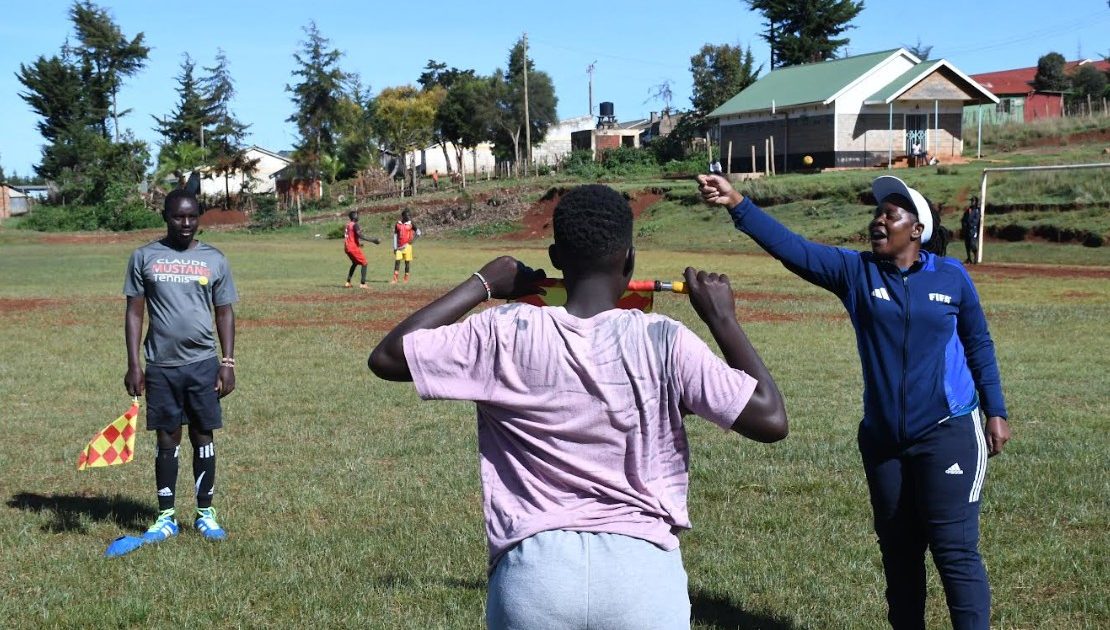
The Football Kenya Federation (FKF) Elgeyo Marakwet branch has launched a referee training programme aimed at addressing a critical shortage of match officials in the county which has increasingly affected the smooth running of local football competitions.
The five-day training, which commenced on April 7 and is set to conclude on April 11, has brought together 25 participants (20 men and 5 women) in a bid to expand the pool of qualified referees.
Speaking during the training, FKF Elgeyo Marakwet Vice Chairman Otieno Dominic noted that the county has made significant progress in increasing the number of referees but the figures still remain insufficient to meet demand.
He noted that the training is aimed at increasing the number of qualified referees, as the county is still behind in terms of qualified referees. “Since taking up office, we have tried to improve the numbers, as we only had six referees then. Currently, we have 140 before adding those who are in training. If we include the current trainees, we will have 165,” he said.
Despite this growth, Otieno emphasised that the county still faces a major shortfall, particularly given the high number of football teams.
“As Elgeyo Marakwet, we have around 540 football teams, which forces us to source referees from Uasin Gishu, Trans Nzoia, and Baringo counties. This leads to revenue leaving the county, yet we want it to remain within,” he explained.
He revealed that the FKF Elgeyo Marakwet branch is targeting at least 300 referees to adequately serve the region and reduce reliance on external officials. “We are working towards reaching 300 referees,” he added.
However, Otieno cited financial constraints as a key barrier to achieving this goal: “Training referees is expensive. Some people may have the passion but lack the financial capacity. Therefore, we will engage the Governor and the County Executive Committee Member for Sports to explore funding opportunities,” he said.
The official also highlighted the need to improve the quality and progression of referees within the county, pointing out that only a handful have reached higher competitive levels.
“Out of the current 140 referees, only two are at the National Super League level. Division One has only two referees, while Division Two has 20. The rest are below these levels,” he noted.
He expressed optimism that with sustained investment, the county can produce referees capable of officiating at the highest levels of football.
“By the time we leave office, we want to create a legacy where we have at least 10 referees in the Kenya Premier League. Our ultimate goal is to see our referees officiating at the Kenya Premier League level, as well as at CAF and FIFA competitions,” Otieno stated.
He underscored that success in refereeing requires more than technical knowledge.
“To go forward as a referee, one must be passionate. The role comes with many challenges, and it requires resilience, dedication, and a real love for the game,” he added.
FIFA referee instructor Evelyn Awuor, who is overseeing the training, said the programme is being conducted under global and regional football frameworks to ensure quality and standardisation.
“We are conducting this programme under FIFA, CAF, and FKF frameworks, where we recruit and train referees from the grassroots level,” she said.
Awuor explained that the training includes both theoretical and practical components designed to equip participants with essential officiating skills.
“We assess both physical fitness and mental ability, offering guidance where necessary. The training covers the laws of the game, which is the theoretical aspect, and also includes practical field sessions,” she noted.
She added that the initiative is critical in addressing the shortage of referees in regions such as Elgeyo Marakwet while promoting the growth of football at the grassroots level.
Meanwhile, participants have welcomed the initiative, with many expressing optimism about the opportunities within refereeing.
Phoebe, a trainee from the FKF Iten branch, challenged more women to take up refereeing, citing the low number of female officials in the sport.
“There are very few female referees. I would like to advance in this field, and the course does not take long. It is a short course, and if you join, it can help you earn a living,” she advised.
By Rennish Okong’o