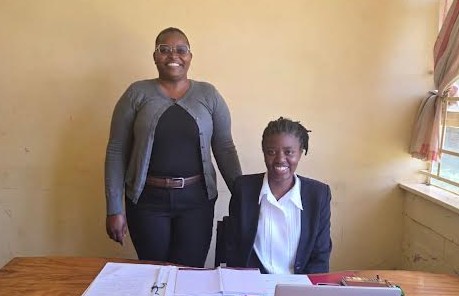
Vulnerable residents in Vihiga County have a renewed sense of hope following the establishment of free legal aid services offered by State Counsels from the Attorney General’s Department under the National Legal Aid Service.
The officers, Majanga Wilgridah and Lourain Angira, are currently stationed in the county, where they provide legal support to indigent individuals, including those earning less than Sh30,000 per household.
In an interview with KNA at their office located within the Vihiga County Commissioner’s compound, Majanga explained that the department focuses on assisting vulnerable groups such as women, children, persons living with disabilities (PWDs), and other indigent members of society.
She noted that their services mainly cover succession matters, land disputes, and children-related cases.
Majanga emphasised that their approach prioritises mediation over litigation, aiming to resolve disputes amicably without resorting to court processes.
“We prefer solving cases through mediation by involving local administrators such as chiefs. Court action is only taken when parties fail to reach an agreement,” she said.
On land-related matters, she stated that the office deals with issues surrounding land transactions, including buying and selling, disputes among landowners, and guiding families through the succession process.
She highlighted that many land disputes arise from informal agreements and lack of proper documentation, which often complicates resolution efforts.
Addressing children’s cases, Majanga said the law provides for custodial maintenance, especially in situations where one parent neglects their responsibilities.
In such cases, the office issues mediation summons to bring the parties together, sometimes involving chiefs to help resolve disputes outside court. This approach, she added, ensures that the welfare of the child remains the central focus.
However, she clarified that the National Legal Aid Service does not handle criminal cases, as these fall under the mandate of the Office of the Director of Public Prosecutions (ODPP). Their role in such matters is limited, and advocates may only step in to support cases where witnesses or victims face intimidation.
Majanga further pointed out that challenges arise when minors are in conflict with the law. In such situations, the office seeks leniency for the children, especially where they show remorse, while also ensuring their rights are protected throughout the legal process.
Angira noted that when individuals seeking assistance do not fall within the vulnerable categories, the office assesses their cases and provides guidance. In some instances, clients are referred to private advocates or advised on how to represent themselves if they have the means to pursue their cases independently.
She added that certain matters are outside their scope, including tax disputes, serious criminal cases such as rape, cases that conflict with public interest, and bankruptcy issues.
On succession matters, Majanga advised landowners to adopt standard agreements that include clear and binding terms, default clauses on payments, and a defined completion period, typically 90 days.
She stressed the importance of involving advocates and witnesses in land transactions and encouraged the use of bank payments to ensure proper documentation and accountability.
“Many succession disputes in Vihiga arise because due process is not followed. Families often subdivide land informally after the death of the original owner without involving legal experts or land officials,” she observed.
The officers cited several challenges affecting their work, including limited resources due to the office being relatively new, language barriers among clients who struggle to communicate in national languages, and low public awareness of legal rights and procedures.
They concluded by noting that the Office of the Attorney General comprises various departments, including litigation, marriage registration, legislative drafting, international law, government transactions, and the National Legal Aid Service, all working to enhance access to justice.
By Florence Oteng’o and Yvonne Misango