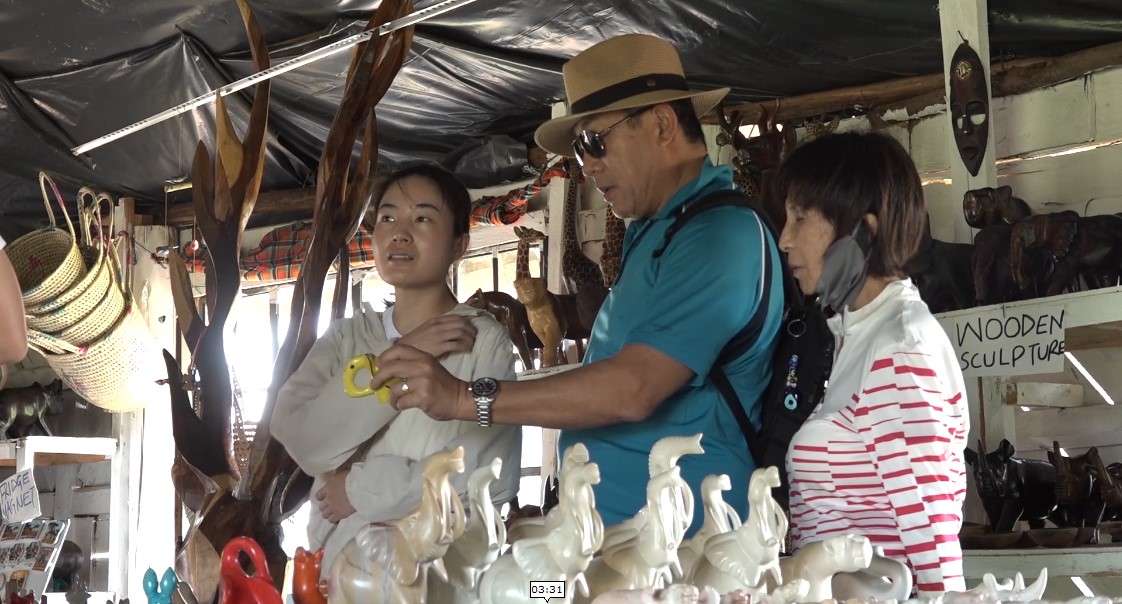
Tourists visiting Masai Mara and Serengeti national parks in Kenya and Tanzania respectively, have found relief after a soapstone dealer opened free lavatory services in a remote village, where they can briefly stop along their 115.7 km journey and refresh themselves.
At a little-known Loliondo village in Lolgorian ward in Narok County, the soapstone trader Daniel Apepo decided to provide the services for tourists en route to the Lolgorian-Kehancha-Isebania border so that he could also benefit from soapstone artefact sales.
According to Apepo, the main aim of opening up the premises four months ago was to promote his business venture dubbed Kisii Soapstone Art and Craft (KISAC) by having the tourists buy the commodities during their stopover.
Apepo explained that he makes sure the tourists see the artefacts on their way to the lavatories by displaying them strategically along the footpaths.
He said the idea was born after he realised Masai Mara and Serengeti attracted many local and international tourists during the world’s great wild beasts migration, accompanied by zebras and antelopes.
According to Apepo, he identified the spot as a conducive site for the services after predicting that the tourists will have travelled many kilometres from both sides through this most convenient route, thus requiring a stopover.
Apepo noted that the business was already picking up even before the August to December peak season was over, when the migration occurs.
“August to December is the peak period for tourists coming to see the great migration of wildebeests,” he said.
However, Apepo appealed to the government to tarmac the road all the way to Kehancha to ease movement of the tourists and to supply last-mile electrification to enable him and other potential traders to serve their customers better.
Another bottleneck, he stated, was the Masurura bridge, which tourists use to cross the nearby Mogori river, 2 km away from the premises.
“Floods normally render the bridge impassable during rainy seasons, forcing tourists to use an alternative route, which is over 30 km longer,” said Apepo.
With at least 30-40 Landcruisers making a stopover at the site every day, Apepo noted that he was doing good business from the tourists, most of whom were from China, parts of Asia, Europe and America.
He said that he also takes advantage of their stopover to exchange contacts with potential buyers, who place orders for the international market.
Apepo expressed optimism that KISAC would soon put up a production factory at the location, where he will incorporate the local Maasai culture through beadwork and traditional dances.
He said the site sitting on one acre of land had potential to grow because each tourist was able to spend at least 40 dollars a day, besides camping services which he offers.
This, he said, enables him to employ 12 people most of them being from the local community.
He also cited lack of water as a major challenge forcing him to buy more than 10,000 litres every week from vendors.
A tourist couple, Bradley and Sarah Hartsell from Tennessee America said they enjoyed the beautiful Maasai Mara wild animals and hoped to find similar scenario in the Serengeti.
They applauded the rich culture of the locals and Mara landscape.
A tour guide of 15 years, Dominic Wangu, decried the poor state of the road network and appealed to the government to improve it.
He said that he travelled 1000 km every week, which can pose a health challenge if the road network is poor.
Tourist Narasimha Reddy Mudupu from Colorado urged the government to improve the roads network to improve such businesses and ease communication.
Mudupu who was visiting the Mara, Mt Kilimanjaro and Serengeti with a group of friends, said they were impressed by the Big Five, making him plan to come back with his wife in future.
Kiran Ganutula from USA who was accompanied by ten friends expressed enthusiasm about having visited Lake Nakuru, adding that he was headed to other places including Arusha
Recently, President Dr William Ruto said Masai Mara, which welcomes more than 400,000 visitors annually, is the crown jewel of Kenya tourism.
During the migration of wild beasts, there is always a breathtaking phenomenon in which , millions of animals accompanied by zebras and gazelles cross to and from the two national parks in search of greener pastures contributing to a balanced ecosystem.
Masai Mara National Reserve spans an area of about 1,510 square kilometres, equivalent to 580 square miles, in southwest Kenya.
For Kenya, it is a key driver of tourism revenue and conservation efforts, anchoring the place as one of the most visited reserves in Africa.
By Jane Naitore and Clinton Nyamumbo