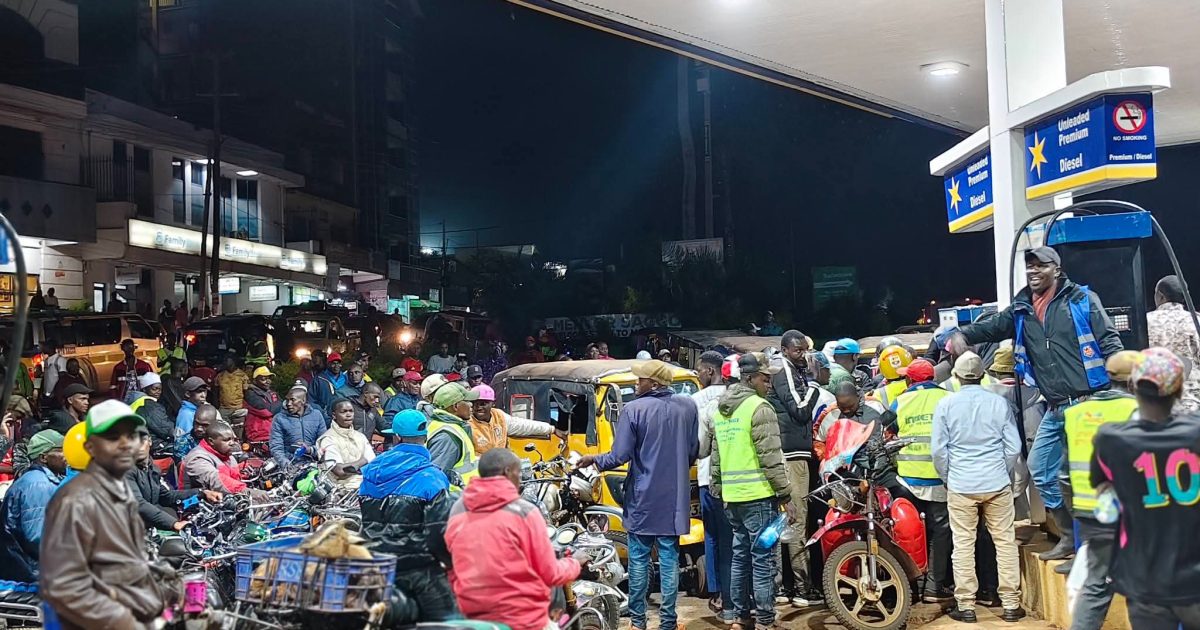
Motorists and commuters in Murang’a County are grappling with a worsening fuel situation, as panic buying sets in amid claims by filling stations that they have run out of stock.
This comes even as the government maintains that the country has sufficient fuel reserves to last several days, assuring the public that there is no cause for alarm.
In Murang’a and Kenol towns, long queues have been witnessed at one of the few petrol stations still dispensing fuel, with motorists and boda boda riders waiting for hours in a bid to secure the now rare commodity.
Motorists have questioned the apparent shortage, saying earlier assurances indicated that the country had adequate fuel supplies. “We were told there is enough fuel to last us three months. What has changed suddenly?” posed John Mwangi, adding: “Yesterday, I went to fuel in the neighbouring county, which is also a loss but today the same place has run out of fuel so I have to queue here for hours.”
Others accused fuel stations of hoarding the product in anticipation of a price increase.
“It feels like some stations are holding back fuel so they can sell at higher prices later because there is a looming hike with the upcoming prices review. That is why we are seeing shortages now,” observed Mugo Kimani a boda boda rider.
The situation has also disrupted public transport, with travelers reporting delays and reduced availability of vehicles.
Along the Sagana–Murang’a route, several tuk-tuk operators have scaled down operations, opting to cover shorter distances to conserve fuel.
A tuk-tuk driver, Sammy Mwangi, said the uncertainty has forced them to adjust their operations. “We cannot risk moving long distances without knowing whether we will get fuel. We are now operating within limited areas to avoid being stranded,” he said.
“While I was ferrying passengers from Murang’a to Sagana and back, right now I can only take them up to Kabuta and back to avoid running out of fuel yet petrol stations have none,” he added.
Passengers have not been spared either, with some resorting to alternative means of transport. One commuter narrated how she was forced to wait for hours before finding a way to her destination. “I was heading to the market in Makutano and waited for a vehicle for two hours. Eventually, I got a lift in a lorry transporting maize to Nairobi,” she said.
Many travelers now fear that transport fares could soon rise if the situation persists.
“We are already struggling to get vehicles, and if this continues, fares will definitely go up,” noted Mary Njeri, another passenger.
Motorists and commuters are now calling for swift intervention to avoid further disruption to transport and economic activities , as the situation will eventually affect livelihoods.
The fuel challenges are being linked to the ongoing conflict in the Middle East, which has disrupted global supply chains and thus reduced availability.
By Florence Kinyua