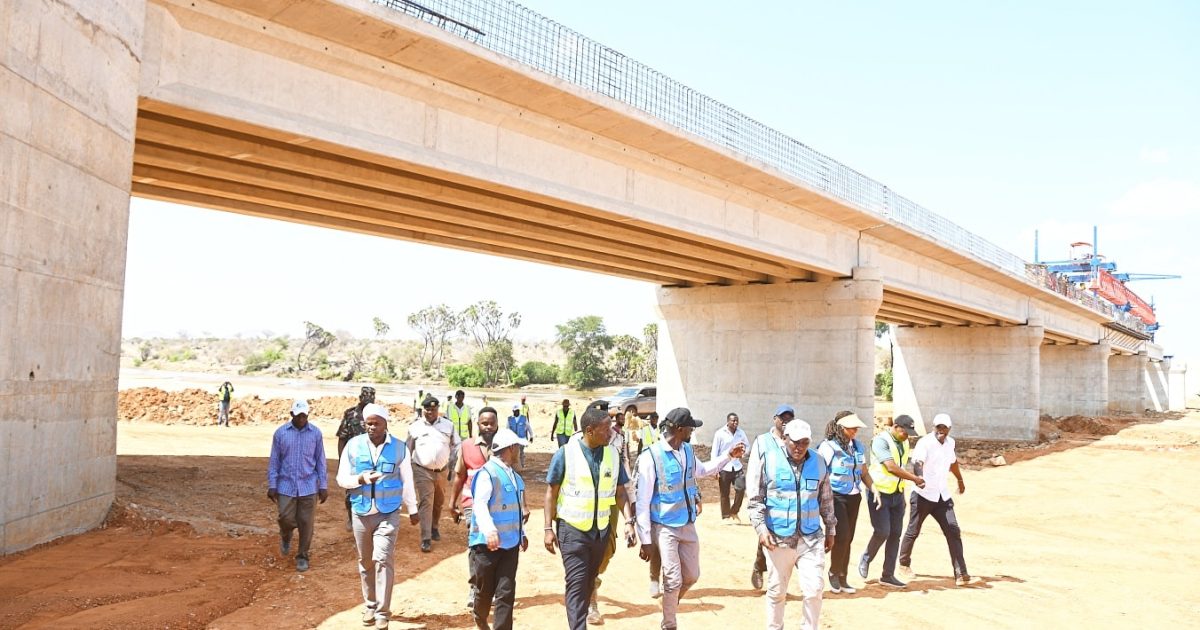
The Sh1.493 billion Galana Kulalu Bridge is now 90 percent complete, marking a major milestone in the implementation of the Galana Kulalu Food Security Project that straddles Kilifi and Tana River counties.
Water, Sanitation and Irrigation Cabinet Secretary Eng. Eric Mugaa inspected the project during a tour of the expansive irrigation scheme. He was accompanied by Principal Secretary for Irrigation Ephantus Kimotho, National Irrigation Authority (NIA) Board Chairman Eng. Gilbert Maluki, and NIA Chief Executive Officer Eng. Charles Muasya.
During the visit, the CS inspected the proposed site for the Athi (Galana) Dam, reviewed ongoing intake protection works and toured the nearly complete Galana Bridge, a critical infrastructure link facilitating movement of farm inputs, machinery and harvested produce within the irrigation scheme.
The Galana Kulalu Food Security Project is a flagship government initiative aimed at transforming agriculture in the coastal region into a large-scale commercial hub to enhance national food security. The project focuses on irrigated production of maize and other staple crops.
Currently, 10,000 acres have already been developed under the project, with expansion underway toward a target of 20,000 acres under Selu Limited. About 3,300 acres are being prepared for crop production this season. Out of the 2,000 acres previously planted, 1,500 acres have already been harvested, demonstrating steady progress in agricultural output.
Eng. Mugaa reaffirmed the government’s commitment to scaling up the project, noting that its success is anchored on strong public-private partnerships. He said such collaborations will reduce the country’s food import bill, conserve foreign exchange and create employment opportunities for young people.
“The Galana Kulalu project demonstrates how effective public-private partnerships can transform irrigated agriculture and strengthen national food and nutrition security,” he said.
The CS highlighted the recently signed NIA contract for the construction of the Athi (Galana) Dam, describing it as a game changer that will unlock irrigation potential for up to 300,000 acres of land. Following the signing of the dam construction agreement, the government aims to place at least 200,000 acres under full agricultural production.
The planned Galana Dam, which will include a 60-kilometre canal network, is expected to address water distribution challenges within the scheme. Feasibility studies are currently underway to assess soil profiles across the remaining 180,000 acres of the Galana Kulalu area to guide expansion plans.
Eng. Mugaa noted that soil assessments conducted in key areas indicate that the soils are suitable for food production with minimal improvement measures. Soil enhancement interventions, including replenishment and use of certified seeds, are ongoing to boost productivity and ensure consistent yields.
He added that private investors continue to expand cultivation under the scheme, with acreage projected to increase from the current 2,000 acres to more than 5,400 acres by May 2026.
The CS emphasised that the government is shifting from overreliance on rain-fed agriculture by investing heavily in irrigation infrastructure to build climate-resilient food systems. He said President Dr William Ruto has shown keen interest in the project and directed the ministry to address bottlenecks slowing progress.
“The government is committed to combating drought through large-scale irrigation investments. Expanding irrigation will not only increase food production but also stabilise foreign reserves by reducing imports,” he said.
Principal Secretary Kimotho commended the NIA for initiating implementation of the dam contract, describing it as a significant milestone in Kenya’s irrigation development journey.
He stressed the importance of irrigation in supplementing rain-fed farming to ensure stable and predictable harvests despite erratic weather patterns.
“Increased food production through irrigation will strengthen our food security and support economic growth,” said Kimotho.
The Galana Bridge and its approach roads are expected to further accelerate agricultural activities by improving connectivity between Kilifi and Tana River counties. Once completed, the bridge will enhance transport efficiency, reduce logistical challenges and support the overall expansion of the Galana Kulalu irrigation scheme.
The project is also anticipated to generate employment opportunities across various agricultural enterprises and value chains, further contributing to socio-economic development in the coastal region.
By Hussein Abdullahi