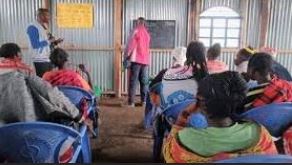
A total of 178 adult learners registered to sit for the Kenya Certificate of Secondary Education (KCSE) this year in Kajiado North Sub-County.
Speaking to KNA, the Adult Education Officer (AEO) Monicah Naisenya said the sub-county has eight recognized centres, both government-owned and privately owned.
“We are encouraging those individuals who missed out on formal schooling to join any of these centres and at least learn the basic education, and for those who dropped out to continue from where they stopped.
Naisenya noted that the average enrollment of adult learners in Kajiado North Sub-County across all eight centres is around 750 to 780, a number that has decreased from almost 2,000, forcing two centres to close down.
“Currently, we have more women than men adult learners, and this is arising from the fact that most men are the ones who are mostly given the priority to study, hence leaving a lot of women illiterate,” she noted.
She explained that education is a vital component to navigating life, hence emphasizing that they not only teach adult learners according to the curriculum of education but also life skills through inviting experts of different capacities to share their skills with adult learners to help them grow even economically.
“The greatest challenges we are facing as the adult education sector are lack of facilities, which include stationery, laboratories for practical classes, enough instructors to facilitate the learning, and enough classes,” she said.
“Lack of instructors has forced us to end up having all learners study in the same classroom, despite them being at different levels,” the AEO added.
Naisenya further said they also follow up their learners even after they sit their KCSE exams and refer them to the government, where they could get bursaries to continue with their education in colleges or universities.
“The adult learners know and understand what they want, hence easily grasp content within a very short period, and the sector tries their level best to protect their self-esteem to avoid the stigma that comes due to the shame of returning back to class.
She added that they ensured they minimised their learners’ trauma through teaching them the same curriculum but with a different style and changing names a bit, such as referring to their institutions as centres instead of schools and using the term instructors instead of teachers.
“I would like to discourage the society from using the term `Ngumbaru` to refer to adult learners and invite every adult who needs education to come fearlessly to improve their life because it is free of charge,” she concluded.
Kajiado North has a fair distribution of adult education centres in Ongata Rongai, two in Kiserian, two in Embulbul, two in Ngong town, and one in Kibiko.
The government’s Kenya Vision 2030 aims to increase adult literacy to 80 percent. Programmes offered through the Directorate of Adult and Continuing Education cover areas like literacy, numeracy, digital skills, and vocational training and are delivered through centres and, more recently, e-learning.
By Anne Wambui