

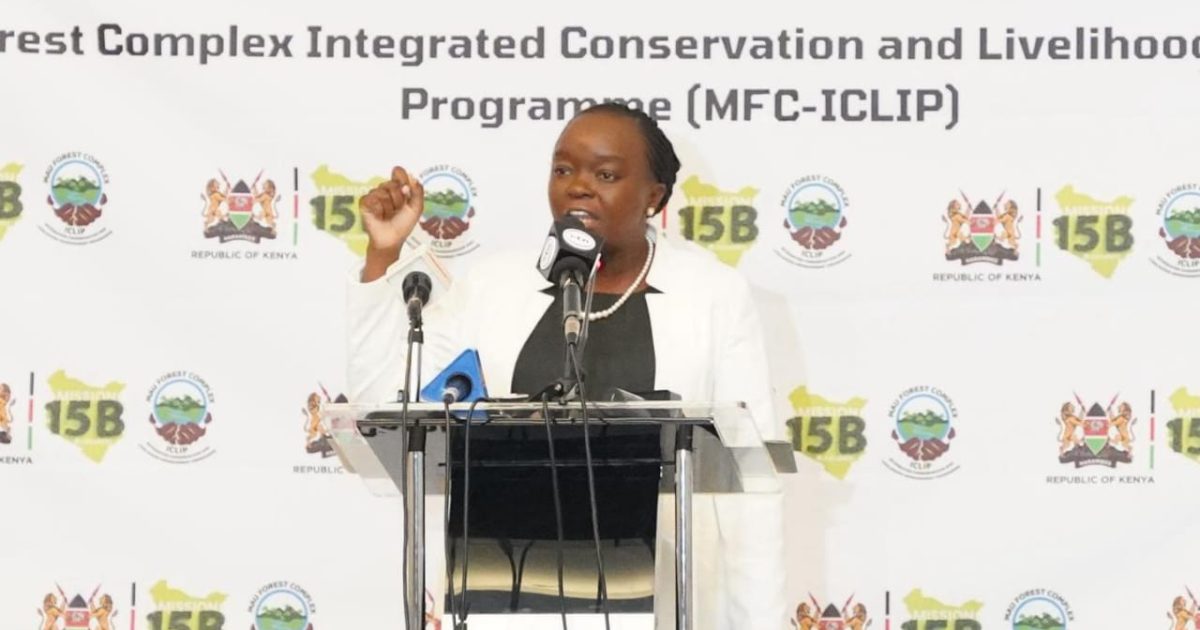
The government has rolled out a ten-year programme to restore 33,000 hectares of the degraded Mau Forest Complex.
Cabinet Secretary for Environment, Climate Change and Forestry, Dr Deborah Barasa speaking in Nairobi on Wednesday during a meeting with conservation stakeholders said that the tree planting drive is far more than an environmental effort.
Dr Barasa said the plan safeguards water towers, protects biodiversity, creates thousands of green jobs and anchors President William Ruto’s 15-billion-tree campaign.
“Every tree planted is a promise, a promise of hope, food security, clean water and a resilient economy,” Dr Deborah Barasa said. “Restoring the Mau is not just an environmental duty, it is an economic necessity critical to protecting our GDP, securing food systems and guaranteeing national energy stability.”
Dr Barasa stressed that the tree-growing campaign is a national agenda requiring collective effort. “This is about jobs, water, energy, food, peace and equity,” she said. “Together, let us rise, heal our land and secure a legacy of shared prosperity for Kenya and the region.”
The Mau, Kenya’s largest water tower, is the source of 12 major rivers including Mara River that features the great wildebeest migration. Besides, Mau supplies water to Lake Victoria and Lake Natron in Tanzania, which is the breeding site for flamingoes and besides Mau supports hydropower stations across the country. It faces threats ranging from illegal logging, forest fires, encroachment and climate change which put biodiversity, energy supply and livelihoods at risk.
Principal Secretary for Environment and Climate Change, Eng. Festus Kipkorir Ngeno, who is the patron of the programme, recalled growing up near the forest and witnessing its degradation.
“The Mau Complex is a global treasure, supporting the great wildebeest migration and acting as a vital carbon sink. But it is under grave threat. We must act now,” Dr Ngeno said.
The restoration programme, guided by satellite mapping, targets fencing 500 km of forest boundaries, creating 200 km of buffer zones, rehabilitating wetlands, introducing sustainable land use management for over 138,000 families and scaling up 50 nature positive value chains such as honey production, dairy and avocado farming.
It will also create 300,000 green jobs, train 100,000 farmers, provide alternative energy sources like solar and biogas and promote environmental education through school camps and annual conferences.
According to Dr Ngeno, work has already begun through mobilising communities to plant trees for regeneration of the forest.
“In the past four weeks we have grown over 150,000 seedlings in the Mau,” he said, adding that Safaricom and the World Resources Institute have adopted blocks of degraded land for rehabilitation.
To sustain gains, the government establishes structures such as the Mau Water Fund which brings together government, communities, private investors and development partners.
Principal Secretary for Livestock Development Jonathan Mueke, whose State Department supports livelihood alternatives, said the initiative must give forest-dependent communities new economic options.
“Our strategy focuses on dairy development, fodder production and apiculture,” Mueke said.
“We are installing milk coolers to commercialise dairy, promoting fodder crops to reduce forest grazing and introducing thousands of beehives for honey production. We are also rolling out a new farm-to-fork traceability system to boost food safety and access to premium markets.”
Mueke said these interventions provide strong incentives for conservation.
“By strengthening these value chains, we improve livelihoods and keep both people and livestock out of the forest,” he said.
The programme uses a block-by-block approach, with each 10-hectare block requiring about Sh2 million for clearing, planting, fencing and maintenance.
Year One targets include restoring 3,313 hectares, planting 4 million seedlings by October 2025, fencing 50 km of forest boundary, rehabilitating 14 water dams and creating 10,000 green jobs. Farmers also receive 50,000 avocado seedlings, 2,000 potato seed packs and fodder inputs.
The Mau conservation and livelihood improvement programme culminates annually in a marathon to raise awareness and funds, symbolising the journey from degradation to restoration.
“This is the moment Kenya turns the tide, from vulnerability to resilience,” Eng. Ngeno said. “When future generations look back, let them see this as the watershed moment when we acted.”
By Lucy Mwende and Naif Rashid
