The State Department for Technical and Vocational Education and Training (TVET) has announced a nationwide plan to solarize all 246 public training institutions by June 2026, through a partnership with Kenya Commercial Bank (KCB).
The move is part of wider reforms aimed at lowering operational costs, stabilizing power for workshops and digital labs, and enhancing institutional resilience by promoting low-carbon, climate-resilient training environments.
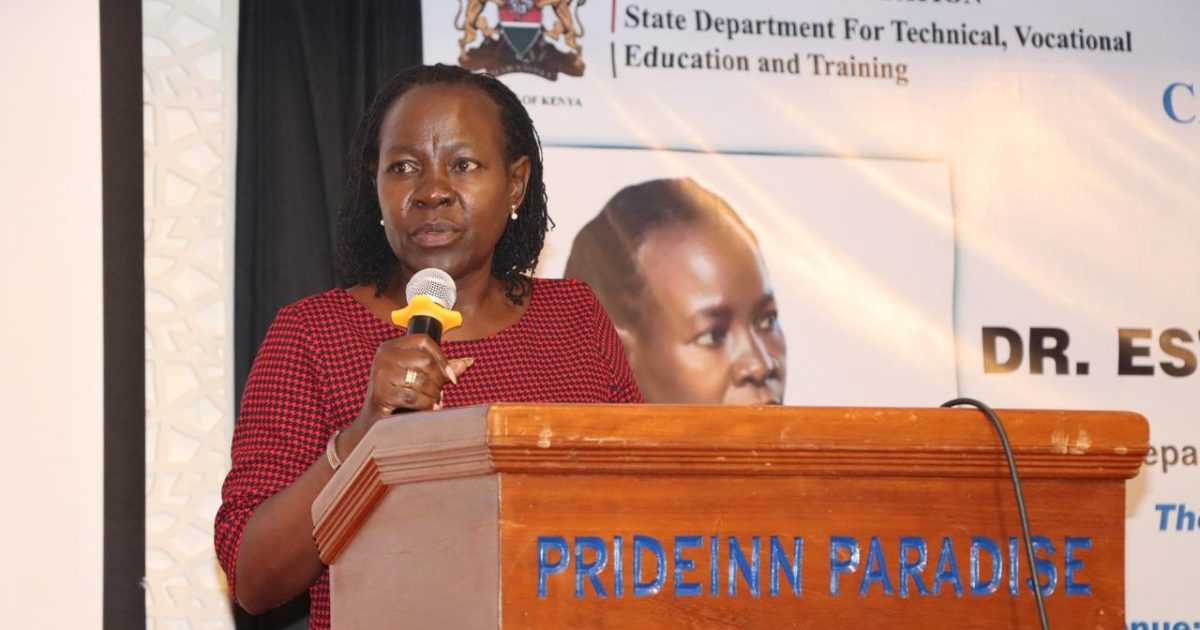
Speaking to the press after officially opening the Kenya Association of Technical Training Institutions (KATTI) capacity building workshop and Annual General Meeting held at Pride Inn Paradise Resort in Mombasa, Principal Secretary (PS), Dr. Esther Thaara Muoria, said the solarization project would be a major turning point for the sector.
“By June of 2026, all TVET institutions will be solarized. This will be one of the major game changers in our institutions this coming year,” said Dr. Muoria.
The initiative, formalized through a Memorandum of Understanding signed, Thursday, December 11, 2025, with implementation beginning on December 15, 2025, will see half of each institution’s current electricity costs directed to KCB loan repayment, while the other half will be saved until the solarization costs are fully recovered.
The PS noted that the solarization project will enable institutions to fully utilize training equipment that has remained idle due to power constraints.
She cited Kakrao Technical and Vocational College, which has a large milling machine that cannot operate due to insufficient power supply. The institution has been prioritized for immediate solarization under the KCB partnership.
“That mill is not only going to be a training apparatus, but it is also going to help the community around in milling whatever it is that they need to be milled,” Dr Muoria explained, highlighting the dual benefit of training and community service.
The partnership with KCB extends beyond solarization to include student financing, with the Bank offering up to five years for students to complete their studies, secure employment, and repay their loans.
“We want to boost government funding in our institutions through public-private partnerships, such as this one with KCB, to ensure that access to our institutions is guaranteed,” said the PS.
She emphasized that the government is exploring innovative funding mechanisms to ensure no student is excluded from TVET education on financial grounds.
The meeting also focused on reviewing key reforms implemented since the current administration took office three years ago, including curriculum transformation, Competency-Based Education and Training (CBET) implementation, modularization, and enhanced industry linkages.
Dr. Muoria announced plans to invite industries to invest directly in TVET institutions, creating in-house training facilities that benefit both students and investors.
She cited Nyandarua National Polytechnic, located in a potato production area, as an example of where the government seeks partnerships with potato processors to utilize institutional equipment, farms, and human resources while generating income for both parties.
“The students are training in agriculture within the institution, yet, at the end of the day, our dream is that we will be able to produce the potatoes with the investor and be able to sell them,” she said.
The PS linked the TVET transformation agenda to President William Ruto’s vision of elevating the country’s development status within the next 10 years, emphasizing that skilled youth are essential to achieving this goal.
“We in TVET are the trainers. We are the producers of that skilled capacity and therefore, we must be at the forefront of training our young people well enough to drive this country to the next level of development,” Dr. Muoria stated.
By Sitati Reagan