The government has urged Kenyans seeking overseas employment to verify job offers through the Ministry of Foreign and Diaspora Affairs or Kenyan embassies before travelling.
The state has further advised citizens to be wary, as human trafficking rings have changed tact and shifted to new trafficking hubs, which they are now using as a trapdoor to entice vulnerable youth into forced labour.
Director and Head of the Welfare and Rights Division, State Department for Diaspora Affairs, Emma Gicheha pointed out human trafficking-fueled scam centers have significantly expanded their operations worldwide, luring unsuspecting job seekers into online scams including fraud, identity theft, romance scams and cryptocurrency fraud.
For decades, the traditional human trafficking hubs have been domiciled in Middle East countries, where millions including Kenyans seeking greener pastures have been exploited in the countries where they go through dubious employment agencies.
While citing 158 Kenyans who were recently rescued from a South-Eastern Asian country, Gicheha explained that victims are often lured with fake job offers and then held captive in scam compounds, where they are forced to run online scams, mostly targeting people abroad to steal money.
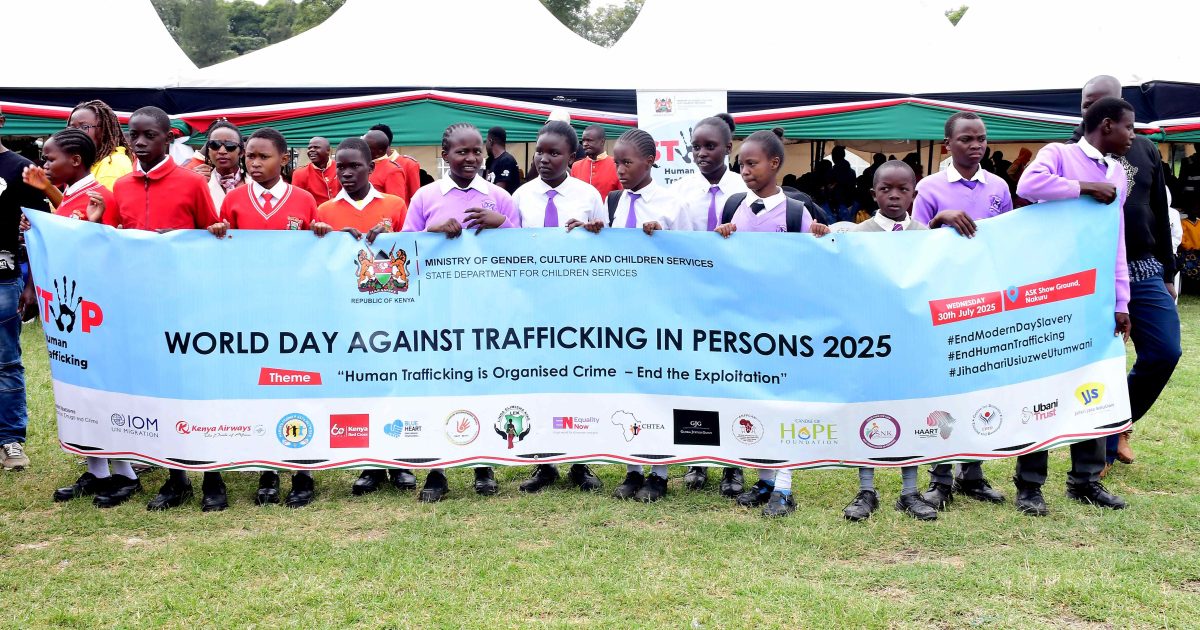
Gicheha made the remarks at the Nakuru Agricultural Society of Kenya show grounds where she represented the Principal Secretary (PS) for Diaspora Affairs Roseline Njogu during celebrations to mark this year’s ‘World Day Against Trafficking in Persons.’
The celebrations marked under the theme ‘Human Trafficking is Organized Crime, End Exploitation,’ sought to highlight that trafficking resulted in forced criminality, with calls for the protection of victims against the vice.
She pointed out that the government was actively auditing recruitment agencies and will not hesitate to strip licenses of those found guilty of human trafficking.
Gicheha affirmed that the State will not relent in prosecuting individuals and entities who would be found responsible for the recruitment, transportation, and exploitation of Kenyans, including state and nonstate actors.
She added that the government was acting proactively to ensure that Kenyans are well aware of transnational human trafficking.
The director said stringent enforcement of labour migration regulations was ensuring that rogue agents are tamed.
She said, “Human trafficking is a challenge that requires an all-of-society and multi-agency approach to curb. As a ministry, we have strengthened the fight against this vice”.
This will ensure individuals luring our youth with promises of a better future abroad are held accountable.
Gicheha revealed that one of the loopholes traffickers have used to beat the regulations is corrupt and fraudulent issuance of tourist or visitor visas to their victims before departure from Nairobi, adding that this made it easier for the victims’ travel documents to be confiscated on their arrival in foreign destinations.
“Once they have verified the authenticity of recruitment agencies, we are advising Kenyans to apply for work permits before departing to foreign destinations to curb the vice. They should only fly out of Kenya after signing work contracts preferably with assistance of legal experts,” she indicated.
The director added that beyond various forms of exploitation, human trafficking also takes the form of forced organ removal.
According to the International Organization for Migration (IOM), across the globe, trafficked persons, often migrants, youth, and children, are coerced into crimes like online scams, drug trafficking, and theft and instead of being recognized as victims, they are criminalized and denied support.
The report adds that Kenyans voluntarily migrate to Europe, the United States, Southeast Asia, and the Middle East—particularly Saudi Arabia, Lebanon, Kuwait, Qatar, the UAE, and Oman—in search of employment, where at times they are exploited in domestic servitude, massage parlors and brothels, or forced into manual labour.
To dismantle these networks, Gicheha said the government response was focusing on victim identification and survivor-centered justice.
She said they were ensuring strong referral systems, reintegration support, and upholding the non-punishment principle.
“By listening to victims, strengthening protections and holding traffickers accountable, we can end exploitation for good,” she observed.
For the crime to end, Gicheha said law enforcers in all countries must enforce strict laws, conduct proactive investigations, strengthen cross-border cooperation, target criminal finances, and leverage technology to identify and dismantle trafficking networks.
“Ensuring justice for survivors requires holding perpetrators accountable and providing a victim-centered approach to protection, support and access to justice,” she noted.
An international NGO report released in 2020 revealed there were between 35,000 and 40,000 sex trafficking victims in Kenya, nearly half of whom were children.
Similarly, a 2024 Trafficking in Persons Report stated that most perpetrators are Kenyan nationals, and in some cases, include government officials.
Countries in the Middle East account for 52.4 percent of persons trafficked from Kenya, while those in Africa account for 42.1 percent, a report by the National Crime Research Centre notes.
Principal Secretary of State Department of Children Welfare Services Carren Agengo noted that victims of human trafficking are not always transported across borders as often, the exploitation happens within the country, sometimes within communities, under the guise of employment or assistance.
Agengo cited poverty, unemployment, and desperation as some of the factors contributing to the vice.
The Principal Secretary observed that reports from both government and non-state actors indicate that children are trafficked from rural to urban areas for domestic work, agricultural labour, street vending, smuggling at border areas, human sacrifices, servitude and prostitution.
In a speech read on her behalf by the Secretary, Directorate of Children Services, State Department for Social Protection & Senior Citizen Affairs Shem Nyakutu, Agengo observed that human trafficking networks were preying on anyone regardless of race, social or economic status, ethnicity and age noting that everyone was vulnerable.
The PS noted that the Counter trafficking in Persons Act had enabled the country prosecute perpetrators of the vice thus bring down the number of incidents adding that the state had resolved numerous cases of forced child labour.
Another worrying trend according to the Principal Secretary, is the trafficking of children with disabilities for purposes of forced begging in the East and Horn of Africa.
Agengo affirmed that the government was actively addressing the menace of child beggars in Kenya’s urban centers.
She stressed the importance of coordinated efforts and strategic approaches in combating human trafficking and other forms of transnational organized crime, as well as the severe threats these crimes pose to the country.
Nakuru County Executive Committee Member (CECM) for Youth, Sports, Gender, Social Services and Inclusivity Josephine Achieng noted that the case of trading in humans is a global challenge that requires intensive collaboration between prosecutors, investigators, law enforcers, border management secretariats, and specialized NGOs.
“This is not something the government can solve alone. We are engaging all relevant actors, including international partners, to build a coordinated and effective response,” she said.
Achieng stated that there was a need for Kenya and its East African counterparts to develop frameworks to address causative factors that increase the vulnerability of victims, legal protection and operational hindsight and also the socio-economic challenges East Africans face that make them vulnerable to trafficking networks.
She said that human trafficking was not a random occurrence but an organized criminal syndicate across borders and deep within communities operating with precision, exploiting poverty, preying on desperation, and silencing survivors.
Nakuru West Deputy County Commissioner Omar Ali regretted that a lot of people from around the world, including Kenya, are being exploited by criminal groups through human trafficking, noting that forced labour is now the leading form of trafficking accounting for 42 percent of all detected global trafficking cases in 2022, surpassing sexual exploitation.
Ali stated that the state was on the lookout for human trafficking networks and cited an incident whereby a 12-year-old who had been trafficked from Tanzania was reunited with his mother following an operation by Kenyan law enforcement agencies.
The administrator called on Kenyans to report suspected foreigners and human traffickers in their midst.
By Jane Ngugi and Nelly Kiarie