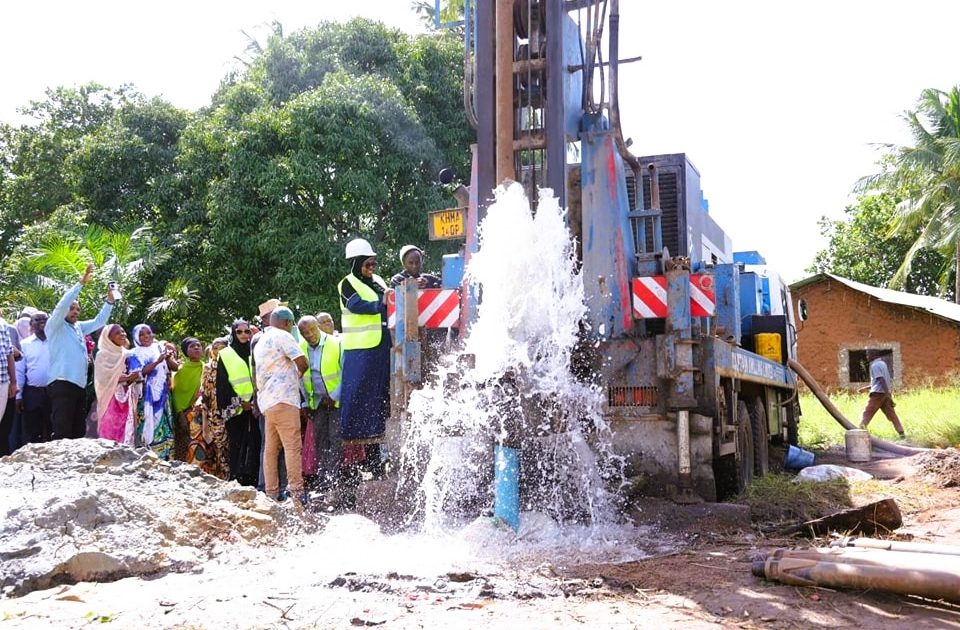
Kwale Governor Fatuma Achani has launched extensive sustainable rural water projects to improve access to clean water in the coastal county.
Governor Achani who has commissioned solar powered water projects in Ng’ombeni and Magongoni villages in Matuga and Msambweni sub counties respectively assured residents that the problem of perennial water scarcity now over.
Achnai said the two projects are expected to benefit 700 households through increased access to potable water besides providing water for livestock.
The water initiative aims to improve access to clean water, ensure a sustainable supply, and promote healthier living for area residents.
She pointed out that the rural water schemes are part of her administration’s commitment to also improve healthcare and sanitation.
Achani said that her administration was working to ensure that people in all parts of the coastal county had access to potable water.
“We want to deliver clean and safe water to our people so to have access to potable water for 24 hours,” she said, adding that she is committed to enhancing the reliability and reach of clean water services in the region.
“Access to clean and safe water is a fundamental right and we will not relent in our efforts to ensure that even the most remote areas receive water services and that every household in Kwale has reliable access to clean water.”
The coastal county boss said the devolved government is expanding the county’s water supply infrastructure through solar powered rural water schemes.
She said the interventions are designed to resolve Kwale’s long-standing water supply challenges.
The coastal county’s main sources of water are boreholes, underground, springs, dams, water pans and rock catchments.
The rural water facilities comprise solar-powered borehole systems, water treatment plants, elevated storage tanks, and an extensive network for transmission and distribution.
She said scarcity of water in rural and far-flung areas limited residents’ access to safe water for drinking and practicing basic hygiene at home, schools and healthcare facilities.
Achani who was accompanied by County Executive Committee Member (CECM) Hemed Mwabudzo stated that she is committed to improving general access to potable water supply in every nook and cranny of the coastal county.
She said the devolved unit is also rehabilitating urban and rural water supply schemes across the county that had been moribund and dysfunctional for a long time.
She stated that some of the rural water projects would have irrigation components in a bid to enhance food security and support agricultural development across Kwale.
Achani noted that the establishment and revival and revamping of moribund water schemes forms part of her administration’s broader strategy to enhance public health, stimulate economic growth, and alleviate poverty by improving access to potable water across the region.
She appealed to the communities to take ownership of the water projects and ensure that they were well maintained and protected from vandals.
“We want the benefiting communities to maintain the water infrastructure provided to ensure its long-term effectiveness,” said Achani.
She said the county government under her leadership has prioritized water security across all the 20 administrative wards.
She said other notable initiatives include drilling of over 40 boreholes countywide in the past two years, expansion of the Kwale Rural Water and Sanitation Project in partnership with development agencies, rainwater harvesting programs in schools and health centres, rehabilitation of existing water pans and installation of solar-powered pumps in drought-prone areas, among others.
By Hussein Abdullahi