The Government has embarked on a comprehensive stakeholder engagement process in the coastal counties, aimed at developing a Marine Spatial Plan (MSP) that will ensure the sustainable use and management of Kenya’s ocean space and marine resources.
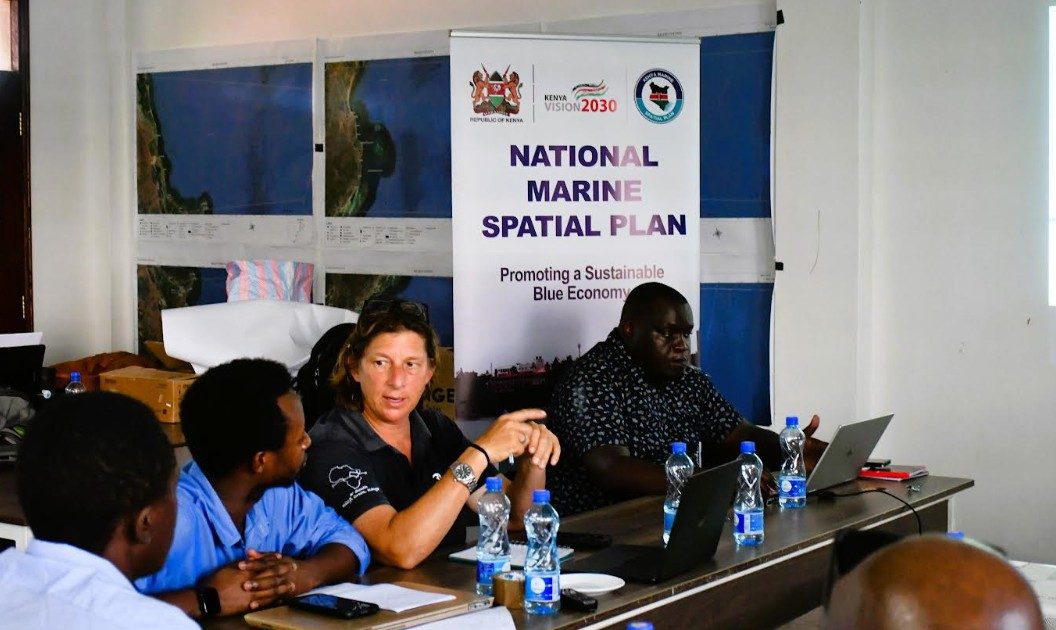
This week, the Ministry of Mining, Blue Economy and Maritime Affairs, through the State Department for Blue Economy and Fisheries, held a series of engagement forums in Kilifi to gather opinions from community stakeholders on resource use, conservation, and development priorities in Kilifi County’s marine environment.
The Marine Spatial Plan, supported by the Government of Kenya and the World Bank through the Kenya Marine Fisheries and Socio-Economic Development (KEMFSED) project, seeks to provide a framework for the orderly utilisation of marine areas by various sectors, including fisheries, shipping, tourism, culture and heritage, and energy.
Speaking during a forum in Kilifi on Friday, the National Coordinator for the Marine Spatial Planning process, Dr. Jackline Uku, said the initiative aims to identify and designate marine spaces for different uses to ensure their full and sustainable exploitation to accelerate the growth of the Blue Economy.
“The reason we are planning the ocean is to ensure that we safeguard spaces. We are using an environmental approach, looking at what the ocean environment has,” she said, adding, “At the same time, we are mapping the economic and social uses.”
She emphasised the importance of County governments and local communities in providing input, noting that their participation will be instrumental in ensuring that the plan reflects actual needs and realities on the ground, as well as anticipated uses in the future.
Dr. Uku explained that the process will bring together County governments and users of marine resources to agree on how specific spaces are allocated, helping to minimise potential conflicts between competing activities.
“This is a process of understanding uses and locating them in the ocean space, so that should somebody come with a conflicting use, we understand that it probably does not fit in that space, and an alternative space can be sought,” she said.
She assured coastal communities that the Marine Spatial Plan is designed to protect public interests and promote local economic activities.
“The plan has nothing to do with land adjudication in the ocean. People should not be suspicious; it is just a way of unlocking what we can do in this economy,” she said.
The Ministry is working closely with the State Department for Lands and Physical Planning, which plays a central role in mapping and planning the marine areas.
Deputy Director of the State Department for Lands and Physical Planning, John Ntabo, said the Marine Spatial Plan will form part of the broader National Spatial Plan, which will cover both terrestrial and marine areas.
“The Marine Spatial Plan will serve as an annex to the National Spatial Plan, providing a framework that identifies how marine spaces are utilised and managed,” said Ntabo.
He added that the Blue Economy represents Kenya’s next frontier for economic growth, with vast potential to contribute significantly to the country’s Gross Domestic Product (GDP).
To unlock this potential, he said, the Marine Spatial Plan will play a crucial role in guiding the sustainable use of marine resources and driving the blue economy to its full capacity.
Environmental conservators welcomed their inclusion in the Marine Spatial Planning process, describing it as a major step forward in addressing recurring conflicts among marine resource users.
The groups, however, urged the government to extend the Plan to include ocean shores and beaches, citing growing concerns over illegal encroachments by private developers on public beachfront land.
They emphasised that integrating shoreline management into the Spatial Plan, will be vital in safeguarding public access and preserving coastal ecosystems.
By Jackson Msanzu