
The Kenyan government has reaffirmed its commitment to strengthening labour protections, particularly for domestic workers, following the conclusion of nationwide stakeholder consultations.
The consultations focused on two critical agreements: International Labour Organization Conventions 189 and 190.
Speaking during a press briefing at the All-Saints Cathedral Hall, Nairobi, Principal Secretary for Labour and Skills Development Shadrack Mwadime announced that the stakeholder engagement phase has been finalised, marking a significant milestone toward ratification.

Mwadime noted that consultations held across counties, including Nakuru, Kisumu, Kiambu, Mombasa, Kakamega, and Garissa, brought together a broad range of stakeholders.
The stakeholders included employers represented by the Federation of Kenya Employers; workers’ unions under the Central Organisation of Trade Unions; the Centre for Domestic Training and Development (CDTD); Youth Alive! Kenya, Oxfam, AICS, and other civil society organisations are advocating for labour rights.
He added that the forum provided a platform for inclusive dialogue among key actors, including government officials, CSOs, employers, trade unions, and domestic workers, with a shared focus on advancing decent work, labour rights, and gender equality in Kenya.
“These conventions are critical in shaping a fair and dignified labour market,” Mwadime said, noting that the consultations were conducted following a directive issued by William Ruto during Labour Day celebrations two years ago.
Convention C189 seeks to safeguard domestic workers, particularly the most vulnerable in the labour force, by guaranteeing fair wages, reasonable working hours, clear employment terms, social protection, and freedom from abuse, while affirming their right to dignity and equal treatment.
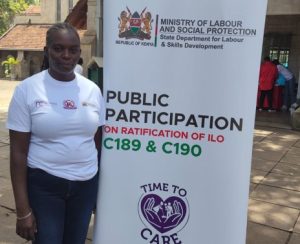
On the other hand, Convention C190 addresses violence and harassment across all sectors, recognising every worker’s right to a safe and respectful workplace and placing responsibility on governments and employers to prevent, address, and remedy physical, psychological, and sexual misconduct.
According to PS Mwadime, the move to ratify these agreements will help the government curb abuse, ensuring safer working environments, and promote dignity for Kenyan workers both locally and abroad.
“We do not want any worker, whether employed locally or internationally, to face harassment,” he said. “Respect must start at home if we expect our workers to be respected globally.”
The PS also issued a stern warning to employers, including foreign investors, who have enterprises in the country against mistreating local workers, citing troubling reports from citizens and viral videos showing abuse in workplaces.
He said the government is firm in protecting citizens against any abuse and urged the public to report any matter when they encounter it.
With the stakeholder consultation process complete, the next phase will see the proposals submitted to the Cabinet for approval before being forwarded to Parliament for deliberation.
Mwadime expressed optimism that the process would be expedited due to ongoing engagements with political leaders and government agencies.
“We are laying the groundwork to ensure this process is fast-tracked,” he said.
Civil society groups present at the forum highlighted persistent challenges facing domestic workers in Kenya. These include low wages, poor treatment, lack of formal contracts, and limited access to training and development opportunities.
They emphasised that many employers are unaware of labour standards and legal obligations, underscoring the need for public education campaigns.

They noted that domestic workers have historically been excluded from standard labour protections despite playing a central role in supporting households and enabling the broader economy to function.
Furthermore, they added that workers are entrusted with managing homes, safeguarding property, and providing essential care, yet often lack recognition and fair treatment.
They anticipated that ratification would offer renewed hope after years of advocacy, adding that it would mark a significant step toward securing dignity, protection, and decent working conditions for domestic workers across the country.
“Domestic and care work is foundational to our economy, yet it remains undervalued,” one representative noted. “These workers deserve dignity, recognition, and protection,” they added.
Despite progress, concerns were raised about enforcement gaps. With a significant number of households employing domestic workers, especially in urban areas like Nairobi, labour inspection remains difficult due to limited personnel and the private nature of homes.
Stakeholders called for innovative approaches, including awareness campaigns and accessible reporting mechanisms such as labour offices, police stations and helplines.
The PS described the ratification of Conventions 189 and 190 as more than a legal obligation. “It is a policy statement on the kind of labour market we seek—one that guarantees decent work for all,” he said.
As Kenya moves closer to formal adoption, stakeholders expressed hope that the reforms will transform working conditions, particularly for domestic workers, and set a new standard for labour rights in the region.
By Ian Chepkuto