
The Government has given traders hoarding maize a 30 days’ period to release their stocks to the market.
Agriculture and Livestock Production Cabinet Secretary (CS) Mutahi Kagwe warned that failure to do so will trigger a major import of duty-free maize to stabilise the supply and prices of the stable commodity in the country.
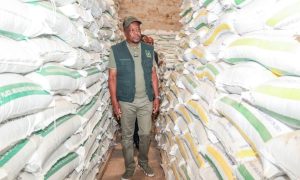
Kagwe stressed that the Government’s priority is to buy locally produced maize to build the Strategic Food Reserve, with Sh1.7B set aside to purchase 1.7M bags at Sh4,000 per bag.
However, he revealed that only 186,000 bags have been delivered so far, a shortfall attributed to hoarding and speculation.
Additionally, Kagwe announced that in order to curb post-harvest losses and aflatoxin risks, the Government is redeploying maize dryers to high-production zones and allowing farmers to dry maize at National Cereals & Produce Board (NCPB) facilities at minimal cost, while millers will be permitted to lease dryers to reduce rejection of local maize.
Furthermore, the CS disclosed that maize output more than doubled following the distribution of 9.1M bags of subsidised fertiliser during the 2025 season, adding that counties will now register agro-dealers to improve last-mile fertiliser access.
“An instant payment system for agro-dealers is also being finalised with the National Treasury, World Bank and commercial banks,” he stated.
On rice and wheat, Kagwe reiterated that locally produced grain must be taken up before imports are allowed, noting that Kenya produces about 20 per cent of its rice and 10 per cent of its wheat needs, underscoring the need to expand domestic production.
As well, he reported that the Government is also rolling out nationwide soil mapping to guide crop-specific fertiliser use and has directed NCPB to urgently fix system inefficiencies slowing grain intake.
“Food security is not optional. We must produce, store and market our food responsibly,” affirmed the CS.
By Michael Omondi