

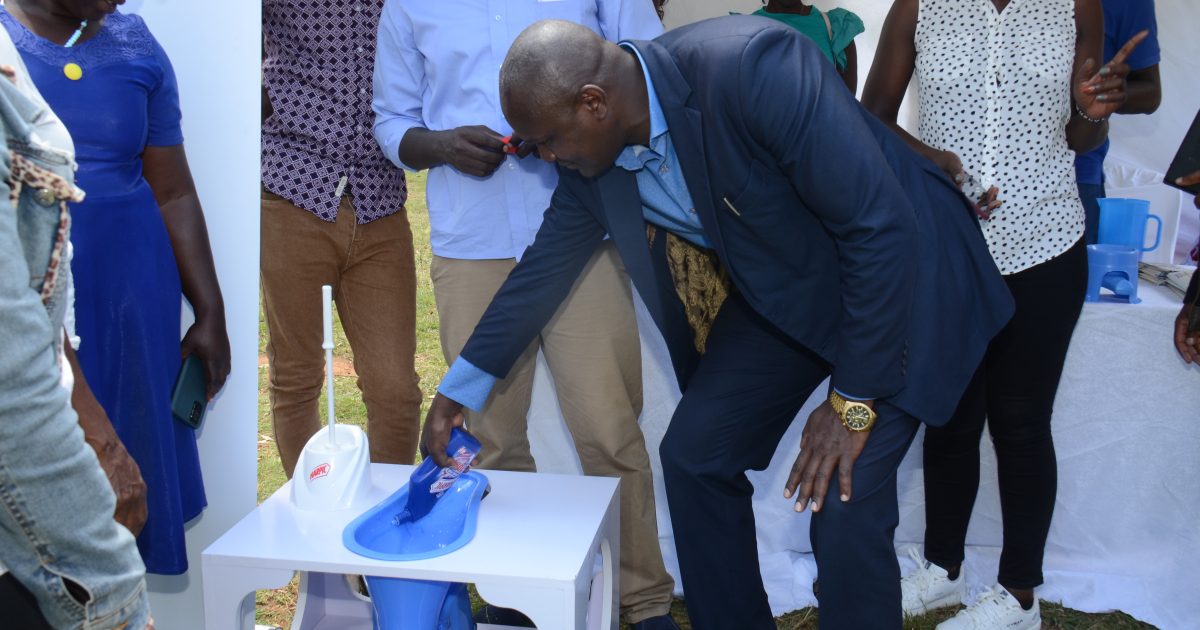
Migori County Executive Committee Member for Health (CECM) Caleb Opondi has challenged residents of Awendo Sub-County to end the habit of open defecation in sugarcane plantations.
The CCM said every homestead should have a clean and accessible toilet and revealed that Migori had recorded significant improvement in sanitation coverage.
He spoke during the World Toilet Day (WTD) celebrations held at Awendo Primary School grounds under the theme “We will always need the toilet.”
The CEC outlined that the county’s latrine coverage now stands at 83.22 per cent, handwashing facilities at 65.54 per cent and households using treated water at 84.42 per cent.
This, he said, was a result of a lot of sensitisation done by the Community Health Volunteers (CHVs) in collaboration with the national government and partners’ support.
Opondi however regretted that Awendo Sub-County still lags with only 67 per cent of households having pit latrines. “We want Migori to become an open defecation-free county; no one should be going to the sugarcane fields or bush to relieve themselves in this age,” said Opondi.
He therefore urged every household to construct decent latrines to drastically reduce water-borne diseases and improve hygiene.
He noted that the county is prioritising child-friendly toilets in all ECD centres to ensure the health of learners is safeguarded.
Migori County Chief Officer in charge of Public Health and Sanitation, Ms Marbel Chanzu, said Awendo Sub-County was deliberately chosen to host this year’s event because of its low latrine coverage.
“Eighty per cent of the illnesses we treat in Migori County are WASH-related. If all households had toilets, we would reduce these cases significantly. We are calling on the remaining 33 per cent of people living in Awendo to act now and improve their sanitation,” said Chanzu.
She commended partners, including United Nations International Children’s Emergency Fund (UNICEF), African Medical and Research Foundation (AMREF), Health Africa, Kenya Red Cross, Plan International, Evidence Action and Care International for their continued support towards achieving total sanitation coverage in the county.
Care International Kenya, representing Newton Oluoch, said that in implementing their project; the Children’s Safe Drinking Water Programme, they were working with schools and Community Health Promoters (CHPs) to distribute water purifiers to vulnerable households, with special focus on children who are most at risk of water-borne diseases.
“In Nyatike Sub-County alone, we have established six water points, three of which are fitted with water ATMs for transparency, easy monitoring and accountability in water usage,” said Oluoch.
Similarly, Evidence Action NGO Programme Officer Andrew Gusaka disclosed that the organisation has installed 2,530 chlorine dispensers at communal water points across rural Migori, serving close to 300,000 residents.
“Our dispensers are free, accurate and simple to use. Community members just fill a 20-litre jerrycan, add one capful of chlorine, shake and wait 30 minutes for the water to be safe for drinking, cooking, washing utensils and hands,” Gusaka explained.
By Polycarp Ochieng and Makokha Khaoya

