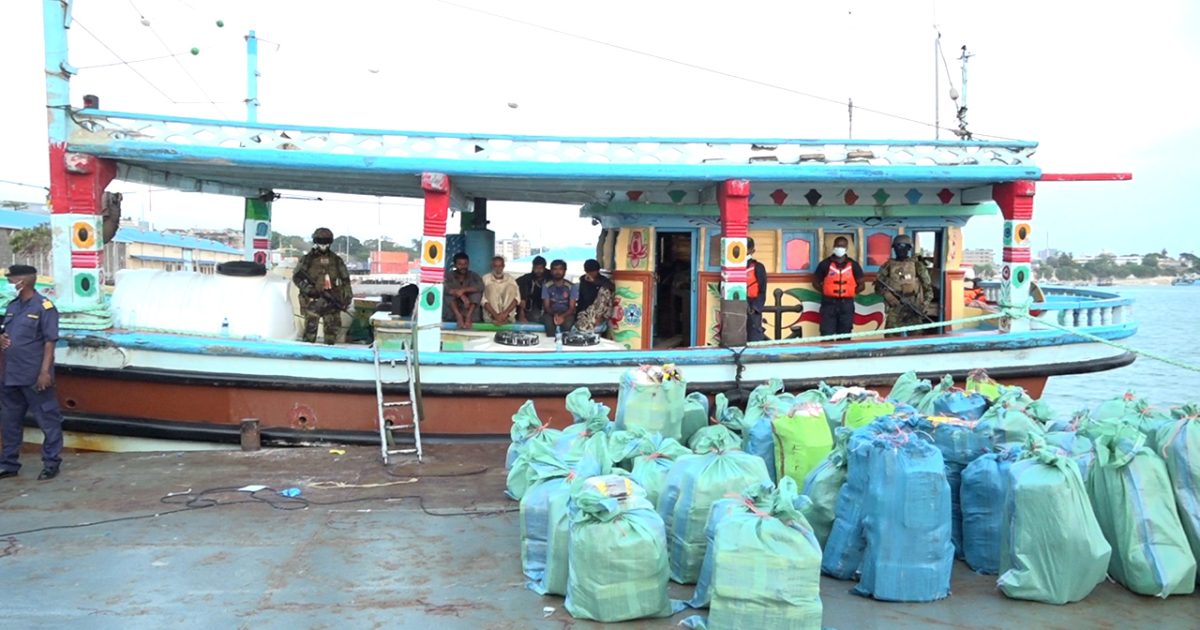
A gripping courtroom account has laid bare how a stateless vessel carrying narcotics worth Sh8.2 billion was intercepted in a high-stakes operation in the Indian Ocean, as six Iranian suspects appeared in the dock to face trafficking charges.
A senior Kenya Navy officer yesterday gave a detailed, blow-by-blow testimony before Shanzu Chief Magistrate Anthony Mwicigi, recounting how the vessel Igor, long under international surveillance, was seized with 1,024 kilograms of methamphetamine on board.
The accused persons Nasem Darzadeh Nia, Rahim Baksh Goharam, Hassan Baloch, Imran Baloch Mustafa, Nadeem Jadgal Abdulgani and Emtiyaz Daryayi were in the dock as the prosecution, led by Deputy Director of Public Prosecutions Joseph Kimanthi alongside Principal Prosecution Counsel Alex Ndiema, opened its case and lined up 12 witnesses.
Major Mohamed Abdulrahman, a senior Kenya Navy officer, testified under oath that the vessel had been flagged by regional intelligence agencies over suspected involvement in illicit drug trafficking across the Western Indian Ocean.
He told the court that he commanded the offshore warship KNS Jasiri, which was deployed to intercept the vessel following intelligence reports linking it to a wider narcotics network operating along the East African Coast and the Horn of Africa.
In his testimony, the officer revealed that Igor had allegedly offloaded part of its consignment in Maputo, Mozambique, in June 2025. He further informed the court that the vessel was one of two identified by a multinational maritime security team, with the second vessel, MV Chevy, managing to evade arrest after fleeing towards the Strait of Hormuz.
The court heard that Igor was eventually intercepted about 350 nautical miles off the Mombasa coast after a coordinated multi-agency operation involving the Kenya Navy, Kenya Coast Guard Service, NACADA and the Directorate of Criminal Investigations (DCI).
Major Abdulrahman testified that the vessel bore Arabic markings but lacked critical shipping documents, including a cargo manifest, and was not flying any national flag, grounds that led authorities to classify it as stateless and subject to seizure under international maritime law.
He further told the court that intelligence received on October 15, 2025, indicated the vessel was ferrying narcotics southwards along the East African coastline. Upon approaching the vessel at around 4 pm, his team noted it failed to respond to repeated radio calls and horn signals.
Moments later, six men emerged from the wheelhouse. The court heard that naval officers used hand signals to order them to move to the bow and surrender, commands they complied with without resistance.
A subsequent search, the court was told, uncovered a white crystalline substance concealed in small containers. The six accused persons allegedly identified the substance as “ice,” a street name for methamphetamine.
The prosecution also tabled an inventory of items recovered from the vessel, including five mobile phones, a Thuraya satellite phone, four identification cards with Arabic inscriptions, two ATM cards and several SIM cards and all produced as exhibits before the court.
By Sadik Hassan