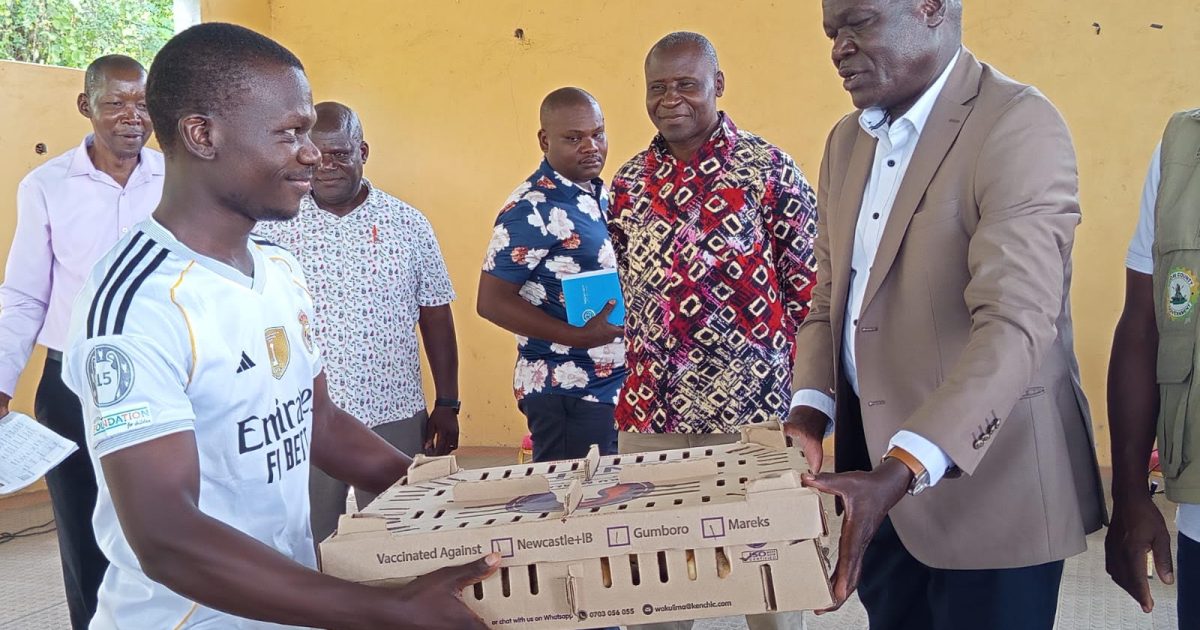
More than 80 farmer groups in Homa Bay County have received improved Kienyeji chicks from the national government in a bid to boost poultry production, food security and household incomes.
Speaking on Wednesday after the handing over of the chicks to the beneficiary groups, Josephat Simolo, from the State Department for Livestock said the support subsidy targets the vulnerable, youth and women groups as part of the government’s Bottom-Up Economic Transformation Agenda (BETA).
Under the initiative, a total of 5,900-day-old chicks were distributed to 83 farmer groups, with each group receiving 73 chicks.
The project, implemented jointly by the national and county governments, aims to empower small-scale farmers economically and enhance local poultry production.
“We expect the farmers to take good care of the chicks with the guidance of our extension officers to achieve a survival rate of over 90 percent,” Simolo said, adding that the goal is to put food on the table and money in the pockets of the beneficiaries.
The project is being piloted in 13 counties, including Migori, Homa Bay, Kisumu, West Pokot, Uasin Gishu, Vihiga, Kakamega, Wajir, Garissa, Makueni, Kitui, and Machakos.
If successful, the program will be scaled up to cover other counties across the country, he pointed out.
Homa Bay Deputy Governor, Joseph Magwanga, welcomed the initiative, asserting that it will improve farmers’ incomes, enhance food security, and create self-employment opportunities.
“This is a sustainable solution, especially for households that do not consume red meat. Kenya, and Homa Bay in particular, imports a lot of poultry products, including eggs, from neighboring countries but this project will help address that deficit,” the Deputy Governor said.
The DG also appreciated the national government for partnering to economically empower local communities through the BETA initiative.
County Executive Committee (CEC) Member for Trade, Joash Oloo, who is also the Acting CEC for Agriculture, noted that the beneficiary farmers were drawn from all the 40 wards across Homa Bay County.
“This program is a form of seed capital for our farmers. Many people have the skills and knowledge but lack the financial support to start agribusinesses. We are optimistic that this initiative, worth about Sh700,000, will transform the livelihoods of the beneficiaries and boost local food production,” Oloo said.
The project will be monitored closely by trained county agricultural officers to ensure proper management and sustainability.
By Sitna Omar