Kenya churns over one million youths into the labour market every year where the government only absorbs a mere 200,000.
The country is a youthful nation with more than 16 million people not in any form of employment, spiking up poverty levels.
Data from World Bank shows over 3.4million young people below the age of 35 are not engaged in any form of employment, as our institutions of higher learning churn out over a million youths to the job market every year.
Data from the International Labour Organization (ILO) shows that unemployment rate in Kenya decreased to 5.40 per cent in 2024 from 5.60 per cent in 2023. Unemployment rate in Kenya averaged years, the Kenyan government has repeatedly emphasised its commitment to stemming unemployment through initiatives like the Hustler Fund, youth enterprise loans, and improved policies for small traders.
These interventions, the government says, are meant to uplift ordinary citizens striving to make a living through informal businesses.
The Hustler Fund is a digital financial inclusion initiative designed to improve financial access to responsible finance for personal, micro, small, and medium-sized enterprises (MSMEs) in Kenya.
This loan is designed to help hustlers and small business owners access money when they need it most. Whether it’s stocking up your shop, fixing your motorbike, or handling an emergency, this loan gives you quick cash without collateral or long approval processes.
More recently, the government came up with the National Youth Opportunities towards Advancement (NYOTA) programme. It is a national youth programme targeting young people across Kenya to promote employment, entrepreneurship, income generation and youth savings and financial security.
The project has four key components: improving youth employability. Expanding Employment Opportunities.
NYOTA is an initiative aimed at boosting employment and incomes for vulnerable youth by providing skills development, entrepreneurship support, mentorship, and access to enterprise equipment and funding. The project distributes equipment like sewing machines, posho mills, and welding machines to groups in various sectors to promote innovation and formalize businesses.
Its objective is to increase employment, income, and savings among targeted vulnerable youth in Kenya and targets vulnerable youth aged 18-29, and up to 35 for persons with disabilities, including refugees in specific counties.
Despite these efforts, many youth continue to yearn for more efforts and policies that can uplift their standards of living.
The real story of the hustler economy lives in places like Hekima area in Kisumu, where 24-year-old John Oyugi begins his day long before most households wake up.
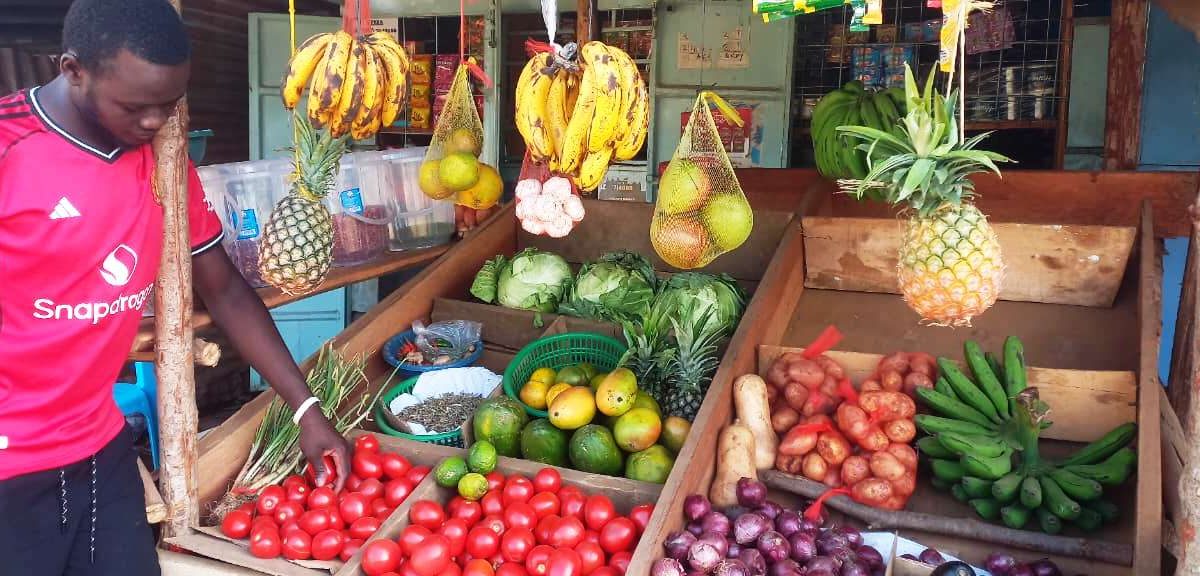
At exactly 6:00 a.m., John is already arranging tomatoes, onions, cabbages, bananas, and bunches of sukuma wiki on a small wooden stall outside a corner shop. His hands move with the quiet confidence of someone who understands the weight of responsibility. This simple kibanda is not just his workplace it is his source of survival.
John stepped into the mama mboga business, which is a domain of women, two years ago after finishing his secondary education, with determination and an initial capital of Sh3,800, money saved from helping a neighbour carry produce from the market. With it, he bought his first crate of tomatoes, a few onions, and some greens – just enough to get started.
Today, the young trader makes between Sh700 and Sh1,200 on a good day, although rainy days, slow evenings, or unpredictable market prices can cut that income by half. But this does not make him lose hope, as he is able to meet his basic needs and occasionally send something small to his mother.
Despite being the exact kind of youth the government says it is trying to support, John admits that he has tried applying for the Hustler Fund, the Youth Enterprise Development Fund, and other government programmes but with no success.
“The loans sound good on paper,” he says, “but when you try applying, the process is confusing. Sometimes you’re disqualified and you don’t even know why.”
John’s challenges mirror those of countless young traders across Kenya: unstable income, rising market prices, high competition, harsh weather, and the lack of proper structures or designated areas to operate from. Without a shade, he works under the scorching sun or races to cover his produce when clouds gather.
When asked what the government could do differently, John speaks with optimism:
“We need easier access to loans, market stalls with roofs, and protection for small traders. Even small support can help us grow,” he says.
Looking ahead, John dreams of expanding his business. He wants a bigger stall, proper storage, and eventually a wholesale supply operation for hotels, restaurants, and schools in Kisumu.
“I believe this business can take me far,” he says, his voice steady. “I just need the right push.”
As the sun goes down over Hekima, John gathers his remaining stock to rush to his one-roomed structure to prepare some supper for himself and rest for the night – tomorrow is another day.
His journey is a living testament to the resilience of Kenya’s youth, building a future with their own hands, even as they wait with anticipation for a better tomorrow.
Stories like John’s remind me that the heartbeat of the hustler economy is found out there in the villages, in the dusty roads, wooden stalls, and raw determination of young men and women who refuse to give up.
What is striking is that armed with only Sh3,800, John built something many would consider too small to matter. Yet from that tiny beginning came a livelihood, a routine, hope and a dream that might eventually flush—one day.
His journey challenges the narrative that youth must wait for perfect conditions to start. It also exposes the gap between government promises and the reality on the ground. For John, success isn’t about grandeur. It’s about consistency, dignity, and the belief that tomorrow can be better if you wake up early enough to chase it.
In his story, there lie thousands of untold stories of young hustlers making something out of almost nothing.
By Mabel Keya- Shikuku and Phanice Daizy