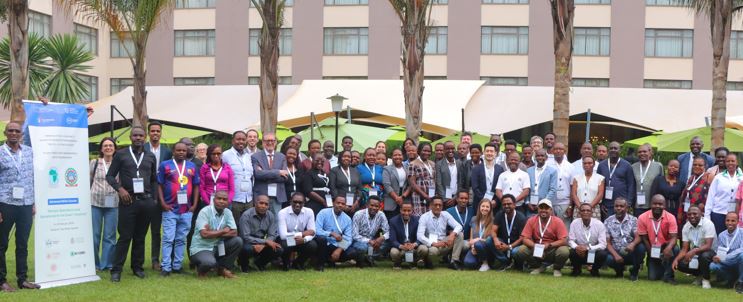
To combat climate change through sustainable land management, Jomo Kenyatta University of Agriculture &Technology has joined a four-year African university partnership to boost agroforestry research.
By training experts in sustainable farming, the project aims to tackle climate change and build environmental resilience across the continent.
The project titled Strengthening Agroforestry Research and Education for Climate Change Mitigation in Africa (SARE) will unite JKUAT (Kenya) with Addis Ababa University (Ethiopia), Chinhoyi University of Technology (Zimbabwe), the National University of Agriculture (Benin), and the University of Juba (South Sudan) with the aim of enhancing research capacity and fostering academic synergy across East, West, and Southern Africa.
The project is expected to strengthen regional expertise by training 65 participants including postgraduate students, researchers, and academic staff. This will be achieved through a mix of full-degree mobility, research exchanges, and joint supervision.
Beyond individual training, the partners led by Dr Shem Kuya a senior lecturer from the department of Botany and one of Kenya’s leading researchers in Agroforestry will collaborate to standardize and improve agroforestry curricula across Africa.
Agroforestry is a versatile solution to Africa’s most pressing challenges. Beyond mitigating climate change, it plays a vital role in restoring degraded land, preserving biodiversity, and securing food and nutrition for growing populations.
It is a cornerstone of national development for all five participating countries. In Kenya, it serves as a primary strategy for meeting international climate commitments, specifically those outlined in the Nationally Determined Contribution (NDC) and the National Climate Change Action Plan (NCCAP).
To meet the constitutional mandate of 10 percent national tree cover, Kenya has identified agroforestry as its most viable strategy. Since the majority of Kenya’s land consists of private smallholder farms rather than public forests, integrating trees into existing agricultural landscapes allows for large-scale restoration without compromising local livelihoods.
For years, agroforestry research has centered on climate action, sustainable land management, and restoring ecosystems to support rural livelihoods. This work is now being transformed by a blend of traditional methods and cutting-edge technologies, including Remote Sensing, GIS, drones, and advanced data analytics for more precise landscape monitoring and management.
Backed by the European Commission, the SARE project is cultivating a new generation of African scientists and professionals. These experts will be equipped with the skills needed to
lead the transition toward climate-resilient land use and sustainable agricultural landscapes across the continent.
By Hellen Lunalo