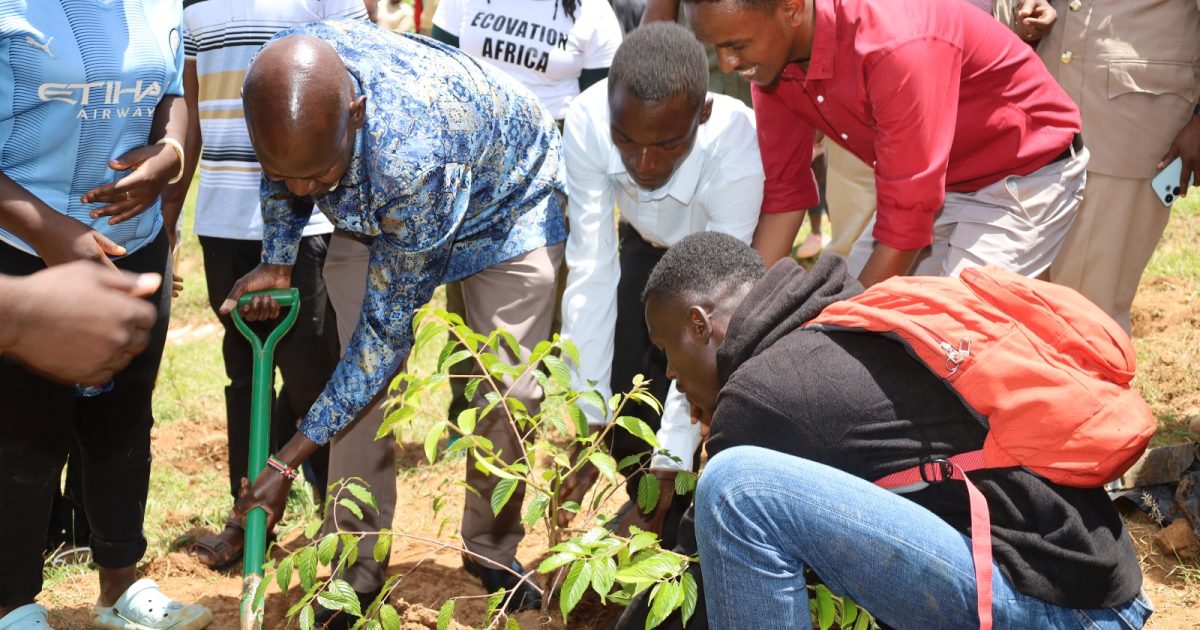
Kaimosi Friends University hosted a major tree planting exercise that brought together national and county leaders in a renewed push to boost Kenya’s forest cover and promote environmental conservation.
The event was led by Kenya Wildlife Conservation Secretary Dr. John Chumo, who joined the university’s Vice Chancellor Prof. Peter Mwita, alongside government officials, university staff, and students in planting 10,000 indigenous tree seedlings within the institution.
The seedlings were supplied through the State Department for Wildlife as part of ongoing national efforts aimed at restoring degraded ecosystems and promoting sustainable environmental management across the country.
The exercise forms part of Kenya’s ambitious target of planting 15 billion trees by the year 2032, a key component in addressing climate change and reversing deforestation trends.
Speaking during the event, Dr. Chumo emphasized that tree planting is a collective responsibility that requires the involvement of all citizens, institutions, and stakeholders.
He noted that Kenya’s forest cover currently remains below the recommended 10 percent, underscoring the need for intensified efforts to increase tree cover nationwide.
“We have come together to partner in achieving this mission as the current forest cover is below 10 percent,” he said.
Dr. Chumo further called on institutions of higher learning to take a leading role in environmental conservation by integrating activities such as tree planting into student programmes.
He proposed that such initiatives be considered as part of graduation requirements in universities to help instil environmental awareness and responsibility among students.
At the same time, he encouraged students to remain focused on their academic pursuits, noting that education remains key in shaping their future and empowering them to contribute meaningfully to society.
Dr. Chumo also explained that Vihiga County was strategically selected for the initiative due to its location within the River Yala catchment area, a critical ecosystem that supports both environmental sustainability and livelihoods in the region.
He added that the programme extends to neighboring counties such as Kakamega and is also aligned with efforts to promote eco-tourism development.
Regional Forest Conservator for the Western Region, Dennis Kerengo, lauded the initiative, noting that such partnerships play a crucial role in advancing environmental conservation efforts.
He said the tree planting exercise would significantly contribute to restoring forest cover and enhancing biodiversity in the region.
On his part, Prof. Mwita expressed appreciation to all partners who supported the initiative, highlighting that tree planting is a key performance indicator for the university.
“Tree planting and ensuring that the trees survive is a key part of our annual performance targets,” he said.
He revealed that the university had set a target of planting 70,000 trees in the current financial year and had already achieved 45,000 trees, including the latest exercise.
The event marked a significant step in strengthening collaboration between government institutions, academia, and local communities in advancing Kenya’s environmental conservation agenda.
The initiative underscores the importance of collective action in increasing tree cover and promoting environmental sustainability in line with Kenya’s broader development goals.
by Rose Wasike