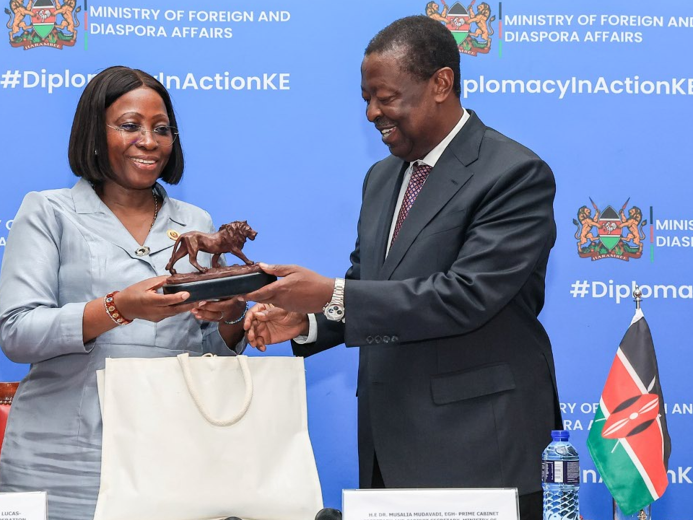
Prime Cabinet Secretary and Cabinet Secretary (CS) for Foreign and Diaspora Affairs, Musalia Mudavadi officially opened the Ministerial Segment of the Third Session of the Joint Permanent Commission for Cooperation (JPCC) in Nairobi co-chaired by Maria Manuela dos Santos Lucas, Minister of Foreign Affairs and Cooperation of the Republic of Mozambique.
The JPCC aims to review the status of bilateral relations between Kenya and Mozambique, while laying the foundation for expanded cooperation across key sectors. The meeting precedes the Official Visit to Kenya by Mozambican president Daniel Francisco Chapo from 24th to 26th March 2026, at the invitation of President William Ruto.
In his opening remarks, Mudavadi underscored the enduring partnership between the two nations, anchored in strong historical, cultural, and people-to-people ties.
He highlighted the recognition of the Makonde community as Kenya’s 43rd tribe in 2017 as a powerful symbol of the deep-rooted connections between the two countries.
“The JPCC, established in 1991, remains the cornerstone of bilateral relations, providing a structured platform for dialogue, coordination, and the advancement of mutually beneficial initiatives across a wide range of sectors,” he noted.
Emphasizing the importance of outcomes, Dr. Mudavadi stated that the success of the deliberations would depend on the timely and effective implementation of agreed commitments as he called for accountability and sustained follow-through to translate shared intentions into tangible results and measurable benefits for both nations.
The Prime CS also urged technical teams to fast-track the implementation of existing Memoranda of Understanding (MoUs) through robust monitoring and evaluation frameworks to ensure their continued relevance and effectiveness.
In her remarks, Ambassador Manuela dos Santos commended the strengthening relations between Mozambique and Kenya, highlighting sustained diplomatic engagement at both high and technical levels, which has led to the formalization of several cooperation agreements.
She cited significant progress under the JPCC framework, including high-level exchanges and mutual support in regional and international fora, fostering enhanced collaboration, solidarity, and mutual respect.
While acknowledging these achievements, Manuela dos Santos emphasized the need to address implementation gaps and urged both sides to expedite the execution of agreed commitments.
Notably, the session took place against a backdrop of global geopolitical uncertainty, with leaders noting the impact of rising energy prices, disrupted trade flows, and broader economic instability on African economies. Both sides stressed the need to accelerate implementation, finalize pending legal instruments, and operationalize joint technical committees.
A key focus of the discussions was the expansion of cooperation in the maritime and blue economy, youth affairs and sports, energy with both countries recognizing their strategic position along the Indian Ocean and the sector’s potential as a driver of sustainable growth and socio-economic transformation.
Kenya also expressed interest in leveraging Mozambique’s natural resource endowment, particularly in natural gas, to enhance energy security and promote investment partnerships.
Similarly, trade and investment promotion featured prominently, with calls for stronger private sector engagement, removal of tariff and non-tariff barriers, and the institutionalization of mechanisms such as the Joint Technical Committee on Trade and the Kenya–Mozambique Business Forum.
Likewise, connectivity was identified as a critical enabler, with the resumption of direct flights between Nairobi and Maputo highlighted as a key step toward boosting trade, tourism, and people-to-people exchanges. Both sides, however, acknowledged the need to address existing logistical and operational challenges.
Beyond economic cooperation, the two countries underscored the importance of coordinated efforts to address shared security challenges, including terrorism and other transnational threats, through strengthened regional collaboration.
Equally, the discussions also emphasized the need to integrate joint responses to natural disasters into the partnership framework, reflecting increasing environmental pressures.
The session concluded on a positive note, marked by the adoption of agreed minutes arising from the Senior Officials’ Segment. Both leaders reaffirmed their commitment to moving from dialogue to implementation by activating agreed mechanisms and advancing priority programmes, with a shared focus on delivering tangible outcomes for their citizens.
By Michael Omondi