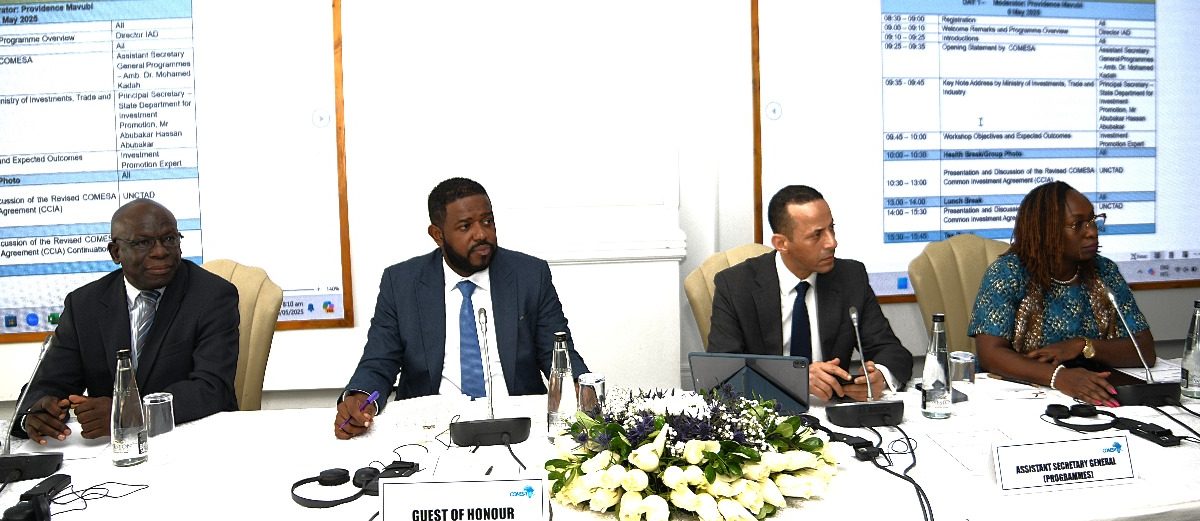
The Principal Secretary for the State Department of Investment Promotion, Mr. Abubakar Hassan Abubakar presided over the opening of a two-day Regional Validation Workshop Wednesday aimed at revising the COMESA Common Investment Area (CCIA) Agreement.
The workshop reaffirms Kenya’s support for a more integrated, inclusive, and investor-friendly regional economic space.
The CCIA Agreement was developed following a decision made at the 3rd Common Market for Eastern and Southern Africa (COMESA) Summit held in June 1998 in Kinshasa, Democratic Republic of Congo (DRC). It was expected to enhance investment flows and competitiveness in the region
The process of reviewing the CCIA started with an inclusive review process that consisted of a comprehensive gap analysis and benchmarking efforts against continental and international investment frameworks.
A regional validation workshop held in Cairo in 2024 helped incorporate feedback from Member States, who later conducted national consultations and submitted formal comments.
The Wednesday event brought together key stakeholders from COMESA Member States, including government delegates, trade experts, and representatives from the United Nations Conference on Trade and Development (UNCTAD) and the International Institute for Sustainable Development (IISD).
The workshop served as a platform to validate the revised CCIA Agreement, a legal framework designed to promote, protect, and facilitate investment across the COMESA region. The revisions were aimed at aligning the agreement with global best practices, improving investor confidence, and enhancing the region’s appeal as an investment destination.
In his opening remarks, COMESA Assistant Secretary General for Programmes Amb. Dr. Mohamed Kadah emphasized the urgent need to boost investment in Africa.
He cited figures from the 2024 UNCTAD Investment Report showing that Africa’s global share of Foreign Direct Investment (FDI) remains a marginal 4–5%.
The report revealed that Foreign Direct Investment (FDI) inflows to Africa fell sharply from USD 54 billion in 2022 to just USD 53 million in 2023, with COMESA Member States alone seeing a decline from USD 23.4 billion in 2022 to USD 18.7 billion in 2023.
Dr. Kadah attributed the downturn to factors such as economic uncertainty, political instability, burdensome business regulations, poor governance, and the high cost of doing business.
He lauded the revision of the CCIA Agreement as a timely intervention to address these challenges and create a more sustainable and attractive investment climate.
In his keynote address PS Abubakar praised the transparent and participatory manner in which the process was conducted.
“Today we stand at a pivotal moment in our journey toward regional integration and development. It is time for member states to move beyond competition and embrace collaboration. A harmonized investment approach will benefit our countries and our people,” he said.
PS Abubakar urged the participants to actively engage in the workshop and ensure that their input positively shaped the region’s investment future.
“We are not here to merely validate an agreement; we are here to build a foundation for sustainable growth in COMESA for generations to come,” he said.
The PS thanked UNCTAD and the International Institute for Sustainable Development (IISD) for the technical support provided and reiterated Kenya’s commitment to championing a robust, inclusive, and future-focused investment agenda.
Delegates were drawn from Eswatini, Madagascar, Zambia, Zimbabwe, Eritrea, Djibouti, Tunisia, Mauritius, Somalia, Egypt, and Rwanda. Their presence signaled a strong regional engagement in shaping the future of investment policy within the COMESA member states.
By Victoria Njeri