The government has intensified its push for irrigation-led, large-scale agriculture backed by scientific, technology-driven and digital farming systems to increase productivity and end over-reliance on food imports.
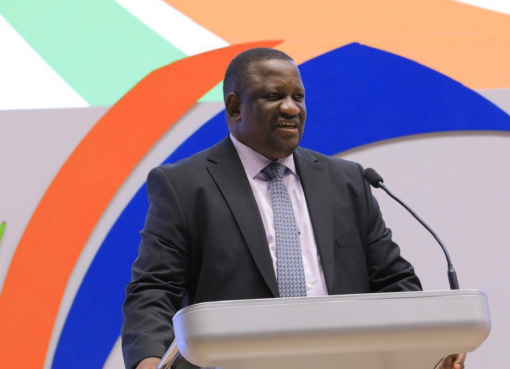
The Agriculture and Livestock Development Cabinet Secretary Mutahi Kagwe warned that small-scale, rainfed farming can no longer sustain the growing population under increasingly unpredictable climatic conditions.
He stressed Kenya’s need to urgently adopt modern technology to increase productivity per acre, particularly in the Arid and Semi-Arid Lands (ASALs), which make up more than 80 per cent of Kenya’s land mass.
“The country must urgently adopt scientific, technology-driven, and digital farming systems to increase productivity per acre, particularly in the Arid and Semi-Arid Lands (ASALs), which make up more than 80 per cent of Kenya’s land mass,” he said.
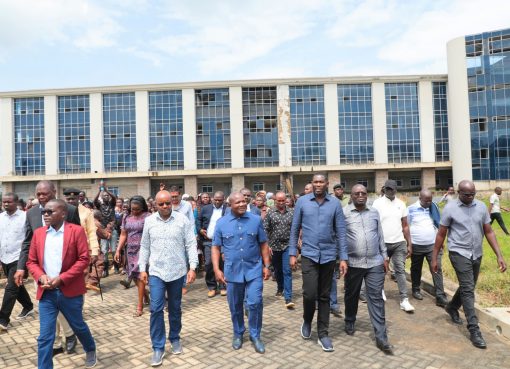
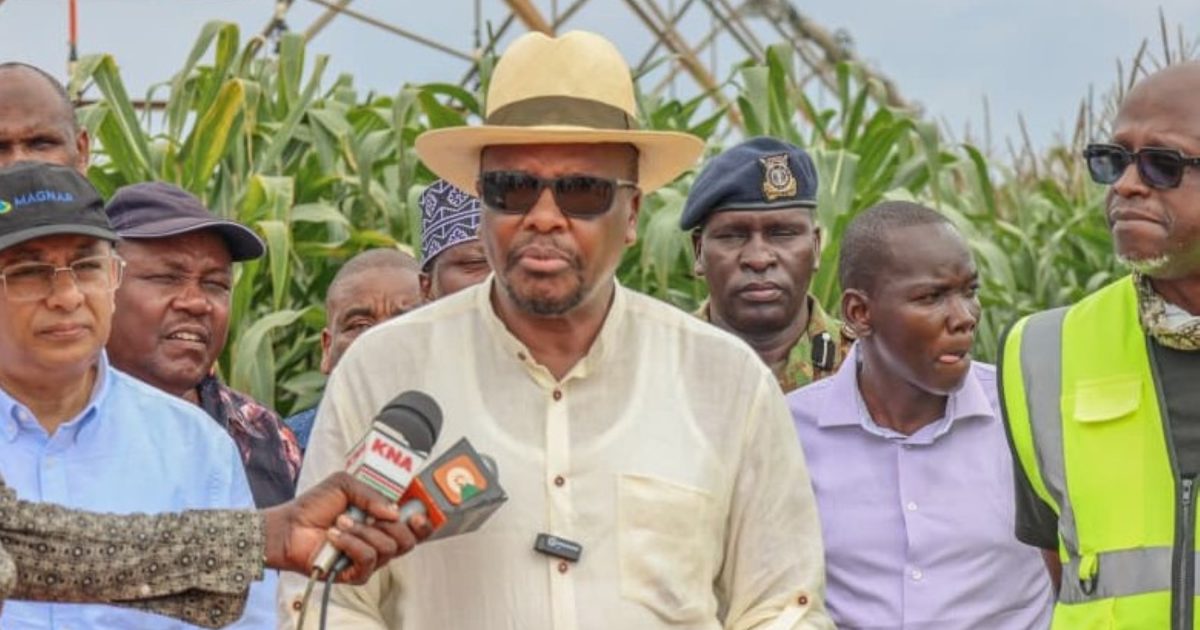
Mr. Kagwe said this during a tour of the multi-billion Galana Kulalu Food Security Project in Kilifi and Tana River Counties, where he announced that the 1.8 million-acre Agricultural Development Corporation (ADC) land was designated strictly for large-scale, mechanised and irrigated farming.
“We are making it clear in public that Galana-Kulalu is strictly for large-scale farming. Subdivision makes mechanisation impossible and defeats the purpose of this project,” he said.
He noted that Kenya’s heavy dependence on food imports—about 92 per cent of wheat, over 80 per cent of rice, and significant quantities of sugar—has been worsened by droughts that routinely disrupt local production.
Large-scale irrigation, he said, is the only viable way to stabilise food supply, reduce the import bill and build long-term resilience.
The government, he said, was inviting serious local and international investors to participate in Galana-Kulalu under the Land Commercialisation Initiative (LCI), assuring them that land allocation will be transparent, competitive and free from favouritism.
The project is expected to generate strong backward and forward linkages across the economy—driving demand for locally manufactured fertilisers, irrigation equipment, transport and logistics services, while stimulating agro-processing and trade, he said.
To lower production costs, the cabinet secretary said government was prioritising affordable irrigation pipes, electricity and water delivery systems, and urged manufacturers in the pipe-making and allied industries to scale up investment, noting that Kenyan-made pipes are high quality and globally competitive.
He encouraged surrounding communities to seize opportunities in housing, retail, services and supply chains to support the growing agricultural workforce.
Kagwe commended investors who have integrated their operations with surrounding communities through schools, health facilities and corporate social responsibility initiatives, saying inclusion is critical to sustainable large-scale agriculture.
Kagwe lauded Nyumba Foundation and Selu Group for investing heavily in mechanized and technology-driven agriculture, saying their presence had shown that Kenya’s dream of food security is realizable.
He toured the Nyumba Group, where he commissioned an 800-acre earth dam capable of holding six billion litres of water for year-round irrigation.
Nyumba Foundation has invested over Sh6.4 billion to develop more than 300,000 acres already producing crops at large scale. Kagwe hailed the Nyumba model as a benchmark for mechanised, technology-driven farming in ASAL regions.
He also visited Selu, a major seed maize producer, underscoring the importance of ensuring farmers have access to high-quality seeds to strengthen productivity and resilience.
By Emmanuel Masha