Kenya is progressing rapidly as a continental leader in leveraging on artificial intelligence (AI) to tackle food security challenges and accelerate economic growth, reinforcing its role as a key player on the global stage, experts have claimed.
Mount Kenya University (MKU) Vice Chancellor Prof. Deogratius Jaganyi affirmed that Kenya was on the right trajectory and urged stakeholders in the agricultural sector, young graduates, entrepreneurs, researchers and innovators among others to embrace AI as the evolving technology continued to reshape every sphere of life locally and globally.
In his presentation during an interdisciplinary conference themed “Emerging Technologies and Sustainable Practices: Innovation in Agriculture, Health, Renewable Energy, and Business Practices,” the Vice Chancellor emphasized that the core of Kenya’s national AI strategy was the drive to apply cutting-edge technologies in critical sectors including in agriculture while using data-driven tools, predictive modelling and AI-powered logistics to boost yields, enhance food security and improve distribution across the country.
While observing that we are living in a time of unprecedented AI technological revolution, the VC explained that AI had wide-ranging applications and benefits which could not be ignored as they cut across virtually all sectors, including precision agriculture that optimizes crop yields with minimal wastage, telemedicine that expands access to advanced health care solutions, clean energy solutions powering communities and business models while prioritizing both efficiency and profitability among others.
“Technology is no longer a luxury; it is a necessity for building a more sustainable future,” Prof. Jaganyi added.
In the agricultural sector, Prof. Jaganyi said AI-powered platforms were capable of hosting real-time analytics for crop monitoring and rotation, weather forecast and soil moisture analysis.
The Vice Chancellor stated that though the 2025 Economic Survey by the Kenya National Bureau of Statistics (KNBS) shows that in 2024, the Agriculture, Forestry and Fishing sectors grew by 4.6 percent, contributing to the overall real GDP growth of 4.7 percent that year, the sector remained extremely vulnerable to climate change.
“Technological solutions, innovative measures and programmes need to be adapted to ensure provision of adequate food for a growing population and to increase export crops to generate foreign exchange,” Prof. Jaganyi advised.
The Vice Chancellor pointed out that with over 80 percent of the country’s agricultural output coming from smallholder farmers, the adoption of AI technologies had become crucial in enhancing productivity, sustainability and resilience within the sector.
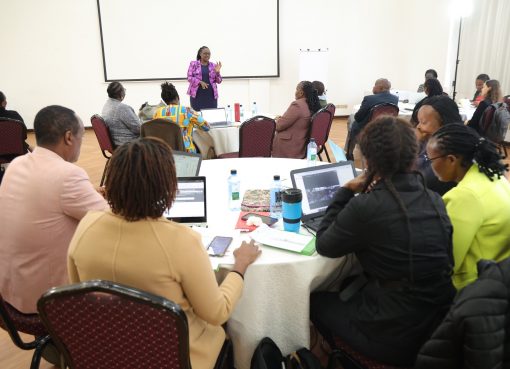
The two-day conference hosted at MKU’s Nakuru main campus, conducted online and by physical attendance, saw representatives of state agencies, industry leaders, research institutions, county governments, international organizations, among others, make presentations on an array of fields, including Agri-Tech innovations, sustainable agribusiness, climate-smart agriculture and food security and agricultural resilience.
It also explored topics on interconnectedness of animal, human and environmental health, precision animal health and building resilient animal health systems.
Notable AI applications discussed at the forum about agriculture include disease prediction through satellite imagery, real-time soil analysis (nutrient content, moisture, pH), supply chain optimization via machine learning, and the empowerment of smallholder farmers through accessible decision-support tools, marking a shift from traditional farming methods to a more data-driven approach to agriculture.
Other innovative initiatives explored were: AI-powered drone sensors to monitor crop stress, AI personalized advice on weather, fertilizer application, pest management, and market prices, directly to farmers through accessible channels like SMS and WhatsApp.
The experts noted that there also existed AI-powered technologies to connect farmers directly with buyers, streamlining supply chains, reducing inefficiencies and enhancing farmers’ access to markets but also contributing to more reliable and efficient agricultural commerce across Kenya.
In her presentation, MKU Nakuru Campus Director Dr. Jacqueline Omuya assured that the institution would be at the forefront of initiating and supporting researches that fuel innovation to transform Kenyan communities.
She said that at Mount Kenya University, they were embracing a culture where ideas meet action, where research fuels innovation, and collaborations spark lasting solutions, adding that the AI conference was more than a meeting of minds, but a launchpad for solutions for the transformation of communities.
Dr Omuya said that incorporating AI technology in agribusiness would help overcome barriers to entry in marketing and value addition, as well as deliver efficient, transparent and last-mile extension services at scale.
She stated that embracing modern-day farming methods would make Kenya’s food secure, adding that solutions to challenges facing agriculture, ranging from shrinking land size as a result of population explosion, poor yields and food insecurity, was in the adoption of modern farming trends.
“There are emerging technologies in the agricultural sector all over the world and part of the discussion is to make sure that Kenya is not left behind in those discussions,” Dr Omuya said.
County Crops Officer Ms Lilian Samoei emphasized Nakuru’s continued effort to partner with organizations that promote innovative and sustainable farming methods and stressed the need for robust collaboration across diverse disciplines to promote a resilient ecosystem for economic growth.
Ms Samoei said that despite the challenges the agricultural sector was facing, new avenues were opening through innovation, technology, and cross-sectoral partnerships and encouraged different disciplines to not operate in silos but build synergies for sustainable economic growth.
Ms Samoei said that the County Government of Nakuru was prioritizing sustainable farming practices in its policies and budget to ensure food and nutrition security and build resilience against climate change shocks.
She said the devolved unit’s administration in collaboration with State agencies, local and international firms and research institutions, were building the capacity of both small-holder and large-scale farmers in practicing sustainable agriculture in the region towards improving crop yields, stimulating the economy and helping mitigate climate change.
“Changes in temperature and precipitation patterns have created extreme weather conditions such as flash flooding, drought and locust invasions that have not only slashed crop yields, but also fueled regional conflict over diminishing access to essential resources,” said the officer.
Ms Samoei expressed concern that promotion of industrialized food systems at the expense of environmentally friendly agricultural production systems like agroecology was aggravating biodiversity loss, deforestation and greenhouse gas emissions.
She observed that agroecology, regenerative practices and indigenous knowledge were avenues that could lead to sustainable food systems and repair the relationship between people and nature.
The official indicated that sustainable agriculture was about increasing profitable farm income, protecting the environment, enhancing quality of life for farming communities and increasing production for human food and fibre needs.
In line with a growing population, experts indicated that global demand for food and changes in dietary habits has spurred additional pressure on agricultural activities, making them unsustainable.
The 2024 ‘AI for Africa’ report published by the Global System for Mobile Communications Association (GSMA) shows that agriculture and food security take up 49 percent of all AI deployments in Kenya, followed by climate action and energy use cases at 26 percent and 24 percent.
The analysis revealed over 90 instances of AI deployment within Kenya’s agricultural systems. In these cases, Machine Learning (ML) was utilized to generate critical insights on crop patterns, pest and weed management, land use, and irrigation practices. Many of these AI-driven applications supported precision farming by improving yield predictions, enhancing crop monitoring, and optimizing resource use.
Moreover, AI and ML technologies played a significant role in automating labour-intensive tasks such as harvesting and weeding.
By providing farmers with data-driven guidance, these tools enabled the adoption of efficient, climate-smart farming techniques that boosted productivity and sustainability.
By Esther Mwangi