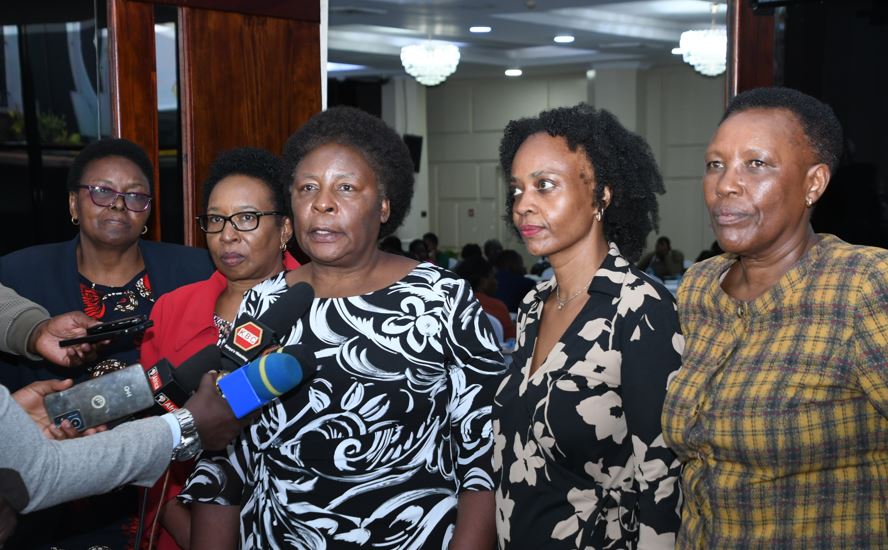
Kenya loses Sh41 billion per year economically to Gender Based Violence (GBV) and Femicide, according to the technical working group on GBV, including femicide.
At a plenary meeting for the working group at KICC, the Working Group on GBV, including Femicide, led by Nancy Baraza, said that GBV, including femicide, has a grave impact on the economy, which is economically draining the country.
“Sh41 billion per annum is a lot of money,” said Baraza, pointing out that because of this massive loss, we need to treat or deal with GBV and femicide so that we can redirect the resources and time to improving our economy.
She said that the working group, having been advised by members of academia from select local universities, has provided very useful data that can be used to assess, review, and recommend measures to strengthen the policy, legal, and institutional response to GBV, including femicide, in the country.
“We have also received submissions from various scholars, including anthropologists and sociologists, gender mainstreaming experts, and theologians from different local universities who have given us different perspectives on GBV, including femicide.” She said.
Baraza said that the Kenyatta University Women’s Economic Empowerment Hub (KU-WEE) has confirmed the economic statistics that the country is losing nothing less than Sh41 billion per annum because of GBV and femicide.
She said KU-WEE Hub is known for researching and putting in place mechanisms for women’s empowerment so that they move out from the abusive spaces where gender-based violence occurs.
“KU-WEE Hub has addressed the Working Group on the impacts of GBV on the economy and given us very specific figures on what GBV including femicide does to our economy,” she said.
The Chairperson further said that according to their submissions, there is a direct link between economic disempowerment of women and GBV. She noted that women who suffer gender-based violence mostly are the economically disempowered.
She noted with concern that occurrences of cases of GBV, including femicide, in local universities are something that is worrying and alarming.
She said apparently there is something called ‘bus fare’ being mentioned by young people that could be a possible reason to increase cases of GBV including femicide.
“Young people who are commenting on it say this ‘bus fare’ thing is quite serious and that, apparently, the ‘bus fare’ comes from the men, and when certain conditions of the ‘bus fare’ are not met, it sometimes leads to GBV, including femicide.” She said.
Baraza said that studies from the universities reveal that one of the issues is that young people are fearing to report incidents of GBV, including femicide.
“They don’t even want to tell their parents. The next thing you hear is worse. It’s now graduated from being a GBV case to a femicide case”, she said, adding that the fight against GBV, including femicide, is a holistic thing that requires the approach of everyone.
“We have several other propositions as to why GBV and femicide is happening. It is something that we are looking into,” she added.
She noted that the government needs to empower our police officers, our chiefs, and other relevant authorities so that they are informed and trained on how to receive cases of GBV, including femicide, so that they don’t stigmatize the victims.
By Anita Omwenga