Kenya has reaffirmed its commitment to protecting the ozone layer and addressing climate change as the world celebrates the 40th anniversary of the Vienna Convention for the Protection of the Ozone Layer.
Speaking during national celebrations to mark World Ozone Day at the John Michuki Memorial Garden in Nairobi, Environment, Climate Change and Forestry Cabinet Secretary Dr Deborah Barasa said Kenya’s commitments under the Vienna Convention and the Montreal Protocol reflect the country’s determination to safeguard both the environment and public health.
Dr Barasa described the ozone layer as humanity’s “invisible shield” that protects life on Earth from harmful ultraviolet rays, stressing that protecting it requires global solidarity as well as national and community-level action.
“Our mission is simple but profound to ensure that future generations live free from the harmful effects of ultraviolet radiation and climate warming gases. This is why Kenya has embraced the Kigali Amendment which addresses hydrofluorocarbons, powerful greenhouse gases with high global warming potential,” said Dr Barasa.
She noted that Kenya joined the Vienna Convention and the Montreal Protocol in 1988 and has since ratified all five amendments.
She highlighted that Kenya’s Kigali HFC implementation plan, approved at the 93rd Executive Committee of the Multilateral Fund, provides a framework to gradually reduce hydrofluorocarbon consumption in line with global targets.
The Cabinet Secretary announced that Kenya has also developed a National Cooling Action Plan aimed at ensuring homes, hospitals, agriculture and businesses can access safe, affordable and sustainable cooling.
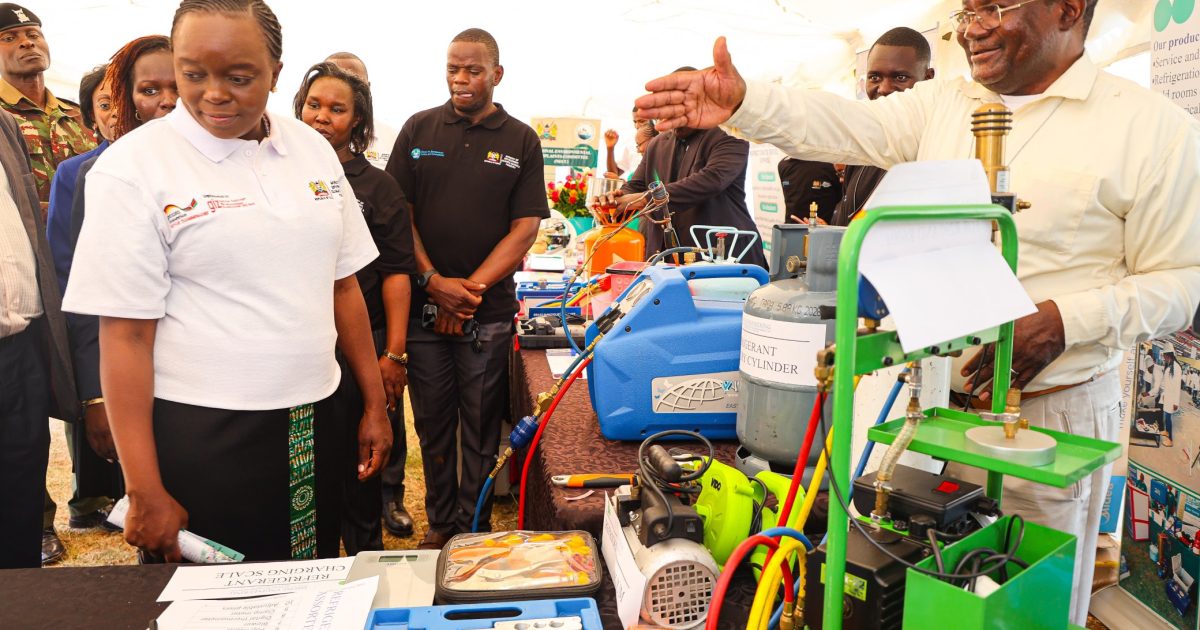
Kenya, in collaboration with the Government of France, GIZ, and local training institutions, has been training refrigeration and air conditioning technicians in good practices, while hospitals and institutions are also being equipped with modern tools that utilise climate-friendly technologies.
She added that the government is working closely with the Kenya Revenue Authority and the National Environment Management Authority to strengthen border controls and curb illegal trade in controlled substances.
“Every Kenyan child, farmer, student and worker deserves a healthy life shielded from the dangers of ultraviolet radiation and extreme heat, but government action alone is not enough. Each one of us has to play a role through the energy we use, the waste we manage, and the trees we plant,” she said.
The CS further announced that in November Kenya will host the 37th Meeting of the Parties to the Montreal Protocol (MOP 37) at the United Nations Environment Programme (UNEP) headquarters in Nairobi, a global gathering expected to reaffirm commitment to ozone protection and climate action.
Environment and Climate Change Principal Secretary Eng Festus Ng’eno, in remarks delivered on his behalf by Environment Secretary Dr Selly Kimosop, said Kenya has made significant progress in fulfilling its obligations under the Montreal Protocol and Kigali Amendment.
He noted that Kenya is fully compliant with its hydrofluorocarbon (HFC) phase-down obligations and is working to meet upcoming reduction targets.
“In partnership with GIZ through the ProClima team, Kenya validated its first national inventory of ozone-depleting substances and HFCs in mid-2025, strengthening policy planning for recovery and destruction of these controlled substances,” Eng. Ng’eno said.
He said more than 2,000 refrigeration and air conditioning technicians have already been trained in safe handling of climate-friendly refrigerants, while over 150 customs officers have been trained to enforce import and export controls on ozone-depleting substances.
He urged Kenyans to support the use of natural refrigerants such as propane and isobutane, which are safer alternatives to harmful chemicals.
Eng. Ng’eno emphasized that ozone protection requires effort at all levels of society.
“Consumers choosing cleaner appliances, technicians ensuring safe servicing and our youth championing innovation are all crucial. Together, we can keep our skies blue, our air clean and our planet safe,” he said.
Deputy Executive Secretary of the Ozone Secretariat, Ms. Maria Socorro Manguiat, commended Kenya for its leadership in advancing the goals of the Vienna Convention and the Montreal Protocol.
She said the Montreal Protocol has phased out 99 percent of ozone-depleting substances globally and remains one of the most successful treaties in history.
“By 2030, the successful implementation of the Montreal Protocol will prevent about 2 million skin cancer cases every year and millions of cataract cases worldwide. Kenya has played an active role in these global efforts and we look forward to returning here for MOP 37,” she said.
She added that the theme of this year’s celebrations, “From Science to Global Action,” underscores the power of scientific evidence to inspire bold global decisions and effective solutions.
Programme Director for Energy, Transport and Climate Change at the German Embassy, Ms. Hanna Salian, said Germany remains committed to supporting Kenya through the ProClima programme implemented by GIZ.
She said green cooling technologies are already proving effective by combining energy-efficient appliances with natural refrigerants that neither harm the ozone layer nor significantly contribute to climate change.
“Cooling is part of daily life, but traditional systems damage the ozone layer and heat the planet. Green cooling offers a solution by using sustainable technologies that are safer for the environment and more affordable in the long run,” she said.
Salian revealed that since 2010, over 1,000 Kenyan technicians have been trained in safe handling of natural refrigerants, while 15 technical institutions have integrated the knowledge into their curricula.
Kenya has also emerged as a regional hub, hosting training for experts from 12 African countries.
Germany has further supported enforcement by equipping more than 200 customs officers with analyzers to detect harmful substances at border points.
Salian said Germany’s broader climate partnership with Kenya, valued at €450 million, includes support for renewable energy, green hydrogen, e-mobility and climate-resilient agriculture.
The World Ozone Day 2025 event was marked under the theme “40 Years of the Vienna Convention: From Science to Global Action.”
By Naif Rashid and Mary Ndanu