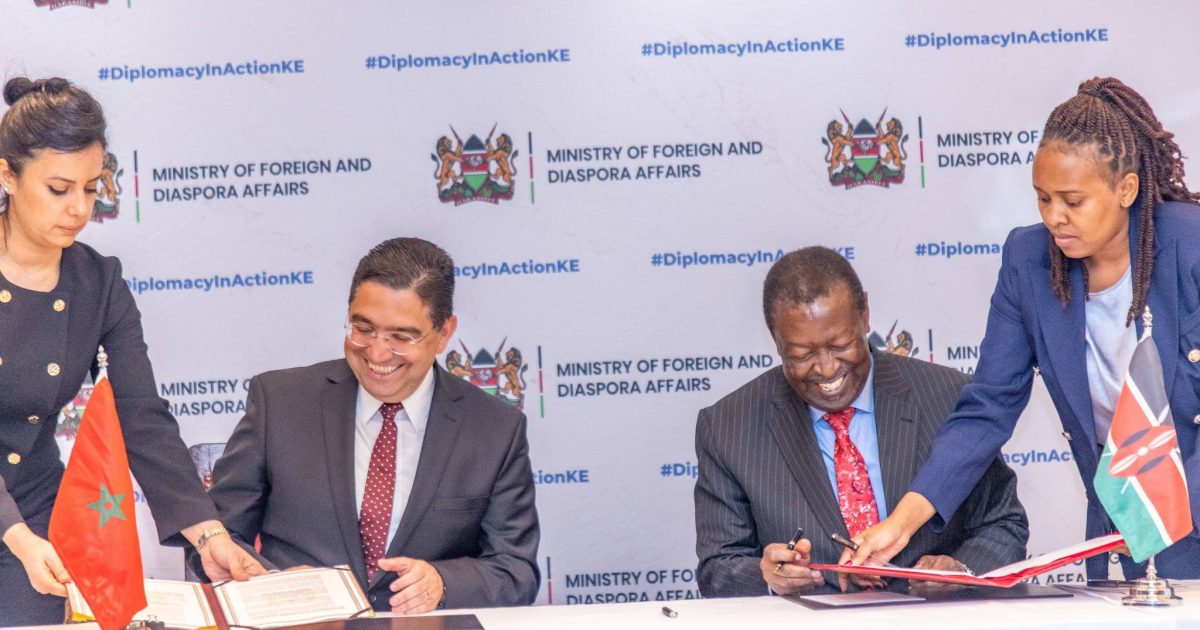
Kenya and the Kingdom of Morocco have reaffirmed their commitment to deepening bilateral cooperation following high-level talks aimed at strengthening political, economic and development ties between the two countries.
Speaking during the Ministerial Session of the inaugural Kenya–Morocco Joint Commission for Cooperation in Nairobi, Prime Cabinet Secretary (PCS) and CS for Foreign and Diaspora Affairs Musalia Mudavadi noted that the meeting marked a significant step in advancing relations from traditional cooperation to a more structured strategic partnership.
Mudavadi observed that the Joint Commission reflects a deliberate decision by the two governments to institutionalise engagement and expand collaboration across key sectors.
“This Joint Commission convenes at a defining moment in Kenya–Morocco relations. It reflects a shared political choice by our two governments to elevate our engagement from cordial cooperation to a structured strategic partnership anchored in clear priorities, institutional follow-through and measurable impact,” he reiterated, reaffirming Kenya’s commitment to strengthening ties with the North African nation.
Further, the Prime CS while welcoming the Moroccan delegation led by Minister of Foreign Affairs of Morocco Nasser Bourita, reaffirmed that Kenya and Morocco have maintained cordial diplomatic relations for nearly six decades that are founded on mutual respect and a shared commitment to Africa’s development.
Importantly, Mudavadi disclosed that the inaugural commission would see the signing of 11 bilateral cooperation instruments covering key sectors including agriculture, justice, health, fisheries and aquaculture, gender equality and women empowerment, cultural cooperation, higher education, scholarships, sports, immigration and wildlife conservation.
“These instruments will serve to translate our shared commitments into practical and impactful cooperation,” stated the Prime CS.
He added that the agreements come at a time when global economic and geopolitical shifts are pushing African countries to build stronger partnerships that support resilient development and sustainable growth.
On the other hand, Mudavadi said Kenya views Morocco as a strategic partner in advancing trade, investment and industrial development, particularly in sectors where Morocco has demonstrated comparative strength, such as renewable energy, automotive manufacturing, agro-processing, pharmaceuticals and infrastructure development.
He also stressed the importance of improving connectivity between the two countries, noting that stronger transport links and the movement of people would accelerate trade, tourism and innovation.
“Connectivity and mobility are critical enablers of our shared ambitions,” he affirmed.
Mudavadi further highlighted that Kenya and Morocco share common positions within international platforms such as the African Union and the United Nations, where both advocate for multilateral cooperation and African-led solutions to global challenges.
He, therefore, emphasised that the success of the Joint Commission would depend on the effective implementation of the agreements.
“The true measure of our success will lie not in the documents we sign, but in the impact of our cooperation on the lives of our citizens,” Mudavadi pronounced.
In his remarks, Bourita maintained that the meeting demonstrated the strong commitment of both governments to strengthening relations and expanding cooperation across multiple sectors.
“We meet today within the framework of a steadfast commitment to strengthening the framework of bilateral cooperation and reinforcing the strong bonds of friendship that unite our two countries and our peoples,” Bourita remarked.
He described Mudavadi’s official visit to Morocco in May 2025 as a turning point in bilateral relations, revealing that the visit led to the signing of several cooperation agreements and the opening of Kenya’s embassy in Rabat.
Additionally, Bourita echoed that the growing partnership reflects the commitment of Morocco’s leadership and the Kenyan government to building stronger African alliances that support development, stability and prosperity across the continent.
“We are today driven by a genuine desire to continue strengthening these strong bonds and building an effective and fruitful partnership,” the Moroccan Foreign Minister asserted.
He at the same time added that Morocco and Kenya possess complementary economic strengths that can significantly boost cooperation in areas such as transport, renewable energy, mining, tourism, the digital economy, and agro-industrialisation.
However, Bourita observed that despite strong diplomatic relations, trade volumes between the two countries remain relatively low compared to their potential and called for stronger engagement between governments, the private sector and other stakeholders.
“Morocco, with its strategic position as a gateway to Europe and its advanced manufacturing base, and Kenya with its dynamic entrepreneurial ecosystem and leadership in digital innovation, are natural economic partners,” he elaborated.
Similarly, the Moroccan minister reiterated that the Joint Commission provides a platform to strengthen the legal and institutional framework guiding cooperation between the two nations.
However, he stressed that the key challenge would be translating agreements into tangible projects that benefit citizens in both countries.
“There is no doubt that the convening of this joint commission represents a decisive turning point in strengthening our bilateral cooperation. The real challenge remains effective implementation and translating signed agreements into concrete projects on the ground,” Bourita said.
Meanwhile, both leaders expressed confidence that the Joint Commission for Cooperation would unlock new opportunities for economic collaboration and strengthen the partnership between Kenya and Morocco as the two nations work together to advance development and integration across Africa.
By Nicholas Ochieng and Nyawira Githinji