Kenya has reaffirmed her commitment to strengthening Micro, Small and Medium Enterprises (MSMEs) as engines of economic growth and regional integration.
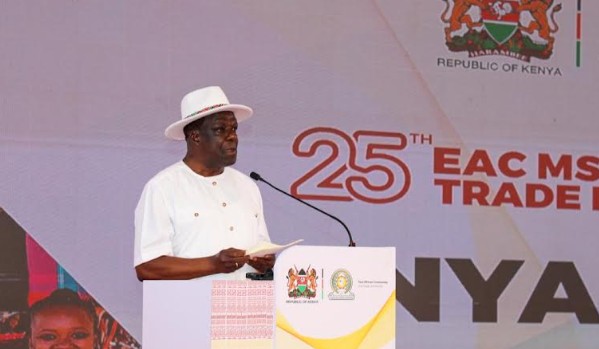
Cabinet Secretary (CS) for Cooperatives and MSME Development, Wycliffe Oparanya, said the trade fair marks an important milestone in advancing Kenya’s Bottom-Up Economic Transformation Agenda (BETA), which identifies MSMEs as a key driver of job creation and inclusive development.
Oparanya, speaking on Monday during the 25th East African Community (EAC) MSME Trade Fair held at Uhuru Gardens, Nairobi, said MSMEs contribute about 30 per cent of Kenya’s Gross Domestic Product (GDP) and account for over 90 per cent of all jobs.
He noted that the government is focused on addressing barriers such as limited market access, inadequate financing and technological challenges to boost productivity in the sector.
“This year’s theme on advancing innovation and regional value chains resonates with Kenya’s economic priorities, including agriculture transformation, MSME development, affordable housing, universal healthcare, digital infrastructure and the creative economy,” said the CS.
He added that the trade fair provides a platform to recognise the resilience of small enterprises and a forum for stakeholders to discuss access to finance, skills development and technology adoption.
“The region’s greatest opportunity for addressing youth unemployment lies in entrepreneurship, particularly youth-led innovation and enterprise development,” he said.
Oparanya called for stronger collaboration among policymakers, financiers and development partners to create a supportive ecosystem that enables MSMEs to thrive.
Cabinet Secretary for East African Community (EAC) Affairs, Beatrice Askul, said the 25th MSME Trade Fair coincides with Kenya’s tenure as EAC chair, offering an opportunity for member states to assess progress and strengthen regional trade.
She noted that the fair, which began in 1999, has grown into a major platform for MSMEs to access markets, enhance product quality and build networks across the region.
“It is a great honour for Kenya to host this 25th trade fair as the chair of the community.
MSMEs contribute over 60 per cent of employment and 29 per cent of regional GDP, playing a critical role in poverty reduction and women and youth empowerment.” said Askul.
Askul said the EAC Industrialisation Policy (2012–2032) and Vision 2050 guide partner states in improving competitiveness and innovation, in line with the African Union’s Agenda 2063 on industrial transformation.
“The EAC is committed to strengthening MSME competitiveness through innovation and value addition to tap into intra- and inter-regional trade opportunities,” she said.
She urged member states to harmonise policies and address challenges such as limited access to finance, high energy costs and inadequate infrastructure.
African Continental Free Trade Area (AfCFTA) Secretary-General, Wamkele Mene, commended Kenya for its leadership in advancing the pan-African economic integration agenda and its contribution to MSME development.
“Congratulations to Kenya for successfully leading the East African Community during President William Ruto’s tenure and for its continued leadership in pan-Africanism,” said Mene.
He said the AfCFTA has so far been ratified by 15 countries, with over 25 tariff offers gazetted, enabling intra-African trade in key sectors such as agro-processing, textiles, manufactured goods and pharmaceuticals.
“The AfCFTA is not just a trade agreement but a framework for industrial development, innovation and inclusive growth; we are encouraged that trade is taking place in sectors that require value addition,” he said.
Mene said the AfCFTA Secretariat had secured a $1.2 billion facility to finance the automotive industry, enabling local vehicle and component production.
“In partnership with the Master Plant Foundation and TradeMark Africa, we are implementing a four-year fisheries programme in Kenya, Uganda, Tanzania and the DRC that will create 240,000 jobs and boost fish trade by $100 million by 2030,” he said.
He added that the AfCFTA had endorsed a ban on second-hand clothing imports to protect Africa’s textile industries and attract new investment, and that a pooled procurement mechanism is being developed with the Africa CDC to enhance pharmaceutical production on the continent.
Mene said MSMEs, which account for 80 per cent of jobs and over half of Africa’s GDP, must be at the centre of industrial transformation.
“Investment in value chains such as agriculture, automotive manufacturing and pharmaceuticals will unlock over $130 billion in opportunities across Africa,” he said.
Principal Secretary, State Department for MSMEs, Susan Mang’eni, said the fair had brought together more than 3,000 exhibitors and key partners from the International Trade Centre (ITC), UN agencies and the World Bank to discuss MSME competitiveness and financing.
“This Kenyan Day provides an opportunity to discuss how MSMEs in East Africa can expand their market access and strengthen their competitiveness under AfCFTA and EAC frameworks,” she said.
Mang’eni said the trade fair has evolved over 25 years into a platform for policy dialogue and business networking aimed at empowering entrepreneurs.
“The fair symbolises a new generation of enterprises that are bold, innovative and ready to compete globally,” she said.
She called on governments and development partners to support MSMEs through capacity building, affordable financing and access to regional and international markets.
“As a government, we are committed to creating an enabling policy environment and building strong linkages between MSMEs and industrial value chains,” she said.
The trade fair brought together EAC partner states, regional organisations and private sector actors to assess progress made in regional economic cooperation.
Delegates agreed to deepen collaboration under the AfCFTA and EAC frameworks to unlock investment opportunities for MSMEs and accelerate Africa’s industrial growth.
By Naif Rashid and Darlene Kuria