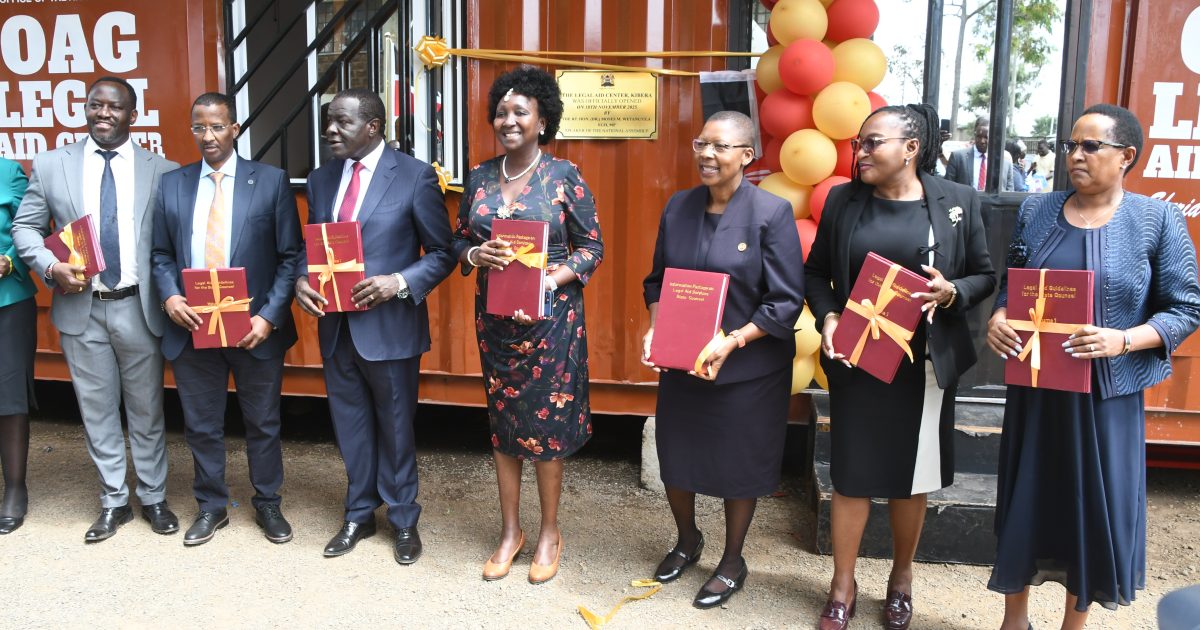
Kenya has strengthened its commitment to equitable justice with the launch of a new Legal Aid Centre at the Kibera Law Courts Complex, a development expected to significantly expand legal assistance for the vulnerable, low-income and marginalised communities.
The Centre, commissioned under the National Legal Aid Service (NLAS) programme, is part of a wider national roll-out designed to operationalise the Legal Aid Act, 2016 and ensure that no Kenyan is denied justice due to poverty, limited information or geographical barriers.
In a speech delivered on his behalf by the National Assembly Deputy Speaker, Gladys Boss Shollei, the National Assembly Speaker, Moses Wetang’ula, described the launch as both timely and transformative.
Wetang’ula viewed the initiative as a strong reaffirmation of the State’s duty under Article 48 of the Constitution, which obligates government institutions to guarantee that justice is not hindered by cost, bureaucracy or procedural rigidity.
He noted that despite ongoing legal and institutional reforms, many Kenyans continue to encounter justice-related challenges that they cannot navigate without professional assistance.
The Speaker stressed that a fair and responsive justice system, must deliberately accommodate vulnerable and marginalised groups, including widows seeking succession services, children entangled in the justice chain, victims of crime, survivors of gender-based violence, informal workers and communities grappling with land or tenancy disputes.
“The launch of this Centre, reflects our collective resolve to dismantle the barriers that prevent many people from asserting their rights,” he observed, emphasizing, “Access to justice is not a privilege, but a constitutional right, that must be realised in practical terms,”
Wetang’ula commended the Office of the Attorney General, for steering the programme with consistency, innovation and strong alignment to national justice priorities.

He further affirmed Parliament’s commitment to strengthening legal frameworks, that support legal aid services and ensuring adequate budgetary allocations, to sustain such operations across the country.
The Attorney General (AG), Dorcas Oduor, pointed-out that the Centre represents a major leap forward in realising Kenya’s promise of inclusive justice.
She described Kibera, a community with pressing legal needs, as a fitting site for the programme’s expansion and said the Government remains committed to ensuring that justice services are ‘visible, accessible, professional and trusted’.
Oduor announced that 90 newly recruited State Counsels have already been deployed across all counties, and two of them will be based at the Kibera Legal Aid Centre.
Their duties, she stated, will include offering legal screening, facilitating alternative dispute resolution, coordinating pro-bono advocates, and supporting community education initiatives.
The AG described the new legal aid model as deliberate, establishing that the Centres are equipped with private service booths, solar power, virtual court capability and spaces for mediation and victim support.
She at the same time disclosed that the Government is rolling-out specialized desks, including on victim protection and the Power of Mercy to broaden the scope of assistance offered to Kenyans.
Oduor emphasised priority areas such as land and inheritance disputes, protection of widows and orphans, support for children in conflict with the law, and guidance for victims seeking compensation or property recovery.
She affirmed that the Government will continue partnering with the Judiciary and Office of the Director of Public Prosecution (ODPP), to ensure no child undergoes unnecessary criminalization, due to structural or social vulnerabilities.
“This Centre belongs to the people of Kibera. Use it, safeguard it, and let it be the pathway that brings justice closer to every household,” she proclaimed.
The Principal Secretary (PS) for Justice, Human Rights, and Constitutional Affairs, Judith Pareno, praised accessibility as the guiding principle behind the new Centres, emphasizing “they are designed as open doors for every Kenyan to begin their justice journey, without hindrance”.
She pointed to the container-based model mobile, solar-powered and community-friendly as a cost-effective formula that enables the State to decentralise legal services rapidly and sustainably.
The PS urged the Kibera community, to embrace the Centre as an important resource and encouraged young people, women’s groups, community leaders and vulnerable households, to seek assistance early when confronted with legal issues.
Pareno also commended the symbolic value of the Centre’s portrait of a national leader, saying the values depicted, including patriotism, dignity, equality and democracy are fundamental to justice.
Mombasa Governor, Abdulswamad Sheriff Nassir, revealed that Mombasa County has been experiencing increasing legal needs, arising from land matters, child protection, gender-based violence, tenancy conflicts and property disputes.
Nassir announced that his County will establish six Sub-county legal aid clinics, each focusing on high-demand areas and community-specific challenges.
He mentioned that these clinics will ease the burden on court registries, improve legal literacy and serve as practical training grounds for young advocates, seeking hands-on experience.
“At the County level, we are ready to partner with the Attorney General and NLAS, so that residents can access justice close to their homes. Let us formalize this through an MOU and expand these services to every Sub-county in Mombasa,” stated Nassir.
Likewise, the Governor stressed that justice delivery must be a shared responsibility between national and county governments, noting that legal aid plays a crucial role in protecting vulnerable households, reducing exploitation and supporting peaceful communities.
He called on both public and private stakeholders, to embrace collaborative models, saying Legal Aid Centres should become hubs, where residents find guidance, mediation, referral services and empowerment.
Independent Policing Oversight Authority (IPOA) Chairperson, Issack Hassan, also delivered remarks, praising the Attorney General for strengthening community-based justice.
Hassan urged NLAS to extend its reach to remote and refugee-hosting regions, where stateless persons, refugees, vulnerable youths and displaced families, often lack access to legal assistance.
“Access to justice must be felt in border communities, informal settlements and among people in conflict with the law,” demanded the Chairperson, insisting that many policing matters intersect directly with vulnerable groups.
He encouraged development partners to support the expansion of legal-aid services beyond major urban centres, where demand is equally urgent.
By Naif Rashid