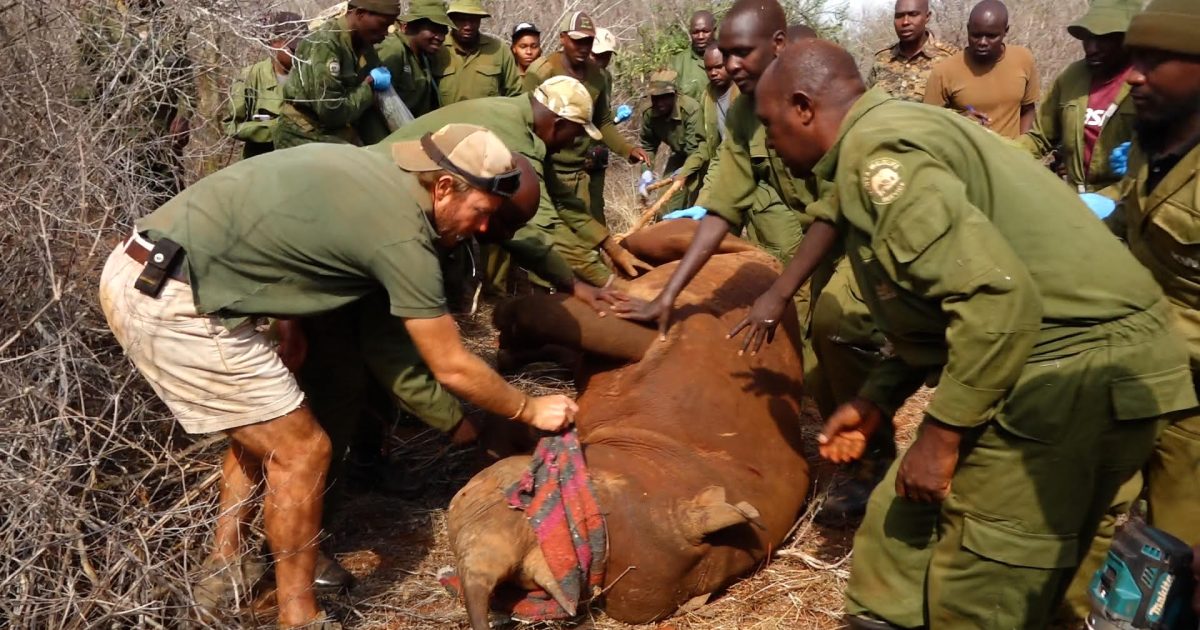
Kenya Wildlife Service has tagged 74 black rhinos at Ngulia Rhino Sanctuary in the first 10 days of the country’s largest rhino ear-notching operation, with over 100 animals expected to receive tracking devices before the 15-day exercise concludes.
The operation, which began on November 11 at Tsavo West National Park, is preparing rhinos for release into an expanded 3,000-square-kilometre range when sanctuary fences are removed by the end of the year.
Speaking at Ngulia Rhino Sanctuary on Friday, Dr Isaac Lekolool, Senior Assistant Director, Veterinary and Capture Services at KWS, said the operation aims to individually identify and track nearly all rhinos at Ngulia before the sanctuary boundaries are eliminated.
“We are doing both ear-notching and also fitting the rhinos with tracking devices. We try to achieve at least a 60% individual identification of the rhinos. This helps our security teams when they are doing their monitoring to ensure that when we are talking about the actual numbers, we are talking about close to the actual numbers,” said Dr Lekolool.
He added that the Ngulia operation is targeting close to 70% coverage of the sanctuary’s rhino population.
Each animal is being fitted with LoRaWAN ear tags and VHF transmitters that will enable rangers to monitor movements in near-real-time once rhinos begin dispersing across Tsavo West National Park.
The expansion will increase rhino habitat from the current 92 square kilometres at Ngulia to over 3,000 square kilometres, making it one of the largest single-range expansions in Kenya’s conservation history.
The technology-driven approach represents a shift from the physical containment that has characterised rhino conservation in Kenya for over three decades.
The operation forms part of the Kenya Rhino Range Expansion (KRRE) Initiative, which aims to address overcrowding in existing sanctuaries that has led to increased territorial conflicts among rhinos.
Dr Lekolool said the cramped conditions in small sanctuaries are reducing breeding rates despite successful conservation efforts over the past three decades.
“By opening up the sanctuaries to greater areas, we are giving them more room, more space to be able to breed more,” he said, explaining that territorial fights in confined spaces are slowing population growth.
Kenya’s rhino population has grown from a low of 381 animals in 1990 to over 1,000 in 2024, but most remain confined to small, intensively protected sanctuaries established during the poaching crisis of the 1970s and 1980s.
The country had approximately 20,000 rhinos before poaching reduced numbers to near-extinction levels by 1990.
“In the 1960s and 1970s, we had over 20,000 rhinos. These numbers dropped to about 380 by the time the Kenya Wildlife Service was being put in place in 1989,” said Dr Lekolool.
The veterinarian explained that achieving 100% identification of rhinos remains impossible due to safety concerns, stating, “We avoid the very young ones and their mothers because we cannot separate them.”
He noted that immobilising young calves risks separating them from their mothers and putting them in danger.
The 60% threshold balances conservation needs with animal welfare, ensuring accurate population monitoring without endangering vulnerable individuals.
Jamie Gaymer, CEO of the Kenya Rhino Range Expansion Initiative, said his organisation is supporting KWS by constructing water pans and erecting electric fencing throughout the expanded sanctuary.
“We are supporting the Kenya Wildlife Service to achieve rhino conservation imperatives, particularly around expanding rhino range in Kenya. But it’s much bigger than rhinos.
It’s about positive ecological outcomes as well as positive social outcomes. We are looking to drive employment and investment into the local economies,” Gaymer said, emphasising the initiative’s broader economic and ecological objectives beyond species conservation.
The initiative targets two areas for rhino expansion: the Central Kenya region and the Tsavo ecosystem.
According to KWS Director General Prof. Erustus Kanga, the programme aims to increase Kenya’s rhino population to 2,000 by 2037 and 3,900 by 2050, while expanding rhino habitat to cover over 34,000 square kilometres, which is nearly six percent of Kenya’s landmass.
Prof. Kanga described the initiative as more than a conservation project, calling it a once-in-a-generation opportunity to transform Kenya’s ecological and socioeconomic landscape.
Dr. Lekolool said mobile veterinary units will continue monitoring rhino health after the fence removal, using what he described as a “One Health approach” that tracks diseases across wildlife, livestock, and human populations.
“We keep close tabs on the diseases that affect even the livestock populations in neighbouring communities. So, we have a One Health approach where we have the livestock, the wildlife, and also the human health aspects being taken into consideration,” he explained.
The units maintain surveillance of zoonotic diseases reported in neighbouring communities to prevent outbreaks that could affect wildlife populations.
The comprehensive health monitoring system extends beyond rhinos to all wildlife in the expanded range. Dr Lekolool said KWS veterinarians maintain close interaction with animals through mobile units, keeping tabs on disease patterns that emerge in both wildlife and domestic livestock.
When zoonotic diseases appear in livestock or are reported at local dispensaries, veterinary teams investigate to confirm whether wildlife populations are affected, creating an integrated disease surveillance network.
The Kenya Rhino Range Expansion Initiative projects that the programme will create over 18,000 jobs and generate $45 million in local conservancy revenue by 2030, while adding $15 million annually in tax income.
The economic projections position local communities as direct beneficiaries of rhino conservation, with Prof. Kanga emphasising that the model treats communities as true partners, not mere beneficiaries, in conservation efforts.
The initiative involves partnerships between KWS, the Kenya Wildlife Conservancies Association, the Wildlife Research and Training Institute, private conservancies, and international conservation experts.
The 15-day operation is scheduled to conclude by the end of November, after which preparations for fence removal will begin ahead of the planned December release.
Once the barriers come down, Ngulia’s rhinos will begin dispersing across Tsavo West National Park, marking the beginning of what conservationists hope will be a new era of sustainable rhino population growth across expanded ranges that mirror the species’ historical distribution in Kenya.
By Arnold Linga Masila