Kenya has reaffirmed its frontline role in global environmental diplomacy ahead of the 7th Session of the United Nations Environment Assembly (UNEA-7), set to take place from 8th to 12th December 2025 at the UNEP Headquarters in Nairobi.
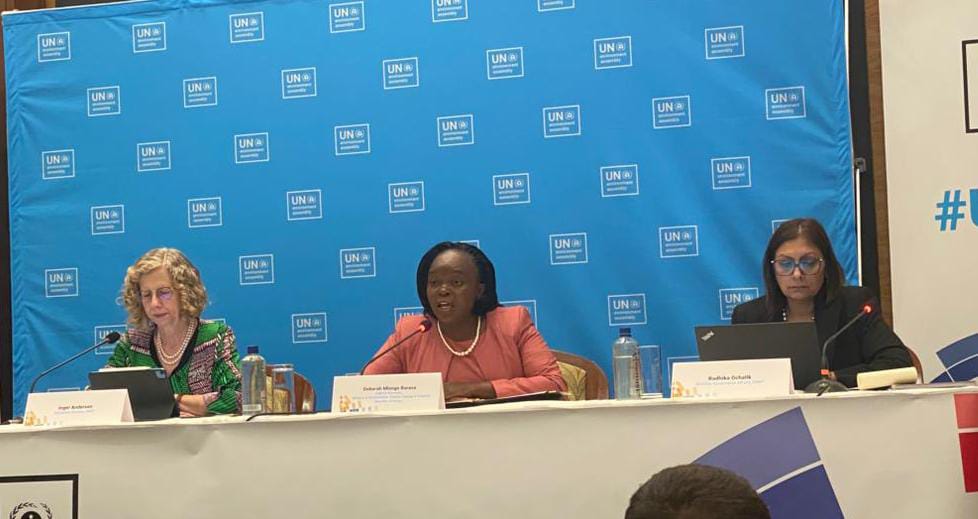
Speaking on Friday during a briefing in Nairobi ahead of UNEA 7, Cabinet Secretary for Environment, Climate Change and Forestry Dr Deborah Barasa said Kenya was not only hosting the world’s ministers and leaders on environmental matters but also using the platform to advance Africa’s collective voice.
“UNEA 7 presents Kenya with a strategic opportunity to reaffirm our leadership in global environmental governance, strengthen partnerships, and guide discussions that align international priorities with our constitutional commitments to a clean and healthy environment,” Barasa said.
She emphasised that Kenya will sponsor three resolutions on antimicrobial resistance, sustainability of artificial intelligence systems, and promoting resilient, sustainable solutions.
“A strong plastic treaty, for instance, will protect ecosystems, communities, and farmers against climate shocks, and we will not support a treaty that merely manages waste,” she added.
Barasa also highlighted Kenya’s domestic environmental achievements, including restoration initiatives and the 15-billion-tree-growing programme, which the country will showcase during UNEA 7 exhibitions and side events.
She said the government has prepared to facilitate delegates’ arrival through free electronic travel authorisations, a branded help desk at Jomo Kenyatta International Airport, and a diplomatic police unit to ensure security.
Kenya’s leadership will extend to representing Africa’s priorities in sustainable natural resource management, equitable energy transitions, and enhanced climate action.
“Ambitious environmental action requires predictable financing, accessible technology transfer, and capacity building for developing countries. We seek decisions at UNEA 7 that will result in tangible benefits for our farmers, youth, communities, and ecosystems,” CS Barasa said.
UNEP Executive Director Inger Andersen praised Kenya for its longstanding support and called Nairobi the “world’s revival capital,” underlining the importance of multilateralism in tackling the interconnected planetary crises of climate change, biodiversity loss, and pollution.
“We are expecting over 3,500 delegates, including more than 60 ministers, to discuss 19 draft resolutions on issues ranging from artificial intelligence and minerals management to wildfires and glaciers,” Ms. Andersen said.
She also highlighted the release of the Global Environmental Outlook report at UNEA, noting that science-based guidance will inform multilateral decision-making.
UNEP Director of Governance Affairs, Radhika Ochalik, outlined practical aspects of UNEA 7, including the formal opening on 8 December, the Multilateral Environmental Agreements Day on 10 December, and the high-level segment on 11 and 12 December, which will feature leadership dialogues and national statements.
She noted that 16 draft resolutions and three draft decisions will be negotiated by member states across four clusters covering nature and climate, governance and law, chemicals and waste, and strategic and procedural matters.
Barasa stressed Kenya’s multisectoral approach to air quality management, coordinated between the Ministries of Environment and Health, with legal and regulatory frameworks, monitoring, enforcement, and capacity building measures in place.
UNEP leaders also emphasised the need for responsible mineral and metal governance, circularity, and equitable climate finance, highlighting Kenya’s early investments in renewable energy and ongoing leadership in clean technologies.
The briefing underscored Kenya’s readiness to host UNEA 7 as a global hub for environmental diplomacy, with strong commitments to multilateral cooperation, actionable resolutions, and innovative approaches that integrate sustainability with economic growth.
By Naif Rashid and Darlene Kuria