African leaders have renewed calls for urgent and coordinated action to address the continent’s escalating environmental challenges during the 20th Ordinary Session of the African Ministerial Conference on the Environment (AMCEN), currently underway in Nairobi.
The high-level forum, attended by ministers and delegates from 33 African countries alongside United Nations agencies and international organisations, marks a key milestone in the continent’s four-decade journey of environmental policy development. It also provides a crucial opportunity for African countries to refine their unified voice in global environmental negotiations.
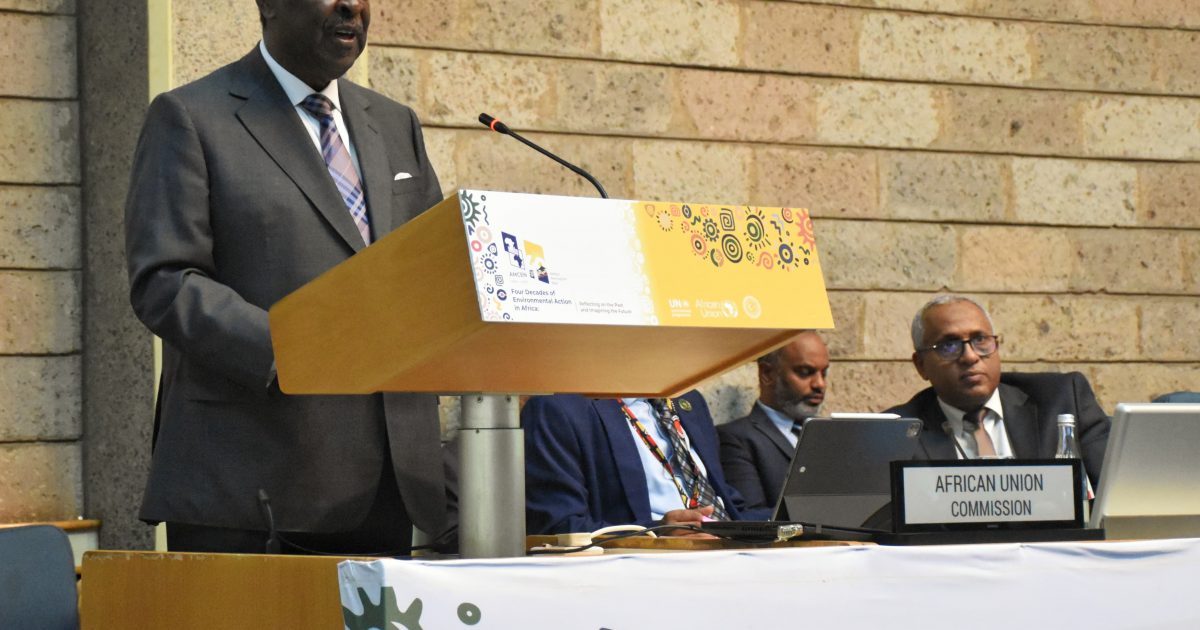
Speaking during the ministerial session in Gigiri, the Prime Cabinet Secretary, Musalia Mudavadi, underscored the significance of the gathering.
“This gathering provides a vital forum for shaping Africa’s coordinated engagement in upcoming global platforms, including COP30, the Global Plastics Treaty negotiations, and the United Nations Environment Assembly,” he said.
He cited alarming reports from the World Meteorological Organisation and the United Nations Environment Programme (UNEP), noting that the average global temperature has already surpassed the critical 1.5°C threshold, while plastic pollution continues to rise to dangerous levels.
“These trends threaten Africa’s hard-won development gains. Without urgent, transformative action, we risk eroding progress made over decades,” he cautioned.
Mudavadi called for strengthened support for UNEP’s Nairobi headquarters and advocated for the permanent establishment of both the Science Policy Panel and the Secretariat of the Global Plastics Treaty within the city.
He also applauded Kenya’s proactive environmental initiatives, including a nationwide ban on plastic bags, biodiversity conservation efforts, and inclusive youth participation in environmental decision making.
“As we convene amid a global retreat in development finance, let us remain resolute in shaping a greener, more sustainable Africa,” he concluded, urging ministers to deliver bold and actionable outcomes aligned with Africa’s Agenda 2063 and the global 2030 Sustainable Development Goals.
Echoing the urgency, Environment Cabinet Secretary Debora Mlongo called on African nations to enhance regional cooperation and accelerate climate-resilient development. Representing the host country.
Mlongo welcomed participants and reflected on recent environmental crises that have affected the continent, from extreme droughts and cyclones to deadly floods and cholera outbreaks.
“Climate change is not a distant threat it is here and now. It is a public health emergency, an economic crisis, and an ecological tragedy rolled into one,” she said.
Mlongo praised AMCEN’s legacy since its founding in 1985, particularly its role in shaping landmark multilateral agreements such as the UN Framework Convention on Climate Change (UNFCCC) and the Convention on Biological Diversity (CBD). However, she noted that Africa still grapples with inadequate financing, weak enforcement of environmental laws, and persistent data gaps.
“Let AMCEN-20 not be just a milestone, but a turning point. Africa must lead, not wait to be rescued,” she declared.
Highlighting Kenya’s recent environmental advancements, Mlongo pointed to key legislative frameworks such as the Climate Change Act and the Sustainable Waste Management Act. She also reaffirmed Kenya’s commitment to hosting the 7th United Nations Environment Assembly (UNEA-7) later this year, where African nations will once again have an opportunity to influence global climate policy.
Adding a continental perspective, Ibrahim Moutiour, Executive Secretary of the United Nations Convention to Combat Desertification (UNCCD), hailed AMCEN as the “foundation of African environmental diplomacy.”
He commended AMCEN’s early recognition of desertification as a critical threat, a foresight that contributed to the adoption of the UNCCD at the 1992 Rio Earth Summit.
“Over the past 70 years, Africa has lost 60% of its arable land while its population has grown sixfold. AMCEN was right to act early,” said Moutiour.
He outlined three priority areas moving forward: strengthening political will to drive policy implementation, increasing investment in sustainable development, and linking land restoration with peace and stability.
Making her remarks, UNEP Deputy Executive Director Elizabeth Mrema urged African nations to align their environmental priorities for 2025 to 2027 with both Agenda 2063 and the Sustainable Development Goals.
“Our challenges are evolving, and so must our responses. We must strengthen the implementation and monitoring of AMCEN decisions to ensure they result in real, measurable impact on the ground,” said Mrema.
As AMCEN-20 continues, delegates will deliberate on key policy areas including climate resilience, biodiversity conservation, pollution control, and green financing. The conference is expected to shape Africa’s unified environmental strategy in global negotiations and influence the continent’s sustainable development trajectory.
By Joan Ogolla