Murang’a residents have expressed diverse opinions on the proposed sale of part of the Safaricom shares owned by the government to Vodacom.
Currently, the government of Kenya owns about 35 per cent of Safaricom shares, the Vodacom Group owns about 40 per cent, while public shareholders including ordinary Kenyans own 25 per cent.
The government intends to raise funds for building roads, electricity, water projects, airports and other critical infrastructure, while reducing borrowing and without increasing taxes.
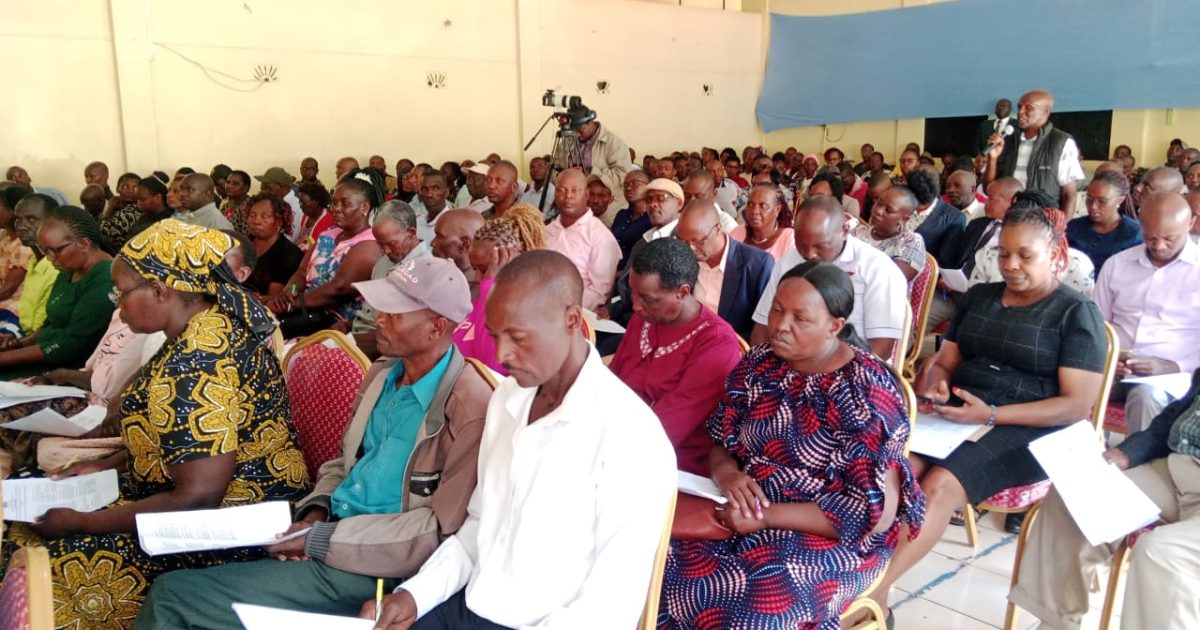
Speaking during a public participation forum held at Murang’a University of Technology, residents expressed both approval and disapproval, with issues of transparency and accountability taking centre stage.
One resident, Edith Kimani, questioned the sustainability of selling national assets, asking how the country would maintain the infrastructure once it is built.
“I oppose the sale because even if we use the money to build infrastructure, we will still need more money to maintain it, so I do not think selling the shares is the solution,” she said.
Another resident, Mary Mwangi, also opposed the sale, noting that the government already collects taxes. She alleged that the government is spending a lot of money on handouts and urged that such funds be redirected to development.
“The government is already collecting a lot of money from taxes. They should put that to use first,” she said.
Ian Otieno, a student leader at Murang’a University, opposed the sale, saying the government should first seal revenue leakages by intensifying the fight against corruption and recovering lost public funds before selling national assets.
“Why would the government sell an asset that generates about Sh16 billion a year for a one-off sale that will be used within one financial year?” he posed.
However, he proposed that if the shares must be sold, Kenyans should be allowed to buy part of them.
On the other hand, Stephen Waithaka supported the sale but recommended that 10 percent be sold to Vodacom, with the remaining 5 per cent being sold to the public.
“I support the sale, but let Vodacom get 10 per cent while five percent is sold to the public, so that Kenyans can own part of the company they love,” he said.
Murathi Magochi also supported the sale but raised concerns about giving a majority stake to a foreign company, noting that this would mean Kenyans would no longer have control over Safaricom.
Stephen Mwangi supported the sale but expressed concerns over accountability and transparency, saying he feared the funds could be diverted to other uses as has happened in the past.
“I support the sale, but I would suggest it be done after the 2027 general election so that the money is not diverted to campaigns,” he stated.
Kesses Member of Parliament Julius Rutto, who chaired the public participation forum in Murang’a, applauded residents for turning up to present their views on the important matter, noting that all opinions were recorded for consideration.
He assured them that Parliament would put laws in place to ensure that once the shares are sold, the money will be used for the intended purposes.
If the government sells 15 per cent of its shares out of the 35 per cent it currently owns, it will retain 20 per cent ownership, while Vodacom’s shareholding will increase to 55 per cent.
The sale of the 15 per cent stake is expected to raise about Sh204 billion in cash.
In addition, the government will receive an advance payment of Sh40 billion against future dividends from the remaining 20 percent and repay about Sh55 billion over six years using dividends from the unsold shares.
Also present at the public participation were Bomachoge Borabu MP Nolfason Barongo, National Government Administrative Officers (NGAO) led by Murang’a East Deputy County Commissioner Charles Muriithi, as well as various community leaders and opinion shapers.
By Purity Mugo