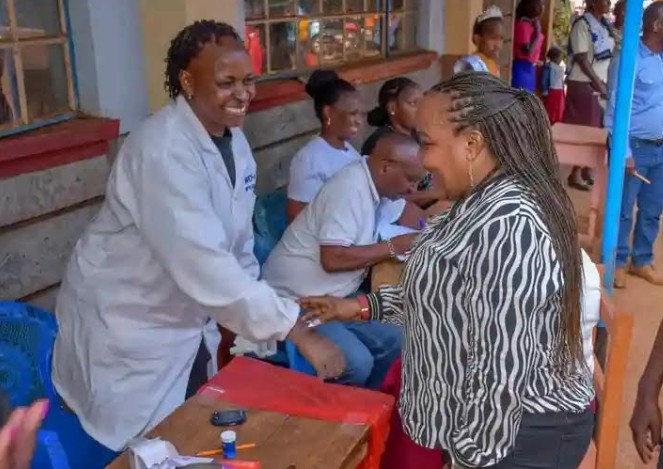
Hundreds of Kirinyaga town residents over the weekend turned up for free medical services, with health experts offering screening, consultation and treatment services.
The initiative led by Ms. Wangui Ngirici, Chairperson of Kenya Seed Company, aimed at improving access to healthcare for local communities.
Ms. Ngirici said healthcare challenges continue to affect many families across the country, particularly in rural areas where access to regular screening and treatment remains limited.
She noted that the medical camp had initially targeted about 1,000 residents, but the turnout exceeded expectations, with more than 2,500 people seeking services.
“The response has been overwhelming. We had planned to serve about a thousand residents, but more than 2,500 people have turned up seeking medical attention. This shows how much communities need such programmes,” she said.

Ngirici said the initiative also aimed to help residents detect diseases early through screening and receive immediate medical support for better health outcomes.
She promised to expand similar medical camps to other parts of Kirinyaga so that more residents can benefit from preventive healthcare services.
“Health challenges are affecting many Kenyans, and programmes like this help early diagnosis for timely treatment. We will continue organising similar camps across the county so that more people can access medical care,” she said.
Ngirici also advised residents to prioritise regular medical check-ups, noting that many illnesses can be managed effectively if detected early.
A clinical officer at the camp, Jonathan Ngichiri, said the outreach had provided a wide range of services, including cancer screening, general medical consultations and testing for non-communicable diseases such as diabetes and hypertension.
Ngichiri reiterated that the number of people who attended the clinic had surpassed the organisers’ expectations.
“We had projected to serve about 1,000 people, but the turnout has been much higher. Many residents came for screening and treatment, especially for non-communicable diseases,” he said.
He explained that cases of lifestyle-related illnesses were increasingly common in the region, stressing the need for regular screening to detect conditions early.
Ngichiri also noted that several young people had been referred for further treatment after doctors identified underlying health conditions during the screening exercise.
“Some of the cases we are seeing involve young people who were not aware they had certain health conditions. Screening helps identify such issues early so they can receive proper treatment,” he said.
He emphasised that healthcare delivery requires collaboration between the national and county governments and private partners to ensure communities access essential services.
Ngichiri urged residents to continue attending medical camps and routine health check-ups to protect themselves against serious illnesses.
Residents who attended the camp welcomed the initiative, saying it had helped them access medical services free of charge.
Elizabeth Wambui Munene, a resident, thanked Ngirici for organising the free medical outreach programme and called for more similar initiatives to support vulnerable members of the community.
“Many residents here struggle to afford medical services. This programme has helped many people get treatment and medicine they needed,” she said.
Another beneficiary, Gladys Njeri, urged the government to address the high cost of treatment in public hospitals, saying elderly citizens often face difficulties in accessing healthcare.
Jackson Waweru, another resident, also called on authorities to strengthen programmes supporting the elderly, noting that many older people face challenges accessing medical care due to financial constraints.
Meanwhile, Harrison Njeru, a resident from Kangai, urged young people to take advantage of such medical camps whenever they are organised.
“Many young people ignore medical screening programmes, yet they are important for detecting diseases early. Youth should take these opportunities seriously,” he said.
Njeru also encouraged young people to actively participate in community programmes and advocated for policies that address youth challenges.
He called on leaders and well-wishers to continue supporting vulnerable members of society through initiatives such as medical camps and empowerment programmes.
Residents said the outreach programme had helped address immediate health needs while also raising awareness about the importance of preventive healthcare in the community.
By David Wandeto