The Kerio Valley Development Authority (KVDA) has launched an ambitious environmental rehabilitation programme along the degraded hanging valleys of Kerio Valley region.
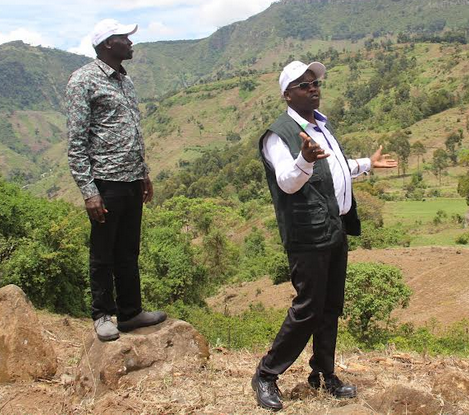
Speaking during an inspecting of Kimwarer tree nursery, KVDA Ag. Managing Director Moses Kipchumba who was accompanied by board Chairperson Mark Chesergon, revealed that the Authority targets to raise over 3.5 million Assorted Fruit and Tree Seedlings this financial year in its 16 nurseries across the 7 counties to distribute to farmers along the fragile Kerio valley landscapes for planting especially as the long rains season continues.
He added that the tree growing campaign is also in support of the Presidential Directive to grow 15 billion trees by 2032 in which they planted over 1 million assorted fruit and tree seedlings against a target of 1.5 million seedlings for this financial year.
As Kerio Valley region continues to face key environmental challenges of Land degradation due to unchecked anthropogenic activities, deforestation, landslides and increasing climate change impacts, KVDA working together with other partners like the Kaptagat Integrated Conservation Programme (KICP), is currently accelerating interventions to mitigate the impacts by distributing assorted fruit and tree seedlings, while at the same time sensitizing the communities on environmental conservation.
Kipchumba highlighted that they are currently carrying out Seedlings Distribution Exercise of over 400,000 fruit trees and 500,000 tree seedlings across the region targeting farmers, schools through school greening program and community groups. The types of seedlings distributed are assorted fruit trees of coffee, mangoes, avocado for nutrition and income generation and assorted trees seedlings for ecological restoration and biodiversity conservation.
“We have launched the assorted seedlings distribution and tree growing campaign targeting 1.5 million assorted fruit trees, 1.7 million assorted tree seedlings, 300,000 certified coffee seedlings, 100,000 tea seedlings,” he said.
He clarified that farmers in the highland areas will receive cash crop seedlings of coffee, tea and avocado, while those at the lower part of the valley will grow mangoes due to favorable temperate climate.
“By growing assorted fruit and tree seedlings, we are committed in restoring degraded landscapes especially along the fragile Kerio escarpments which is susceptible to recurrent landslides, improving food security and nutrition and improving community income streams through sale of fruits,” added Kipchumba.
He commended the technical approach embraced by the authority in selection of the locally adapted tree species to ensure high survival rates coupled with training and sensitization of farmers on proper planting techniques, tree management, maintenance, and protection of seedlings.
He affirmed the authority’s commitment in collaboration with other agencies to step up environmental conservation initiative along the fragile Kerio Valley escarpments. These efforts, he said will have positive impacts in terms of increased tree cover in the region and purify the air, improve household nutrition through fruit production, enhanced income opportunities for local communities and strengthening climate resilience in the region.
“Recently, we have had problems with the Kerio Valley, especially the so-called hanging Valleys or the escarpments prone to landslides like the case of Chesongoch, where we lost many lives and property and as long as we don’t do anything in terms conserving environment, we will continue to experience the same disaster,” alluded the Ag. MD Kipchumba.
He decried that the escarpments continue to deteriorate due to the human activities that are unfriendly to environment like cultivation on the steep slopes, felling trees for logs, excavation, and others all of which contribute to degraded soil structure increasing the risk of landslides.
The National Environment Management Authority (NEMA) through the Environmental Management and Co-ordination Act (EMCA) 1999 and subsequent regulations provides for controls on planting on slope areas to prevent soil erosion, landslides, and degradation of water catchment areas.
The Ag. MD Kipchumba called for concerted efforts to ensure protection of hilly and mountainous areas in Kerio, promoting re-forestation and afforestation and restricting farming activities on the hanging and volatile slopes to prevent degradation.
Board Chairperson Mark Chesergon said that they are conducting the assorted seedlings distribution and planting at ideal moment during the start of the rainy season which offer perfect conditions for growth and survivability of both fruit and tree seedlings.
He affirmed the KVDA’s support not only in promoting seedlings but supporting the entire value chain, from seeding to nurseries, distribution to farmers and also doing the value addition of mangoes through their factory which is in Tot in Elgeyo Marakwet County to support farmers in the region by purchasing and promoting mango farming.
“We are happy as a government that we have doubled our production of mango and today
we are issuing and launching about 30,000 seedlings to be distributed to farmers to grow as we build capacity with them to boost the livelihood in the region,” he noted.
Farmers in the region praised the authority’s support to local communities by making available certified fruit and tree seedlings that they could not easily access from the region due to economic challenges and lack of knowledge.
Stakeholders commended the project noting it aligns with national goals of achieving at least 10 percent tree cover and contributing to the national goal of 15 billion trees by 2032 and supporting implementation of the National Climate Change Action Plan (NCCAP) through community-based adaptation and mitigation.
By promoting agroforestry and restoration of degraded lands in Kerio valley in line with national ecosystem restoration priorities KVDA plays a key role in the support of Kenya’s climate commitments under the Paris Agreement through increased carbon sequestration.
Additionally, it contributes to climate change mitigation and environmental sustainability, advancing the environmental sustainability pillar of the Kenya Vision 2030 and enhancing watershed protection and restoration, in line with national priorities on water tower conservation
Through empowering local communities to actively participate in national climate action through community-led tree growing initiatives, the initiative supports the National Landscape and Ecosystem Restoration Strategy, which targets restoration of degraded lands across the country.
By Ekuwam Sylvester