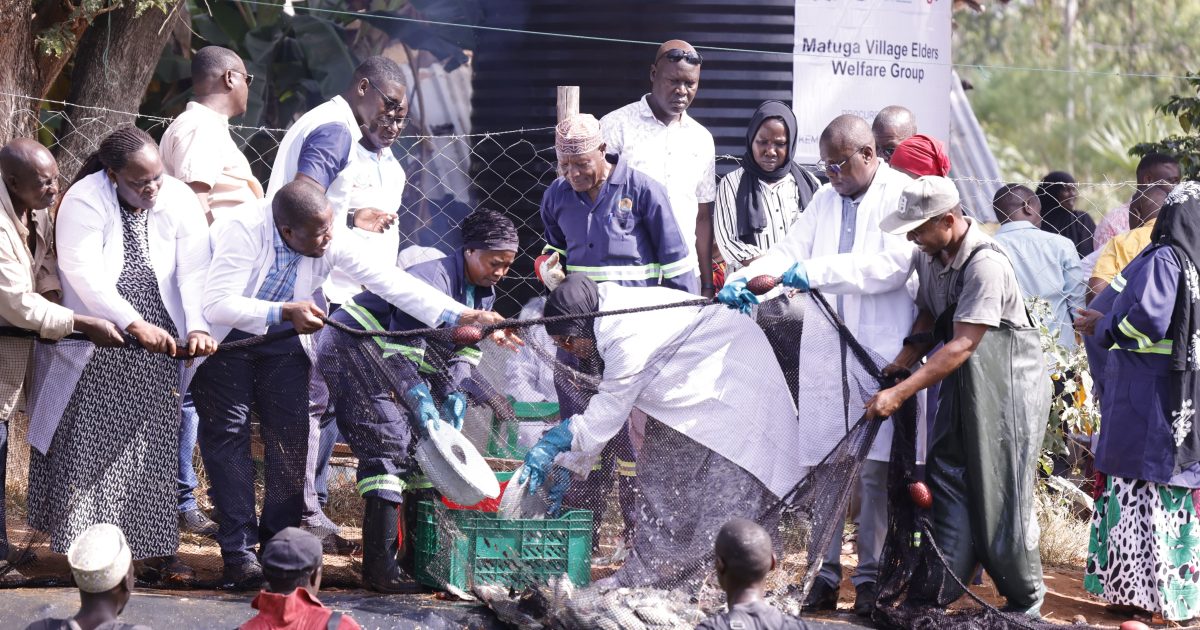
Residents of Matuga Sub-Location in Waziria Location, Kwale County, are celebrating a successful first harvest from a community fish farming project supported by the World Bank-backed KEMSED initiative in partnership with the County Government of Kwale.
The Matuga Village Elders Welfare Group, founded in 2017 under the leadership of Senior Assistant Chief Bakari Omari Chuvi, has harvested approximately 120 kilograms of tilapia. The initiative is aimed at boosting local livelihoods, promoting nutrition, and providing a sustainable source of income for vulnerable community members, particularly widows and informal workers.
“We thank God because we have harvested about 120 kilograms of fish,” said Chuvi, Senior Assistant Chief of Matuga Sub-Location.
He noted that their group started as a small savings initiative with merry-go-rounds. Later, they applied for funding from various government institutions and were selected as beneficiaries of fishponds under the KEMSED project.
The project was officially launched last year by Governor Fatuma Achani, who commissioned fish fingerlings and guided the community to nurture them until maturity.
“So far, we have harvested about 120 kilograms of tilapia,” said Chuvi. “Fish farming is important because it complements crop farming and provides essential protein for community members who cannot rely solely on agriculture.”
Lilian Musha Kitsao, popularly known as ‘Mama Dobedobeza’, a member of the group, said the project has transformed lives in the community.
“Before this project, we were few and disorganised. Most of us have no formal employment, and some are widows. This project has helped us educate our children and manage daily needs. We almost lost hope, but today we are grateful for the support and the skills we have gained,” said Kitsao.
Despite its success, the project faces challenges, especially related to fish feed, water access, and climate conditions. The group reported losing about 100 fish in the early stages due to lack of experience and the high cost of feed.
“Water is a major challenge,” said another group member. “We do not have our own borehole and rely on water purchased from neighbouring projects. The high temperatures in Kwale cause rapid evaporation, which increases costs. Climate change has made sustainability even more difficult, but guidance from local leaders has kept the project operational.”
The fish reach maturity in about five months and are sold at Sh500 per kilogram. Income from sales are reinvested into the project and used to support families, pay school fees, and improve community welfare.
“The Governor encouraged us to form a registered company to ensure the sustainability of this initiative. We have already completed the registration and are preparing for the next phase of development,” said Kitsao.
Ali Vizo Jumaa, a village elder from the Mwatate area, added that the water used is not theirs, as they purchase it from another group, but they cooperate and support each other to sustain the project.
The Matuga Village Elders Welfare Group comprises 30 members. Through their dedication, the initiative has become a vital source of income, nutrition, and empowerment in a community where formal employment is limited, and agricultural land is scarce.
By combining community leadership, international funding, and county government support, the project serves as a model of how small-scale fish farming can enhance food security, provide economic stability, and empower vulnerable groups in rural Kenya.
by Chari Suche