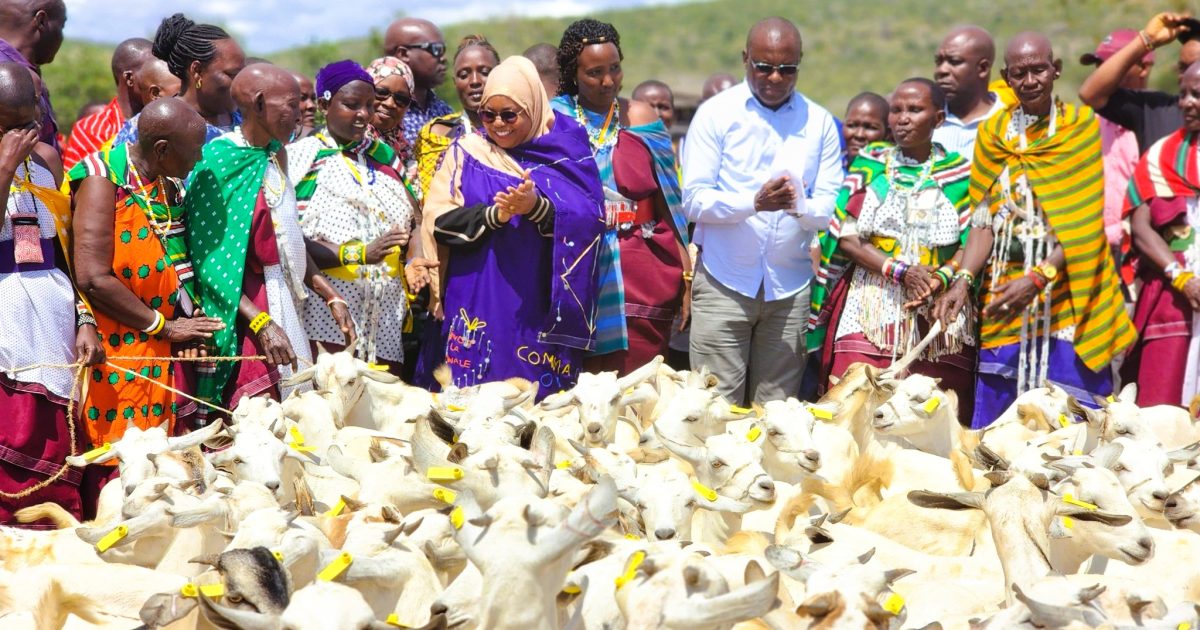
Small-scale farmers in Lunga Lunga Sub County of Kwale have received 355 hardy galla goats from the county government in an initiative designed to improve livelihoods, strengthen food security, and build resilience against climate change.
The white, long-legged Galla goat, commonly associated with pastoralist communities in northern Kenya, is well known for its adaptability to arid and semi-arid conditions. It is highly valued for its superior milk and meat production, disease resistance, and market demand.
The livestock was handed over by Governor Fatuma Achani to two self-help groups in Mwereni Ward. The Neema Namelock group received 175 goats, while the Amkeni Kimwangani women’s group received 180.
Governor Achani said the initiative is part of her administration’s wider agriculture value chain programme aimed at empowering rural farmers.
“We want to ensure that when our livestock keepers take their animals to the market, they earn good money to sustain their lives,” she said, noting that galla goats are particularly suited for dryland farming and will provide long-term benefits to households.
Since 2022, the devolved unit has distributed over 5,200 Galla goats and 100 dairy cows to more than 30 self-help groups across the coastal county. According to Achani, the programme is transforming livestock farming by raising productivity and increasing incomes.
“Our aim is to ensure livestock farmers boost meat production, enhance food security, and ultimately alleviate poverty in Kwale,” she said, adding, “Galla goats fetch higher market prices than local breeds, giving farmers better financial returns.”
The governor emphasized that her administration remains committed to supporting vulnerable farmers, particularly women and youth, through sustainable agriculture.
The empowerment project is being rolled out with support from the Financing Locally-Led Climate Action (FLLoCA) programme and the Kenya Marine Fisheries Socio-Economic Development (KEMFSED) project, both supported by the World Bank.
FLLoCA is a national initiative designed to strengthen the capacity of both county and national governments in addressing climate risks and building resilience. KEMFSED, implemented in coastal counties including Kwale, aims to boost livelihoods, strengthen food systems, and provide grants to vulnerable households.
Governor Achani explained that these projects are tailored to help farmers cope with the impacts of climate change. Beneficiaries are also required to pass on some of the goats’ offspring to other eligible farmers, creating a ripple effect that expands access to improved livestock.
County Executive Committee Member for Agriculture and Livestock Roman Shera described the galla goat as one of the best breeds for farmers in Kwale.
He said the goats are known to quickly regain weight after dry spells, produce more milk than the East African goat, and withstand extreme heat and drought. They are also resistant to gastrointestinal parasites and common infectious diseases, making them highly sustainable for small-scale farmers in marginal areas.
“The galla goat is an ideal livestock option because it ensures higher returns even in challenging climatic conditions,” Shera said.
In addition to livestock, the project provides beneficiaries with farm equipment, veterinary drugs, and training on animal husbandry, group management, and financial record-keeping.
Farmers and self-help groups in Lunga Lunga expressed gratitude for the support, describing it as a lifeline for households struggling with poverty and food insecurity.
Elizabeth Nadzua, a member of the Amkeni Kimwangani group, praised the initiative, noting that it would help women boost milk and meat production while securing household incomes.
“As women involved in rural farming, we are happy because this project will help us earn a living and fight hunger in the area,” she said.
Her sentiments were echoed by Mama Chidzidzingo, who said the livestock programme was a big step forward, especially for youth and women seeking income opportunities in rural communities.
Local farmer Mwanzegele Kalu described the donation as timely: “The project is a new beginning for many of us who have been struggling to make ends meet. If you empower a group, you’ve empowered the whole society.”
Governor Achani reaffirmed her government’s commitment to expanding the livestock empowerment programme to more wards in Kwale. She said partnerships with donor agencies would ensure that the county not only improves household incomes but also builds resilience against climate change.
The distribution of the 355 Galla goats, she noted, represents a long-term investment in sustainable agriculture, poverty reduction, and women’s empowerment.
By Hussein Abdullahi