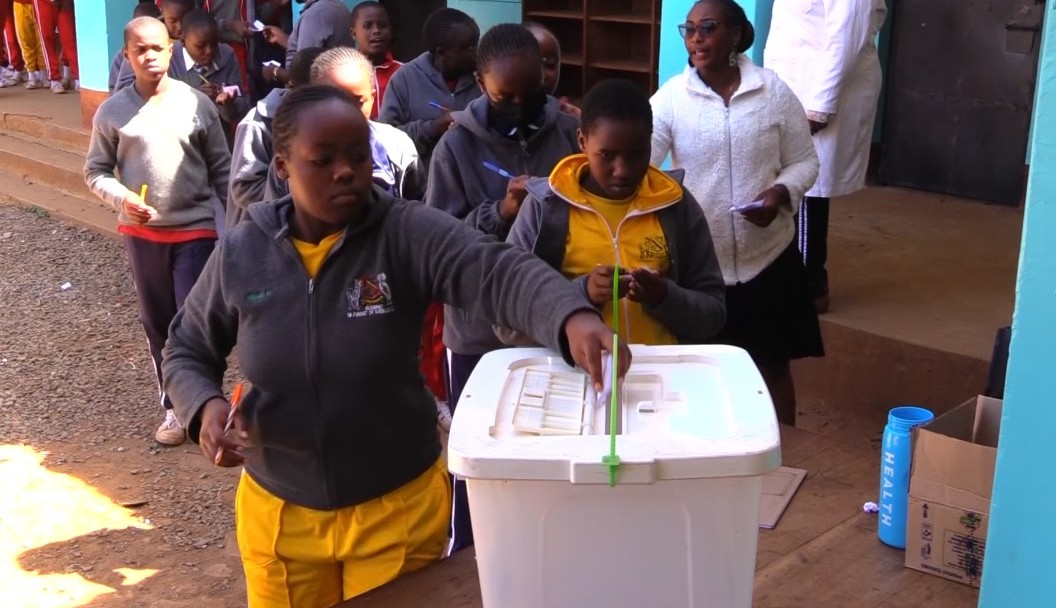
The administration of Hill School in Eldoret, Uasin Gishu County, has trained learners on the entire electoral process as conducted by the Independent Electoral and Boundaries Commission (IEBC).
The training was aimed at preparing the competency-based curriculum learners early enough to understand the process and undertake their democratic rights in future by electing leaders in the society.
During the training, the learners participated in the entire election exercise by electing various student leaders to represent them in various capacities in school.
While casting their votes in the ballot boxes with the help of teachers and IEBC officials, the learners demonstrated a clear understanding of the key civic education process.
The teachers lauded the process noting it would help prepare the students to understand how to participate in national elections in future to elect leaders of their choice.
The school principal, Naftali Mibei indicated that the initiative was actually like civic education where they were training learners at a young age to elect student leaders democratically.
The student leaders are selected to contest on various parameters, including academic performance and discipline, besides having a high number of followers.
Mibei encouraged other schools across the country to embrace the same model since it prepares the leaders of tomorrow.
It is actually civic education, because we are training these learners at this age on electing the student leaders democratically from this level,” he said.
“Because this is a learning process, we shall also continue trying to tell them that by the end of the day, we have only one leader. So at this level, maybe we don’t have opposition. We are going to win and we are going to lose,” explained Mibei.
A Junior Secondary School (JSS) teacher Folziah Chepkirui, emphasised that the students were exercising what is in the syllabus since, in social studies, they are taught about democracy and this comes in handy especially now that the country is preparing for the upcoming 2027 general elections, and learners will actually know what elections involve.
“If we can start this process at this level, by the time the learners in grade one may be in university, they will be aware of what it is and what elections in Kenya entail,” she added.
Deputy Chairman of the Hill School Election Commission Vidija Jadizu argued that incorporating civic education in primary school curriculum would help transform the narrative of Kenyan elections.
He noted that civic education is fundamental to the integrity and health of elections in the country, serving as the bridge between basic voter awareness and deep-seated democratic participation. It goes beyond simple “how-to” instructions (voter information) to equiping citizens with the conceptual knowledge, skills, and dispositions necessary to navigate and sustain a democracy, he added.
By Ekuwam Sylvester