Learners have been encouraged to continue nurturing their talents by embracing innovation, science, and technology to drive positive change in society.
Speaking after the conclusion of the five-day intensive STEM Boot Camp at the Centre for Mathematics, Science and Technology Education in Africa (CEMASTEA), Karen Campus, Acting Chief Executive Officer of CEMASTEA, Gladys Masai, noted that through the camp, learners get exposure to Science, Technology, Engineering, and Mathematics (STEM), which is key to shaping their future careers.
The Acting CEO said the platform provides young people with a valuable opportunity to showcase their skills and learn from experts, enabling them to realise their full potential and develop their careers.
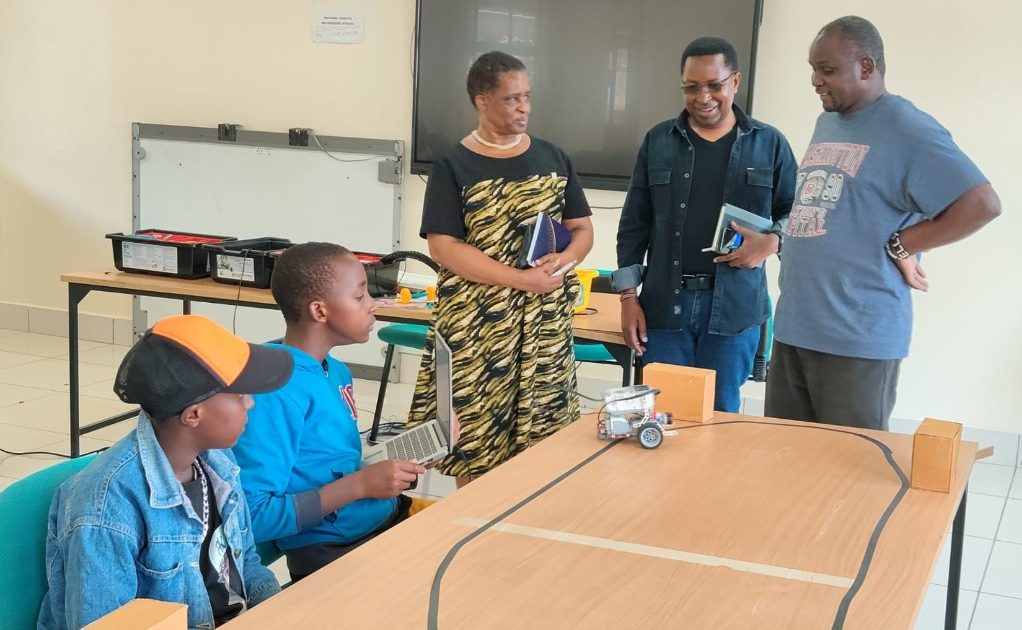
Ms. Gladys, alongside other leaders, visited and assessed the projects developed by learners within the Institution.
Throughout the week learners were involved in mobile app development, 3D designs, and robotics projects at the Campus.
She was impressed by how the young innovators used technology to communicate, solve problems, build robots, and code in Scratch and Python, creating website prototypes and using Canva to produce presentations for addressing global plastic pollution and other real-world challenges.
“We have witnessed great learning throughout the week. You have gained valuable skills by thinking critically and solving problems through your projects,” she said.
Ms Gladys said the innovative ideas developed during the boot camp, including systems to detect water levels and prevent tank leakages, and (ATM) money transfers, and automated doors and sensors, are intended to make life easier when implemented.
She further revealed plans to expand the boot camps to other regions across the country to broaden access to STEM education.
“As we issue certificates today, we are celebrating your achievement and the skills you have gained,” she said.
She added that CEMASTEA plans to continue expanding the STEM programme while strengthening teacher support to build a generation that is well equipped with skills.

National Trainer and Coordinator of the STEM Boot Camp at CEMASTEA, Mr Martin Mungai, said the programme has equipped learners with critical skills by exposing them to robotics, coding, and Arduino technologies.
“It has been exciting to see what these young minds are able to do in terms of creativity, innovation, and problem-solving. These are skills for the future,” he said.
Mungai noted that many learners joined the programme with little or no prior exposure to such technologies but quickly adapted and developed practical projects within a short time.
“It is impressive to see them pick up knowledge and skills very fast and apply them in real projects. Some are even integrating elements of artificial intelligence in their work,” he added.
He however pointed out that limited exposure and inadequate teacher training remain key challenges affecting STEM uptake in the country.
“One of the gaps is that many students have not had prior exposure, and some teachers may lack the necessary skills. We are working to support teachers through training and capacity building so they can cascade these skills in schools,” he said.
Mr Mungai revealed that CEMASTEA is collaborating with partners to strengthen digital literacy through the provision of robotics kits and teacher training in emerging technologies, in line with the Competency-Based Curriculum (CBC). He added that the initiative is also supporting teachers in both junior and senior schools to effectively implement competency-based education.
He further highlighted increased participation of girls in STEM, noting that more than 60 per cent of coding participants were female.
“This is a positive shift. It shows the girl child is not being left behind in STEM,” he said.
Among the innovative projects is an automated construction site lift system designed to assist engineers and construction workers in lifting heavy materials in tall buildings, developed by 11-year-old Kimberly Waringa (St. George Kiringatha) together with Kushal Asher.
Also, an automated door system developed by Aiden Chege Mugendi (Grade 6, Consolata School, Nairobi) and an ultrasonic sensor system created by Celestine Wanjiku and Sheldon Alex. Additional projects featured PID colour sensors and traffic light detection systems.
A Grade 9 student and facilitator, Yash Asher from Shree Cutchi Leva Patel Samaj School, underpinned the impact of the programme, reflecting on his journey from learner to professional STEM trainer.
Yash said he previously attended the boot camp many times and utilized his time to learn EV3 robotics, Arduino systems, and coding before becoming an expert.
“I joined this boot camp several times as a student, where I learned different skills in robotics and coding. With the support of trainers, I have now grown into a facilitator teaching EV3 and SPIKE robotics,” he said.
Asher noted that learners demonstrated strong innovation in projects such as ultrasonic obstacle detection systems and PID line-following robots capable of precise movement using colour sensors.
He encouraged schools to embrace STEM education, describing robotics as “the future of global innovation”.
The young expert urged institutions to invest in STEM clubs in order to build the capacity of learners, challenging schools to utilize scarce resources to enhance education.
“Even with limited resources, schools should make an effort to introduce robotics. It is an investment that will benefit students in the long run,” he said.
Organisers said the five-day boot camp, held during the school holidays, provided learners with hands-on experience in robotics, coding, engineering, and innovation, with the aim of nurturing future innovators.
They thanked parents and facilitators for supporting the learners, emphasizing the importance of guidance and encouragement in nurturing young talent.
They further urged more parents to continue enrolling their children in similar programmes and encouraged learners to return for future sessions, bringing along their peers.
CEMASTEA continues to position STEM education as a key pathway for equipping learners with skills needed in a rapidly evolving digital world.
By Ian Chepkuto